
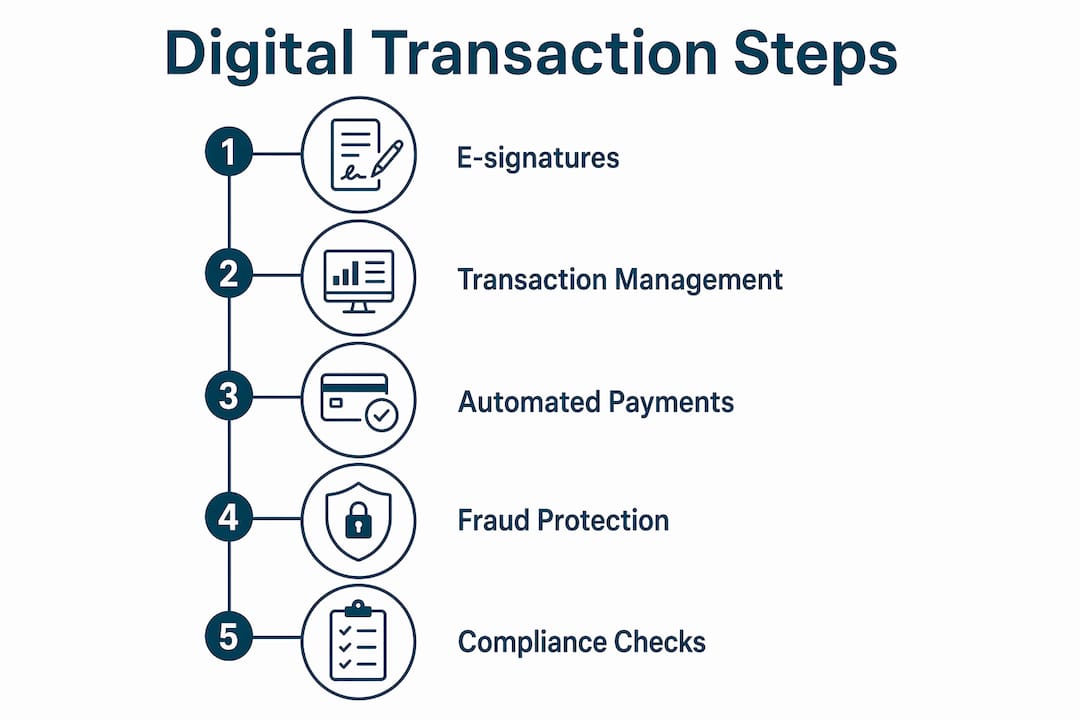
A digital real estate transaction is the use of technology to conduct property deals electronically, replacing paper-heavy manual steps with e-signatures, transaction management platforms, and automated payment systems. The result: fewer errors, faster closings, and a process that agents and clients can manage from anywhere. This is not about virtual land or NFTs. It is about how physical property deals get done in the United States today.
The core components of a digital property transaction include:
- E-signatures governed by the federal ESIGN Act and the Uniform Electronic Transactions Act (UETA), giving electronic signatures the same legal weight as wet ink
- Transaction management platforms that consolidate forms, compliance checklists, and document storage in one place
- Automated payment systems using ACH transfers, API-driven escrow, and tools like Dwolla for moving funds without paper checks
- Compliance management built into platform workflows, reducing the risk of missing disclosures or deadlines
- Audit trails that log every action, signature, and document change for legal protection
The National Association of Realtors (NAR) has made e-signature adoption a formal priority, partnering with Docusign as its official and exclusive provider of electronic signature services under the REALTOR Benefits® Program. That institutional backing matters: it signals that digital transaction processes are now the expected standard, not an optional upgrade.
What are the core components of a digital real estate transaction?
The technology stack behind a digital property deal has three layers: signature, management, and payment. Each one solves a specific bottleneck in the traditional paper process.

E-signatures and their legal foundation
The ESIGN Act (2000) and UETA give electronic signatures full legal enforceability across the U.S., with UETA adopted in 47 states. That legal foundation is what makes it possible to close a purchase agreement without anyone printing a single page. Electronic signatures reduce the pain of paperwork, accelerate deals, and improve client satisfaction across all age groups, according to NAR. Buyers of every generation now expect digital experiences rather than paper-based ones.
Remote Online Notarization (RON) extends this further. RON lets agents notarize electronic signatures from anywhere, eliminating the logistical challenge of coordinating buyers, sellers, and agents in the same room. Reputable RON solutions use advanced security measures to verify identity and protect document integrity.
Transaction management platforms
A transaction management platform is the operational hub of a digital deal. It consolidates forms, compliance steps, document libraries, and e-signature workflows into one place. Platforms like Docusign Rooms for Real Estate give brokers visibility across all active deals, let agents track task completion, and reduce data rekeying and the security risks that come with it. Agents access the latest state and local association forms pre-filled with transaction data, send them for signature, and monitor status in real time.
The difference between a true transaction management platform and a basic e-signature tool is significant. A full platform handles compliance checklists, document storage, deadline reminders, and custom approval workflows. A basic tool handles only the signature step, leaving agents to manage everything else manually.
- Forms access: Pre-built state and local association forms with autofill
- Compliance tracking: Custom approval workflows and audit trails
- Document storage: Centralized library for all transaction files
- Integrations: Connections to CRM, accounting, and MLS systems
Automated payment systems
Moving money in a real estate transaction has traditionally meant paper checks, wire transfers with manual verification, and days of waiting. Automated payment systems change that. ACH (Automated Clearing House) transfers move funds electronically between bank accounts. API-driven escrow platforms automate the release of funds when specific conditions are met. Dwolla, a payment platform used in real estate contexts, enables programmatic ACH transfers with bank account verification built in, reducing the risk of misdirected payments.
Pro Tip: When evaluating payment automation tools, prioritize platforms that include bank account verification at the point of entry, not just at setup. Fraud in wire transfers often exploits the gap between account registration and transaction execution.
How are digital transactions used across different property deal types?
The practical applications of electronic real estate deals span every transaction type, from residential sales to commercial leasing to property management.
Residential sales see the broadest adoption. Purchase agreements, seller disclosures, inspection contingencies, and closing documents all move through digital workflows. An agent in Virginia can send a listing agreement to a seller in another state, get it signed in minutes, and have it stored and compliant before the ink would have dried on a paper version.
Agent commissions are another high-value use case. Platforms that integrate with back-office accounting systems can trigger commission disbursements automatically when a transaction closes, cutting the time between closing and payment from days to hours.
Rent collection and property management have moved almost entirely digital. Automated ACH drafts pull rent on a set date, generate receipts, and flag failed payments without any manual intervention. For property managers handling dozens of units, this eliminates a full category of administrative work.
Fee processing for HOA dues, earnest money deposits, and inspection fees follows the same pattern. Digital payment rails handle the movement of funds while the transaction platform logs each payment against the deal record.
Digital tools do not just speed up the process. They create a documented, auditable record of every step, which protects agents, brokers, and clients when disputes arise. That paper trail is often more valuable than the time saved.
The compliance benefit is real at every stage. Digital workflows can enforce disclosure deadlines, flag missing documents, and prevent a transaction from advancing until required steps are complete. That kind of built-in guardrail is something no paper-based process can replicate.
How do digital transactions protect against fraud and security risks?
Security is where digital processes often outperform their paper equivalents, not just match them. The mechanisms are specific and worth understanding.

Tokenization replaces sensitive financial data (bank account numbers, routing numbers) with a unique token that has no value outside the system that generated it. Even if a transaction record is intercepted, the token cannot be used to access the underlying account.
Encryption protects data in transit and at rest. Enterprise-grade transaction platforms use TLS encryption for data transmission and AES-256 for stored documents, the same standards used in banking.
Bank account verification authenticates the destination of a payment before funds move. Micro-deposit verification and real-time bank data APIs confirm that the account receiving funds actually belongs to the intended party. This directly addresses the most common vector for real estate wire fraud: fraudulent wiring instructions sent by email.
Blockchain applications are moving from experimental to practical in deed recording and title verification. Blockchain-verified deeds and secure automated payment reconciliation are emerging to reduce risk and accelerate closings. A blockchain-recorded deed creates an immutable, publicly verifiable record of ownership that cannot be altered after the fact, which is a direct counter to deed fraud.
Smart contracts automate the release of escrow funds when predefined conditions are met, removing the human step where fraud most often occurs. The contract executes when the conditions are satisfied, with no manual authorization required.
Security fact: Electronic signatures carry a complete audit trail, including IP address, timestamp, and identity verification, that wet signatures cannot match. That audit trail is admissible evidence in legal disputes.
Best practices recommended by industry associations and security experts include:
- Use platforms with SOC 2 Type II certification for data security compliance
- Require multi-factor authentication for all platform access
- Verify wiring instructions by phone using a number from the original contract, never from an email
- Enable real-time alerts for any change to payment instructions within the transaction platform
- Conduct annual security training for all agents and staff on phishing and wire fraud tactics
What barriers still block full digital adoption in U.S. real estate?
Despite real progress, a fully digital closing remains more aspiration than reality for most U.S. transactions. The reasons are structural, legal, and behavioral, and they are worth understanding clearly.
Full digital closing in the U.S. remains incomplete due to legal and municipal frictions, with most progress concentrated in digitizing individual transaction touchpoints rather than the end-to-end process. Appraisals, inspections, and municipal compliance steps still introduce delays that no platform can eliminate. Even with e-signatures and RON, a transaction can stall waiting for a county recorder's office that still requires paper filings.
The specific barriers include:
- Fragmented state laws: RON is not uniformly available in all states, and recording requirements vary by county, creating a patchwork that forces hybrid approaches
- Municipal recording offices: Many county recorders still require paper deeds or have limited digital intake capacity
- Platform incompatibility: When agents, lenders, title companies, and attorneys each use different systems, data must be manually transferred between them, reintroducing the errors that digital tools were supposed to eliminate
- Consumer trust gaps: Some buyers and sellers, particularly older clients, remain uncomfortable with fully digital processes and request paper alternatives
- Legal liability concerns: Attorneys and title companies sometimes insist on paper documents for liability reasons, regardless of what technology allows
Brokerages that cobble systems from incompatible vendors risk data errors and compliance failures. The integration gap between a CRM, an e-signature tool, a transaction management platform, and a payment system is where data gets lost, duplicated, or corrupted.
The industry response has been a push toward vertical integration. The Rocket Companies acquisition of Redfin signals a bet on platforms that can handle search, financing, and closing in one ecosystem. Generative AI is being applied to document preparation, customer service, and compliance checking. Remote notarization is expanding state by state. Hybrid approaches combining e-signatures and management platforms with selective paper steps remain the practical standard for now, and will likely stay that way until municipal recording infrastructure catches up.
Digital transactions vs. digital real estate: what U.S. professionals need to know
This distinction trips up clients constantly, and it costs agents credibility when they cannot explain it clearly.
Digital real estate refers to virtual assets that exist online: domain names, websites, NFTs, and virtual land in metaverse platforms like Decentraland. These are investment assets, not transaction methods. A client who asks about "digital real estate" may be asking about buying a website or a virtual plot of land, not about how to sign a purchase agreement electronically.
Digital transaction technology, by contrast, is the set of tools that makes physical property deals happen faster and more securely. E-signatures, transaction management platforms, and automated payment systems are all transaction technology. They do not create a new asset class. They change how an existing asset class (physical property) changes hands.
Clients often confuse these two concepts, and the confusion can derail a conversation about the home-buying process before it starts. A client who thinks "going digital" means buying virtual land needs a clear, patient explanation before any discussion of e-signatures makes sense.
The agent's job is not just to use digital tools. It is to explain them in plain language so clients understand what they are signing, where their money is going, and why the process is faster than it used to be. Technology only works when the people using it trust it.
Digital transactions free agents to focus on client relationships by automating routine paperwork and compliance steps. The technology handles the administrative layer; the agent handles the advisory layer. That division is what makes digital tools valuable, not as replacements for human judgment, but as tools that clear the path for it.
Pro Tip: When onboarding a new client, spend two minutes explaining the difference between digital transaction tools and digital real estate investments. It prevents confusion later and positions you as the informed professional in the room. A short explainer document sent before the first meeting works well for this.
For real estate professionals in Virginia, understanding digital marketing's role in property sales is equally important. Digital tools extend beyond transaction management into how properties are marketed and how clients are reached in the first place.
How do major digital transaction platforms compare for real estate use?
The platform market for real estate digital transactions has consolidated around a few categories. No single platform does everything perfectly, and the right choice depends on brokerage size, workflow complexity, and integration needs.
Full transaction management platforms handle the entire deal lifecycle: forms, compliance, e-signatures, document storage, and reporting. These are built for brokerages that need visibility across multiple agents and transactions. Docusign Rooms for Real Estate is the most widely deployed example in this category, serving as NAR's official e-signature partner. It centralizes compliance, document libraries, form editing, and e-signatures in one tool, with pre-built integrations to CRM, accounting, and MLS systems including Lone Wolf, zipForm® Plus, and kvCORE.
Individual agent e-signature tools are lighter-weight solutions for solo agents or small teams. They handle document preparation and signature collection but lack the compliance tracking and brokerage-level reporting of full platforms. Docusign eSignature for Real Estate fits here, with a starter tier allowing five envelopes per month and a standard tier offering 100 envelopes per user per year.
Payment automation platforms like Dwolla sit in a separate category, focused specifically on moving money rather than managing documents. They integrate with transaction platforms via API to automate commission disbursements, earnest money transfers, and rent collection. The key differentiator in this category is bank account verification depth and ACH processing speed.
Integrated ecosystem platforms attempt to combine search, financing, and transaction management in one experience. These are the platforms that the Rocket-Redfin model is pushing toward: a buyer finds a home, gets pre-approved, makes an offer, and closes without leaving the platform. In practice, these remain works in progress, but the direction is clear.
| Platform category | Best for | Key strength | Key limitation |
|---|---|---|---|
| Full transaction management | Brokerages, teams | End-to-end compliance and visibility | Higher cost, steeper learning curve |
| Individual e-signature tools | Solo agents | Fast setup, low cost | No brokerage-level reporting |
| Payment automation | Commission and rent processing | ACH speed, bank verification | Does not manage documents |
| Integrated ecosystem | Large platforms | Single-platform experience | Still largely incomplete in practice |
The most common mistake brokerages make is choosing tools from each category independently, without checking whether they share data cleanly. A transaction management platform that does not push data to the accounting system means someone is rekeying numbers by hand. That manual step is where errors and compliance gaps appear. Integrated platforms that connect these functions from the start avoid that problem entirely.
For transactions involving legal complexity, understanding the role of a real estate attorney in the closing process helps clarify which steps genuinely require human legal oversight and which can be handled by platform automation.
Key Takeaways
Digital real estate transactions use e-signatures, transaction management platforms, and automated payment systems to replace paper-based processes, reducing errors and accelerating closings across all U.S. property deal types.
| Point | Details |
|---|---|
| Legal foundation is solid | The ESIGN Act and UETA give electronic signatures full legal enforceability across the U.S. |
| Platform integration matters | Brokerages using incompatible tools risk data errors and compliance failures that integrated platforms prevent. |
| Fraud protection is built in | Tokenization, bank verification, and blockchain-verified deeds reduce the most common fraud vectors in property deals. |
| Full digital closing is still hybrid | Legal and municipal frictions mean most U.S. closings combine digital tools with selective paper steps. |
| Digital real estate is a different concept | Virtual assets like domains and NFTs are investment classes, not transaction technology, and clients frequently confuse the two. |
Work with a Team That Understands Digital Transactions

Technology changes how deals get done. The expertise behind the deal still determines the outcome. Beamsrealtygroup combines deep Virginia market knowledge with a clear-eyed understanding of digital transaction processes, so clients know exactly what they are signing, when, and why. Whether you are buying, selling, or investing in property, the Beamsrealtygroup team guides you through every step with the kind of direct, informed communication that digital tools alone cannot provide. Start your transaction with a team that makes the process work for you.