
You can sell or transfer marital property during a divorce in most U.S. states, but your first move is not calling a real estate agent. It is confirming whether an Automatic Temporary Restraining Order (ATRO) is already in place and what your state's property rules require before any transfer can happen.
Here is what to do right now:
- Call your family law attorney before signing anything or agreeing to a listing price.
- Check for an ATRO. At least 15 states impose these orders automatically upon filing, blocking asset transfers without court permission.
- Gather title documents, mortgage statements, and recent tax returns so your attorney can assess your equity position and any liens.
- Request a home valuation from a licensed appraiser or experienced real estate agent before you agree to any buyout figure.
- Do not transfer, refinance, or list the property until you have written legal clearance.
Selling before versus after the divorce is finalized each carries real trade-offs. Selling before can provide liquidity and a clean financial break, but it may forfeit certain tax advantages and force temporary housing costs on both parties. Waiting can preserve stability, though it raises carrying costs and the risk of disputes over maintenance and mortgage payments. Understanding those trade-offs early shapes every decision that follows.
Table of Contents
- When can a court order a divorce sale?
- What are your options for dividing ownership?
- Step-by-step: how to sell the marital home during divorce
- What changes when the marital asset is a business?
- How are sale proceeds divided and what are the tax consequences?
- What legal disputes come up most often, and what do judges look for?
- Documents to gather and questions to ask your attorney, lender, and agent
- How do an agent, appraiser, and attorney work together in a divorce sale?
- Key Takeaways
- What most people get wrong about selling during divorce
- Beamsrealtygroup helps Virginia homeowners through divorce sales
- Useful sources
When can a court order a divorce sale?
A court-ordered sale is exactly what it sounds like: a judge directs that a property be sold, sets the conditions, and typically requires that proceeds be held in escrow pending final distribution. Courts reach for this tool when spouses cannot agree, when one party is wasting the asset (letting it fall into disrepair or missing mortgage payments), or when the property cannot be physically divided.
Automatic Temporary Restraining Orders
In many states, an ATRO takes effect the moment a divorce petition is filed. It freezes the status quo: neither spouse can sell, refinance, encumber, or transfer marital assets without the other's written consent or a court order. Many states impose ATROs automatically, and violating one can result in contempt sanctions, reversed transactions, and serious damage to your credibility with the judge. If you are in a state without an automatic ATRO, a spouse can still request a temporary restraining order early in the case.
Community property vs. equitable distribution
Where you live determines the starting point for any division. Several states, including California, Texas, and Arizona, follow community property rules: assets acquired during the marriage are presumed to be owned equally. The remaining states use equitable distribution, which means a judge divides assets "fairly" but not necessarily equally, weighing factors like each spouse's income, contributions, and economic circumstances.
In practice, this changes the default outcome significantly. In a community property state, neither spouse can unilaterally sell or transfer marital property without the other's consent. In equitable distribution states, the court has broader discretion to award one spouse a larger share, which can affect whether a sale or a buyout makes more financial sense.
California courts make clear that spouses can often agree on how to divide property without going to trial. When they cannot, a judge will decide. That decision can include ordering a sale, setting a minimum price, and directing how proceeds are distributed. California Courts Self-Help explains the full process for community property states.
How a Texas court-ordered sale works
Texas is a community property state, and its courts have clear authority to order a sale when spouses deadlock. A judge can appoint a receiver to manage the listing, set a minimum acceptable price, and require both parties to cooperate with the agent and buyer. Texas court-ordered home sales follow a defined procedural path: one spouse files a motion, the court holds a hearing, and the order specifies the terms of sale. Ignoring the order is not an option.
What are your options for dividing ownership?
Three paths exist for resolving ownership of the marital home. Each has different tax consequences, timelines, and risk profiles.
Sell to a third party and split the proceeds. This is the cleanest exit. Both spouses list the home, accept a market offer, pay off the mortgage and selling costs, and divide what remains per the settlement agreement. The downside is timing pressure. Buyers who sense a divorce sale may offer less, and if the market is slow or the home needs work, a forced-sale discount can erode equity significantly. Dividing proceeds from a family home sale follows a predictable sequence: mortgage payoff first, then selling costs, then any agreed-upon adjustments, then the split.
Spousal buyout under IRC §1041. One spouse buys out the other's interest by refinancing the mortgage into their name alone and paying the departing spouse their equity share. Under IRC §1041, transfers of property between spouses incident to divorce are generally tax-free. No capital gains tax is triggered at the time of transfer. The receiving spouse takes the transferor's original cost basis, which matters when they eventually sell to a third party. This route avoids the open market entirely and is often the most tax-efficient path when one spouse wants to stay in the home.
Continue co-ownership temporarily. Some couples agree to keep the home jointly for a set period, often until children finish school. This can make sense emotionally and financially in a rising market, but it requires airtight settlement language covering who pays the mortgage, insurance, taxes, and maintenance, and what happens if one party stops paying. Family law and real estate professionals generally caution that ongoing co-ownership carries real financial risk if those rules are not spelled out in detail.
Quick comparison:
- Court-ordered sale: — Imposed when spouses cannot agree; judge sets terms; proceeds held in escrow.
Step-by-step: how to sell the marital home during divorce
The process has a fixed sequence. Skipping steps, especially the legal clearance stage, creates delays and can expose you to contempt of court.
Typical timelines and costs
| Stage | Estimated Timeline | Typical Cost |
|---|---|---|
| ATRO petition / court motion | 2–8 weeks | Attorney fees vary |
| Independent appraisal | 1–2 weeks | — |
| Home preparation and staging | 2–6 weeks | — |
| Listing to accepted offer | 30 days (market-dependent) | Agent commission (typically 3% per side) |
| Closing | 30 days after contract | 2–5% of sale price in closing costs |
Pro Tip: Ask your attorney to include a "cooperation clause" in the temporary orders. This requires both spouses to sign listing agreements, disclosures, and closing documents on a set timeline, preventing one party from stalling the sale.
What changes when the marital asset is a business?
Selling a business during divorce is significantly more complex than selling a home, and the consequences of getting it wrong are proportionally larger.
ATROs routinely block business transfers in states that impose them. Even in states without automatic ATROs, courts will often issue a temporary order preventing the sale or transfer of a business interest once divorce proceedings begin. You will almost certainly need to petition the court before any sale can proceed.
Valuation is the central challenge. Business valuation in a divorce context typically follows the IRS Rev. Rul. 59-60 eight-factor framework, which considers earnings capacity, book value, dividend-paying capacity, goodwill, and comparable sales, among other factors. Courts expect a formal, defensible valuation from a certified business appraiser or forensic accountant, not a back-of-the-envelope estimate. The earlier you commission this work, the better your position.
The forced-sale discount risk is also higher for businesses than for real estate. A buyer who knows the seller is under divorce pressure and court deadline has significant leverage. Discounts of 20–40% below orderly market value are not unusual in distressed business sales.
| Factor | Business Sale | Spousal Transfer (IRC §1041) |
|---|---|---|
| Typical timeline | 6 months | 3–6 months |
| Valuation standard | IRS Rev. Rul. 59-60 (forensic) | Licensed appraisal or agreed value |
| Tax treatment | Capital gains on third-party sale | Tax-free incident to divorce |
| Forced-sale discount risk | High (20–40%) | None (private transfer) |
| Court approval required | Usually yes | Often yes (ATRO states) |
| Key professional needed | Forensic accountant + M&A counsel | Family law attorney + appraiser |
Key steps specific to a business divorce sale:
- Retain a certified business appraiser or forensic accountant before any negotiations begin.
- File a motion with the court to obtain permission to sell if an ATRO is in place.
- Negotiate buyer confidentiality agreements to prevent the divorce from becoming a negotiating tool.
- Ensure the settlement agreement specifies how any earnout provisions or post-closing adjustments are treated.
How are sale proceeds divided and what are the tax consequences?
At closing, proceeds do not go directly to the spouses. They flow through a defined sequence.
Typical proceeds waterfall:
- Mortgage payoff (first lien, then any second liens or HELOCs)
- Selling costs (agent commissions, title fees, transfer taxes, attorney fees at closing)
- Court-ordered adjustments (reimbursements for one spouse's separate property contributions, carrying cost credits)
- Remaining equity split per the settlement agreement or court order
What is left after those deductions is the distributable equity. In a community property state, that is typically divided 50/50. In an equitable distribution state, the split reflects the court's or the parties' agreed allocation.
Tax treatment depends on how the transfer happens. Under IRC §1041, transfers of property between spouses incident to divorce are tax-free. No capital gains tax is recognized at the time of transfer, and the receiving spouse takes the transferor's original cost basis. When that spouse later sells to a third party, capital gains are calculated from the original basis, not the transfer value.
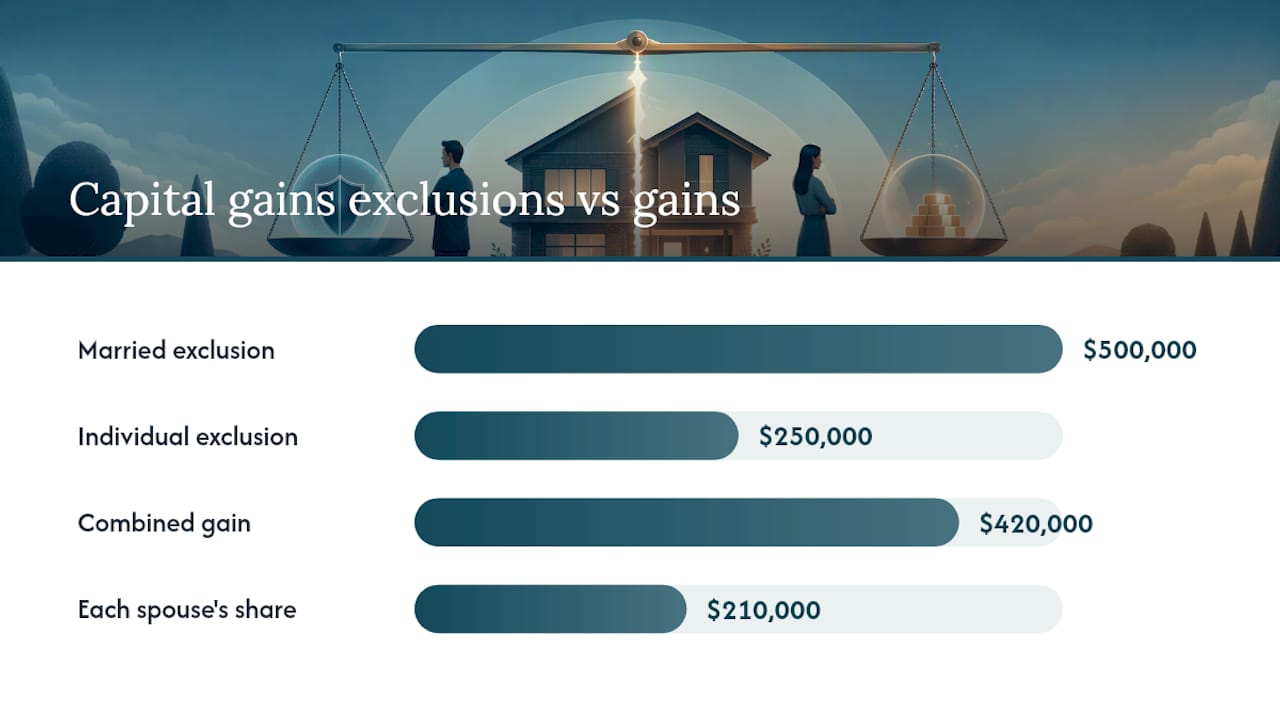
For third-party sales, the standard capital gains rules apply. Married couples filing jointly can exclude up to $500,000 of gain on the sale of a primary residence under IRC §121, provided both parties meet the ownership and use tests. After divorce, each individual's exclusion drops to $250,000. Timing the sale while still legally married can preserve the larger exclusion, which is a meaningful consideration in high-equity markets.
High-income sellers should also account for the Net Investment Income Tax (NIIT), which applies to capital gains above certain income thresholds.
Two scenarios that illustrate the difference:
- Scenario A: Spouses sell the home before the divorce is final. Combined gain is $420,000. As a married couple, they qualify for the $500,000 exclusion and owe no federal capital gains tax.
- Scenario B: They wait until after the divorce. Each spouse's share of the gain is $210,000. Each has a $250,000 individual exclusion, so neither owes capital gains tax in this case. But if the gain were higher, the post-divorce split could push one or both above the individual threshold.
The math matters. Run both scenarios with your tax advisor before deciding when to close.
What legal disputes come up most often, and what do judges look for?
The most common flashpoints in a divorce sale are valuation disagreements, disputes over who pays carrying costs during the sale process, and fights over whether to accept a specific offer.
Courts resolve these disputes by weighing a predictable set of factors: preservation of asset value, fairness in division, the best interests of any minor children who live in the home, and protection of creditors. A judge who sees one spouse refusing reasonable offers or failing to maintain the property will not look favorably on that party.
When petitioning a court for permission to sell, the motion should include a licensed appraisal, a proposed marketing plan, a clear distribution of proceeds, and buyer protections such as an escrow arrangement. Courts want evidence that the sale will be conducted at arm's length and that both parties' interests are protected. Texas court procedures offer a clear example of what judges expect in a sale motion.
What to include in a sale motion:
- A current, licensed appraisal establishing market value.
- A proposed listing price and the basis for it.
- The name and qualifications of the listing agent.
- A marketing plan showing how the property will be exposed to the full market.
- A proposed distribution of proceeds, including mortgage payoff and selling costs.
- A request for an escrow arrangement to hold proceeds pending final order.
If the dispute is over valuation, courts often appoint a neutral appraiser whose value is binding on both parties. This is faster and cheaper than litigating competing appraisals at trial.
Documents to gather and questions to ask your attorney, lender, and agent
Walking into a meeting without the right documents wastes time and money. Gather these before your first consultation.
Essential documents:
- Current mortgage statement (balance, lender, monthly payment)
- Title report or deed showing how the property is vested
- Most recent property tax bill
- Homeowners insurance policy
- HOA documents and any outstanding assessments
- Last two years of federal tax returns
- Any existing appraisals or broker price opinions
- Home equity line of credit statements if applicable
- Business financial statements if a business interest is involved
Questions for your attorney:
- Does an ATRO apply in our state, and has one been issued in our case?
- Do we need to file a motion to list, or is a written stipulation sufficient?
- What are the tax consequences of a sale now versus a buyout?
- How should the settlement agreement describe the proceeds distribution?
- Can we set a court-approved minimum sale price?
Questions for your lender:
- What is the exact payoff amount, and how long is it valid?
- Who must sign the payoff authorization?
- If one spouse wants to refinance and buy out the other, what are the qualification requirements?
Questions for your real estate agent:
- What is your experience with divorce sales specifically?
- How will you market the property without signaling distress or urgency?
- What is your recommended listing price based on current comparable sales?
- How do you handle situations where both spouses must approve decisions?
For a practical overview of the full home selling process step by step, including timelines and what to expect at each stage, that resource covers the operational side in detail.
How do an agent, appraiser, and attorney work together in a divorce sale?
A divorce sale with three professionals working in coordination closes faster and at a higher price than one where each party is operating independently. The roles are distinct but overlapping.
What an experienced divorce-sale agent does:
- Coordinates the appraisal timeline with the attorney's court filing schedule.
- Markets the property in a way that attracts full-market buyers without advertising the divorce.
- Vets buyers for financing strength to avoid deals that fall apart at the last minute.
- Manages communication between both spouses neutrally, reducing the chance that a disagreement derails the transaction.
- Provides the court with a marketing plan and comparable sales data if a motion is required.
What the valuation expert provides:
- A licensed, court-admissible appraisal that establishes a defensible market value.
- For businesses: a forensic valuation following IRS Rev. Rul. 59-60 that can withstand cross-examination.
- Expert testimony if the case goes to a hearing on value.
What the attorney manages:
- Legal clearance to list (ATRO compliance, court motions).
- Settlement language that governs how proceeds are distributed and what happens if the home does not sell by a set date.
- Protection against one spouse sabotaging the sale or refusing to sign closing documents.
When these three professionals share information and align on timing, the process moves in weeks rather than months. The alternative, where the agent lists without legal clearance or the attorney negotiates a buyout without a current appraisal, creates gaps that buyers and opposing counsel exploit.
Pro Tip: Instruct your agent to use neutral listing language. Phrases like "seller is motivated" or "priced to sell quickly" are red flags to experienced buyers. A clean, condition-focused listing with professional photography signals a normal market transaction, not a distressed one.
Key Takeaways
A divorce sale handled with legal clearance, a current appraisal, and an experienced agent consistently produces better outcomes than one rushed to market under pressure.
| Point | Details |
|---|---|
| Check for an ATRO first | At least 15 states impose automatic restraining orders that block transfers without court permission. |
| Get a valuation before any agreement | An independent appraisal protects both parties and gives the court a defensible floor price. |
| IRC §1041 transfers are tax-free | Spousal buyouts incident to divorce trigger no capital gains tax; third-party sales do. |
| Time the sale for maximum tax exclusion | Selling while still married may preserve the $500,000 joint capital gains exclusion under IRC §121. |
| Beamsrealtygroup for Virginia sellers | Beamsrealtygroup provides divorce-sale valuations, court-aligned marketing, and coordination with counsel for Virginia property owners. |
What most people get wrong about selling during divorce
The conventional wisdom says the hardest part of a divorce sale is the market. In practice, the hardest part is the coordination problem: an attorney who does not know the listing timeline, an agent who does not know about the ATRO, and two spouses who cannot agree on a listing price are a recipe for a deal that falls apart two weeks before closing.
What actually preserves value is not finding the perfect buyer. It is getting the legal, financial, and real estate pieces aligned before the property hits the market. An appraisal ordered too late, after one spouse has already agreed to a buyout figure, is nearly useless. A listing that goes live before the court has cleared the sale can be pulled at enormous cost. These are not edge cases. They happen regularly when people treat a divorce sale as a normal home sale with extra paperwork.
The IRC §1041 spousal buyout is also underused. Many people default to a third-party sale because it feels cleaner, but for a spouse who wants to stay in the home and can qualify for refinancing, the buyout eliminates market risk, forced-sale pressure, and capital gains exposure in one move. The tax basis issue matters later, but that is a problem for a future tax advisor, not a reason to avoid the structure entirely.
One more thing worth saying plainly: the emotional weight of a divorce sale is real, and it affects financial decisions in ways people do not always recognize. The spouse who wants out fast may accept a low offer. The spouse who is grieving the home may refuse reasonable ones. A good agent and a good attorney both serve as a buffer against those impulses, keeping the transaction focused on the financial outcome rather than the emotional one.

Beamsrealtygroup helps Virginia homeowners through divorce sales
Divorce sales in Virginia carry specific procedural and market considerations, and Beamsrealtygroup has direct experience handling them. The team provides home valuations aligned with court timelines, markets properties in a way that attracts full-market buyers without advertising the circumstances, and coordinates directly with your family law attorney to keep the transaction on schedule.

Services available for divorce-sale clients include independent home valuations, divorce-specific listing and marketing strategies, escrow structuring to protect proceeds, and ongoing coordination with legal counsel throughout the transaction. Whether you are weighing a spousal buyout or preparing to list the marital home, the process starts with a clear picture of what the property is worth and what your legal position requires.
Schedule a consultation with Beamsrealtygroup to get a home valuation and a clear plan before you make any decisions about the property.
Useful sources
Authoritative references for legal, tax, and procedural guidance on property division and divorce sales:
- Should You Sell the House Before or After Divorce? - Garden City Divorce & Family Lawyer | Jerome A. Scharoff, P.C.
- Can You Sell Your Business During a Divorce? | Ad Astra Equity
- irs.gov
- Property and debts in a divorce | California Courts | Self Help Guide
- Court Ordered Sale of House in Divorce: What Texas Homeowners Need to Know
- Selling the Family Home in Divorce
- Dividing property when a marriage or common law relationship ends | ontario.ca
This article is general information, not legal, tax, or financial advice. Laws vary by state and individual circumstances change the analysis. Confirm current rules with a licensed family law attorney and a qualified tax professional before making decisions about marital property.