
Due diligence in real estate investment is the formal verification process buyers conduct to confirm all critical property details before closing. It covers financial performance, physical condition, legal standing, and market position. Skipping or rushing this process is the single most common reason investors inherit costly surprises after purchase. Approximately 30% of commercial real estate deals fail during due diligence because unresolved issues surface too late. That figure tells you everything about the stakes. Beamsrealtygroup works with investors daily to structure this process so nothing critical slips through.
What are the key components of a due diligence real estate investment checklist?
Investors must verify four primary pillars during property investment due diligence: financial performance, physical condition, legal standing, and market position. Each pillar carries distinct risks, and weakness in any one of them can destroy projected returns.
Financial due diligence
Financial review is where most investors spend the most time, and rightly so. You need to verify rent rolls, trailing 12-month (T-12) operating statements, net operating income, and all expense categories. Never accept a broker's proforma as fact. Cross-reference every line item against actual bank statements and lease agreements.
Physical due diligence
Physical inspections cover roofs, HVAC systems, foundations, plumbing, and electrical. Properties older than 20 years require particular scrutiny, including a Phase I Environmental Site Assessment (ESA) as standard practice. A Phase I ESA identifies recognized environmental conditions. If the Phase I flags concerns, a Phase II investigation follows within 3–6 weeks to test soil and groundwater.

Legal, tenant, and market due diligence
Legal review includes title searches, zoning confirmation, permit history, and lien searches. Tenant due diligence means pulling lease abstracts, reviewing tenant creditworthiness, and analyzing occupancy trends. Market analysis positions the property against comparable assets and evaluates neighborhood trajectory.
A complete due diligence checklist for investment property covers all five areas without exception:
- Financial: Rent rolls, T-12 statements, net operating income, capital expenditure history
- Physical: Property condition assessment, Phase I and Phase II ESA, system inspections
- Legal: Title report, zoning compliance, permits, lien and judgment searches
- Tenant: Lease abstracts, rent concessions, tenant credit scores, occupancy rates
- Market: Comparable sales, vacancy rates, absorption trends, neighborhood demographics
Pro Tip: Request the seller's actual operating statements for the past 24 months, not just the trailing 12. Two years of data reveals seasonal patterns and expense spikes that a single year can hide.
How long is the due diligence period?
The commercial real estate due diligence period typically runs 30–60 days, with complex deals requiring 90 or more days. Residential transactions move faster. California residential due diligence averages 17 days, and most markets fall in the 7–21 day range. The gap between residential and commercial timelines reflects the volume of documents and the number of third-party reports required.
The clock starts the moment the Purchase and Sale Agreement (PSA) is executed. The due diligence period runs on a fixed timeline with no automatic pauses. Missing a contingency waiver deadline means forfeiting your earnest money deposit, regardless of what caused the delay.
Managing the timeline well requires a structured approach from day one:
- Day 1: Execute PSA and immediately calendar all contingency deadlines with 48-hour buffer alerts.
- Days 1–5: Send document request list to seller and confirm receipt of all financial and legal records.
- Days 3–7: Schedule all physical inspections and environmental assessments to run concurrently, not sequentially.
- Days 7–14: Complete financial analysis and begin legal review with your attorney.
- Days 14–21: Conduct tenant interviews and market analysis; flag any deviations from seller's proforma.
- Week 3: Start assembling your lender's due diligence package to align financing timelines. Early alignment can save thousands in closing costs.
- Final week: Reconcile all findings, negotiate remedies or price adjustments, and make your go/no-go decision.
Pro Tip: If you need more time, request an extension before the deadline, not after. Sellers are far more willing to grant extensions when you ask proactively rather than at the last minute.
How to execute due diligence step by step
Effective real estate investment analysis follows a clear workflow. Improvising the process creates gaps. The seven steps below apply to both residential and commercial transactions, scaled to the deal's complexity.
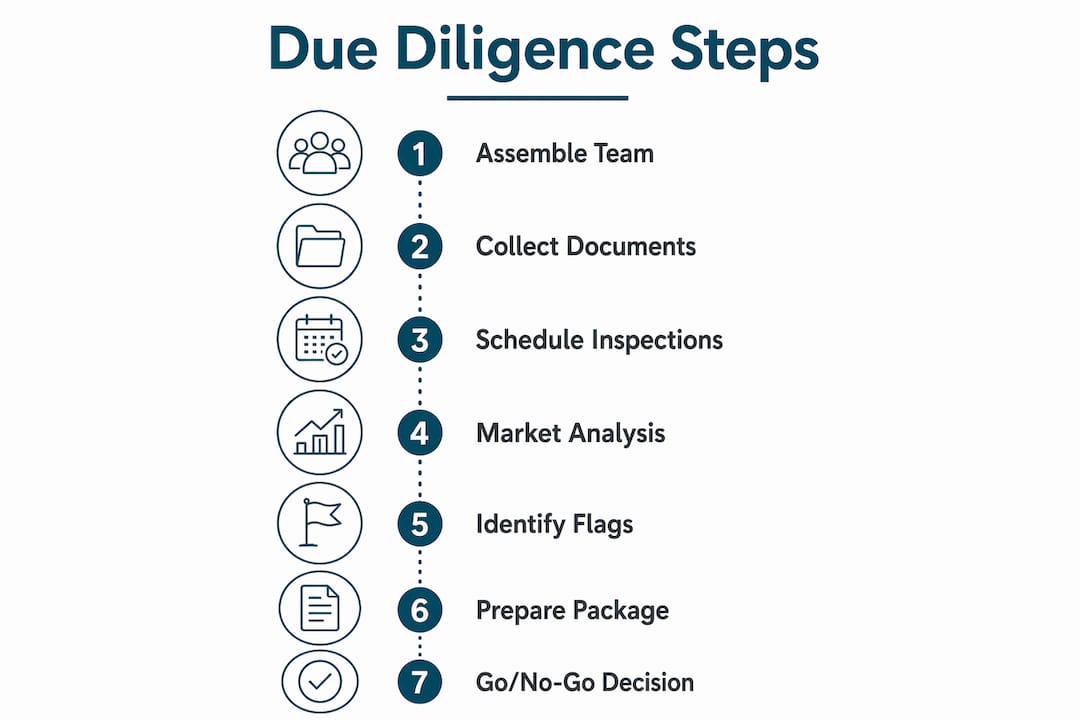
Step 1: Assemble your team
Your due diligence team includes a real estate attorney, a licensed inspector, an environmental consultant for commercial assets, a CPA familiar with real estate, and a local market analyst. Each specialist covers a lane you cannot cover alone.
Step 2: Collect and review documents
Request all financial statements, leases, permits, tax records, and prior inspection reports on day one. Organize documents in a shared digital folder with clear naming conventions. Disorganized files waste time and create the conditions for missed items.
Step 3: Schedule physical inspections
Run all physical inspections in parallel, not in sequence. Booking the inspector, the environmental consultant, and the structural engineer for the same week compresses the timeline and surfaces conflicts faster.
Step 4: Perform tenant and market analysis
Pull lease abstracts for every tenant and verify rent against the actual lease, not the rent roll summary. Assess each tenant's payment history and financial strength. Layer this with a market analysis covering vacancy rates, absorption, and comparable rents within a one-mile radius.
Step 5: Reconcile findings and identify red flags
When seller numbers deviate from actual operating statements, experienced investors shift from verification to investigation. A 10% gap between proforma income and actual income is a red flag. A 25% gap is a deal-defining moment that requires either a price renegotiation or an exit.
| Finding Category | Red Flag Threshold | Recommended Action |
|---|---|---|
| Income variance | More than 10% below proforma | Request 24-month bank statements |
| Deferred maintenance | Repair costs exceed 5% of purchase price | Negotiate credit or price reduction |
| Environmental condition | Phase I flags recognized conditions | Commission Phase II ESA immediately |
| Tenant credit risk | Anchor tenant below investment grade | Model vacancy scenario in underwriting |
| Zoning non-compliance | Existing use not permitted by right | Consult attorney before proceeding |
Step 6: Prepare the lender package
Lenders require their own set of documents, including an appraisal, environmental reports, and a rent roll certified by the seller. Synchronize your internal milestones with lender requirements early. Delays in delivering the lender package push closing dates and generate extension fees.
Step 7: Make your go/no-go decision
Every finding feeds a final decision matrix. If the numbers still work after adjusting for all discovered risks, proceed. If they do not, walk away. The discipline to exit a bad deal is what separates profitable investors from those who learn expensive lessons.
Common due diligence pitfalls and how to avoid them
Most due diligence failures trace back to process failures, not market conditions. Standardizing due diligence processes with consistent tracking matrices protects capital and prevents the memory lapses that ad-hoc processes create.
The most common pitfalls are:
- Accepting broker numbers at face value. Broker summaries are marketing documents. Verify every figure against source documents.
- Running inspections sequentially. Sequential scheduling burns time. Parallel inspections are the professional standard.
- Ignoring environmental risk. Skipping a Phase I ESA on a commercial property to save $2,000 can expose you to six-figure remediation liability.
- Failing to align lender requirements early. Lenders have their own checklists. Discovering lender requirements in week five of a 45-day period creates a crisis.
- Underestimating tenant risk. A single anchor tenant with a lease expiring in 12 months changes the entire investment thesis.
- Missing extension deadlines. Extensions must be requested before contingency deadlines expire, not after.
"Due diligence is where profits are made or lost before closing. The investor who treats it as a formality is the investor who inherits someone else's problems."
Due diligence serves as a hypothesis testing framework to validate underwriting assumptions against actual documents. Properties that look exceptional on broker summaries often hide critical surprises. Your job is to find them before you own them.
Key Takeaways
Effective due diligence real estate investment requires verifying financial, physical, legal, tenant, and market factors within a fixed timeline before closing.
| Point | Details |
|---|---|
| Four verification pillars | Every deal requires financial, physical, legal, and market review without exception. |
| Timeline is fixed | The due diligence clock starts at PSA execution; missed deadlines forfeit earnest money. |
| Parallel inspections save time | Schedule all physical and environmental inspections concurrently to compress the timeline. |
| Lender alignment is critical | Assemble the lender package by week three to avoid closing delays and extra fees. |
| Standardize your process | Consistent checklists and tracking matrices prevent costly oversights across multiple deals. |
Why I think most investors underestimate due diligence
After working through dozens of real estate transactions, the pattern I see most often is investors treating due diligence as a box-checking exercise rather than an investigative process. They collect the documents, skim the numbers, and move toward closing because they are emotionally committed to the deal.
The mindset shift that changes outcomes is treating every deal as a hypothesis. Your underwriting model is the hypothesis. Due diligence is the experiment that either confirms or refutes it. Due diligence profits are realized during the analysis phase, not at the closing table. The investor who finds the hidden deferred maintenance or the below-market lease before closing negotiates from strength. The one who finds it after closing absorbs the loss alone.
The other thing I have learned is that time management during due diligence is a skill most investors develop only after missing a deadline once. The earnest money deposit you forfeit because you ran out of time is a tuition payment. The better approach is to build your timeline backward from the contingency deadline and treat every milestone as non-negotiable.
Employing standardized checklists and tracking systems is not bureaucracy. It is the difference between a deal you understand completely and one you only think you understand. Build the matrix, work the matrix, and let the findings tell you what to do.
— Myra
How Beamsrealtygroup supports your investment property evaluation
Conducting thorough property investment due diligence requires coordinating financial analysis, physical inspections, legal review, and lender requirements within a tight deadline. That coordination is where deals either hold together or fall apart.

Beamsrealtygroup brings deep market knowledge and hands-on transaction experience to every investment evaluation. The team helps investors organize document review, manage inspection schedules, and prepare lender packages that meet financing timelines. Whether you are evaluating a single-family rental or a commercial asset in Virginia, expert investment guidance from Beamsrealtygroup gives you the structure and clarity to make confident, well-informed decisions. Reach out to Beamsrealtygroup to discuss your next acquisition before the due diligence clock starts.
FAQ
What is real estate due diligence?
Real estate due diligence is the formal verification process a buyer conducts after signing the purchase agreement and before closing. It covers financial, physical, legal, tenant, and market analysis to confirm all property details and identify risks.
How long does the due diligence period last?
Residential due diligence typically runs 7–21 days, while commercial real estate due diligence periods run 30–60 days. Complex commercial deals can require 90 or more days depending on asset size and deal structure.
What happens if I miss the due diligence deadline?
Missing a contingency waiver deadline results in forfeiting your earnest money deposit. The due diligence clock starts at PSA execution and does not pause, so extensions must be requested before the deadline expires.
What is a Phase I Environmental Site Assessment?
A Phase I ESA is a standard environmental review that identifies recognized environmental conditions on a property. If the Phase I flags concerns, a Phase II investigation follows to test soil and groundwater for contamination.
What are the biggest mistakes investors make during due diligence?
The most costly mistakes are accepting broker-provided numbers without verification, running inspections sequentially instead of in parallel, and failing to align lender requirements early in the process. Each mistake either wastes time or exposes the investor to undiscovered risk.