
An exit strategy in real estate investment is a pre-planned approach to divesting property that protects returns and controls tax liability. Without one, investors default to reactive decisions that cost them significantly at closing. Strategic exit planning can reduce 2026 tax liability by 20–40% compared to unplanned sales. The five primary exit methods available to investors are outright sale, 1031 exchange, installment sale, portfolio roll-up, and partial sale. Choosing the right real estate exit plan starts with understanding each option and formalizing your approach well before you need it.
What are the primary exit strategies in real estate investment?
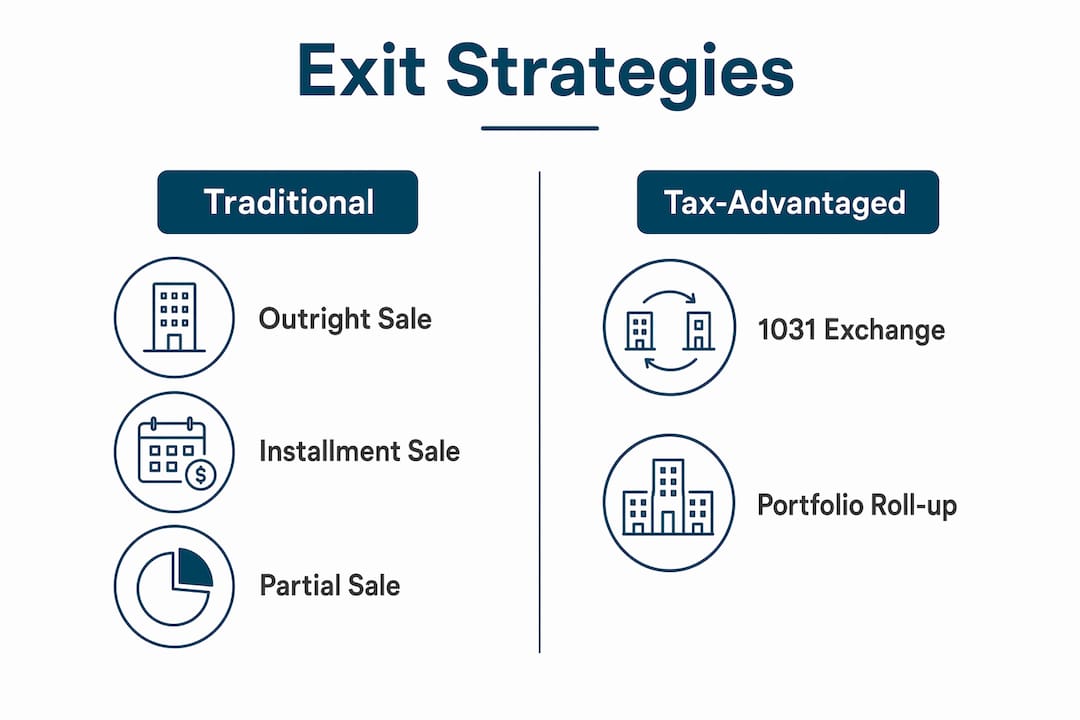
The five primary exit strategies for property investors each serve a different financial goal. Your age, income level, and estate objectives determine which one fits your situation best.
Outright sale is the most direct method. You list the property, negotiate a price, and close. It delivers immediate liquidity but triggers capital gains tax and depreciation recapture in the same tax year.

1031 exchange lets you defer capital gains taxes by reinvesting proceeds into a like-kind property within strict IRS timelines. You must identify a replacement property within 45 days of closing and complete the purchase within 180 days. This method works best for investors who want to keep wealth compounding in real estate without a tax hit.
Installment sale spreads the income from a sale across multiple years. The buyer pays you over time, and you recognize gain only as payments arrive. This approach lowers your annual taxable income and can keep you in a lower tax bracket.
Portfolio roll-up consolidates multiple smaller properties into a single larger asset or fund structure. Investors use this when they want to reduce management complexity while preserving equity. It often pairs with a 1031 exchange to defer taxes on the consolidation.
Partial sale means selling a percentage of ownership in a property, often to a partner or private equity buyer. It generates liquidity without fully exiting the asset. Investors use it when they want cash but believe the property still has upside.
| Exit strategy | Best for | Key tax consideration |
|---|---|---|
| Outright sale | Immediate liquidity needs | Full capital gains and recapture due at closing |
| 1031 exchange | Continued real estate investment | Deferred taxes, strict 45/180-day deadlines |
| Installment sale | Income spreading over time | Gain recognized as payments received |
| Portfolio roll-up | Simplifying large portfolios | Often combined with 1031 for tax deferral |
| Partial sale | Partial liquidity with retained upside | Taxed on the percentage of gain realized |
Each strategy carries trade-offs between liquidity, tax timing, and control. The best exit strategies for investors are the ones aligned with their specific financial timeline, not the ones that sound most sophisticated.
How to plan and prepare a real estate exit strategy effectively
Formalizing your real estate exit plan 18–24 months before your target sale date is the single most impactful step you can take. Investors who wait until they are ready to sell leave significant money on the table through poor cost basis management and rushed tax decisions.
Here is a practical planning sequence:
- Audit your current cost basis. Calculate accumulated depreciation, capital improvements, and adjusted basis. This number determines your taxable gain at sale.
- Model your tax exposure under each exit method. Run projections for an outright sale, a 1031 exchange, and an installment sale. The differences in after-tax proceeds can be substantial.
- Deploy liquid assets into tax-aware separately managed accounts (SMAs). Deploying assets into tax-aware SMAs 12–18 months before sale generates harvestable losses that offset capital gains and depreciation recapture at closing.
- Document a secondary exit path. Market conditions change. Build a backup plan, such as refinancing into a debt-service-coverage-ratio (DSCR) rental or a long-term hold, before you need it.
- Engage a tax advisor and a real estate professional early. The structural decisions made 18 months out are far more valuable than last-minute tax moves.
Pro Tip: Never disclose your minimum acceptable price during early negotiations. Formalizing your negotiation strategy before any buyer contact is as important as formalizing the exit method itself.
Underwriting two exit strategies at acquisition, not just at sale time, gives you the flexibility to adapt when interest rates shift or buyer demand softens. Investors who plan only one path face fire-sale pressure when that path closes.
How do you execute the most common exit strategies step by step?
Execution separates investors who plan well from those who actually profit. Each method has a distinct sequence that, if rushed or skipped, creates costly problems.
Executing an outright sale
- Order a pre-listing appraisal and a property condition report. Surprises during due diligence kill deals.
- Set your listing price based on comparable sales, not your desired return. Overpricing extends time on market and signals desperation to buyers.
- Negotiate terms before price. Control over closing date, contingencies, and earnest money protects you more than squeezing the last $10,000 from the purchase price.
- Coordinate with your tax advisor on the closing date to manage which tax year the gain falls in.
Executing a 1031 exchange
- Engage a qualified intermediary before you close on the relinquished property. The IRS requires that the intermediary hold proceeds. You cannot touch the funds.
- Identify replacement properties within 45 days. Name up to three properties or use the 200% rule for more options.
- Close on the replacement property within 180 days of selling the original asset.
- Confirm the replacement property's value equals or exceeds the relinquished property's sale price to defer the full gain.
Executing an installment sale
- Negotiate the payment schedule, interest rate, and security instrument with the buyer before signing the purchase agreement.
- File IRS Form 6252 each year you receive payments to report the installment income correctly.
- Build in a balloon payment clause if you want full payoff within a defined period.
Term sheet negotiations for real estate exits should cap exclusivity periods at 30 days. Longer exclusivity hands the buyer leverage and reduces your ability to pursue competing offers.
What are the most common pitfalls when exiting a real estate investment?
Most exit failures are not market failures. They are planning failures. Recognizing the patterns in advance is the fastest way to avoid them.
- Disclosing your floor price too early. Telling a buyer or their agent your minimum acceptable number before receiving an offer destroys your negotiating position. Formalizing your negotiation strategy before any buyer contact preserves leverage and improves outcomes.
- Ignoring depreciation recapture. Investors focus on capital gains rates and forget that depreciation recapture is taxed at 25% under current federal rules. This often represents a larger tax bill than the capital gain itself.
- Having no secondary exit path. A single-path exit plan is a liability. Investors who structure acquisitions with at least one secondary plan, such as refinancing into a DSCR rental, avoid being forced into bad timing.
- Holding too long out of attachment. Emotional attachment to a property causes investors to miss peak market windows. Set a performance threshold in advance and commit to it.
- Rushing the 1031 exchange timeline. Missing the 45-day identification window or the 180-day closing deadline disqualifies the exchange entirely. The full gain becomes taxable immediately.
Pro Tip: Build your exit criteria into your original underwriting model. Define the price, cap rate, or market condition that triggers your exit before you close on the acquisition.
How do 2026 market and regulatory changes affect your exit plan?
The regulatory environment in 2026 adds new urgency to exit planning. Two major developments demand attention from serious investors.
The One Big Beautiful Bill Act (OBBBA) of 2025 introduced significant changes to real estate tax treatment. Investors need to model their exits against the updated capital gains and depreciation rules that take effect under this legislation.
A 2026 Senate housing bill requires large investors owning over 350 single-family homes to divest newly built rental properties within seven years. This mandate forces institutional and large-scale investors into planned exits on a fixed timeline, regardless of market conditions. Proactive exit planning is no longer optional for this investor class.
| Regulatory factor | Impact on exit strategy |
|---|---|
| OBBBA of 2025 | Updated capital gains and depreciation rules affect after-tax proceeds |
| Senate housing bill (2026) | Mandatory divestiture within 7 years for large-scale rental investors |
| Rising interest rate environment | Reduces buyer pool for leveraged acquisitions, favoring installment sales |
| Increased IRS scrutiny on 1031s | Requires tighter documentation and qualified intermediary compliance |
Diversified exit tactics improve portfolio outcomes precisely because no single regulatory change can derail all paths simultaneously. Investors who rely on one method face the full impact of any rule change. Those with modular plans absorb it.
Key Takeaways
A well-structured exit strategy in real estate investment, formalized 18–24 months before sale, is the primary driver of after-tax returns and negotiating leverage.
| Point | Details |
|---|---|
| Plan 18–24 months early | Early planning optimizes cost basis and unlocks tax reduction of 20–40%. |
| Use dual exit paths | A secondary plan prevents fire-sale pressure when market conditions shift. |
| Match strategy to investor profile | Age, income, and estate goals determine whether a 1031, installment sale, or outright sale fits best. |
| Cap exclusivity at 30 days | Short exclusivity windows preserve your leverage during term sheet negotiations. |
| Monitor 2026 regulations | The OBBBA and Senate housing bill create new mandatory exit timelines for large investors. |
Why I think most investors exit too late and too simply
Most investors treat the exit as the finish line. I think that framing is the root cause of most exit failures. The exit is a structural decision you make at acquisition, not a reaction you have when you are tired of managing a property.
The investors I have seen execute the cleanest exits are the ones who built modular exit playbooks from day one. They combined 1031 exchanges into Delaware Statutory Trusts (DSTs), charitable donation strategies for appreciated assets, seller financing for buyers who could not get conventional loans, and outright sales for properties that hit their return targets. No single method dominated. The mix shifted based on market conditions and personal tax situations.
The other pattern I have noticed is that disciplined negotiators always outperform optimistic ones. Investors who set a price floor and never disclose it, who cap exclusivity at 30 days, and who walk away from bad terms consistently close at better prices than those who telegraph desperation. Exit planning is not just financial modeling. It is behavioral discipline applied to the most consequential transaction in your portfolio.
The 2026 regulatory environment makes this more urgent, not less. Waiting to formalize your real estate exit plan is now a measurable financial risk, not just a missed opportunity.
— Myra
How Beamsrealtygroup helps investors execute winning exits
Beamsrealtygroup works with real estate investors at every stage of the exit process, from initial tax modeling to final closing. The team brings deep market knowledge of the Virginia market and a track record of structuring transactions that protect investor returns.

Whether you are weighing a 1031 exchange, planning an installment sale, or preparing a portfolio for divestiture under the 2026 regulatory timeline, Beamsrealtygroup provides the personalized guidance that generic brokerages cannot. The team prioritizes clarity at every step, so you know exactly what your exit will cost and what it will return before you commit to a path. Connect with Beamsrealtygroup to build your exit plan with professionals who treat your investment goals as their own.
FAQ
What is an exit strategy in real estate investment?
An exit strategy in real estate investment is a pre-planned method for divesting a property that maximizes financial returns and minimizes tax liability. The five primary methods are outright sale, 1031 exchange, installment sale, portfolio roll-up, and partial sale.
How far in advance should I plan my real estate exit?
Investors should formalize their exit plan 18–24 months before the target sale date. This window allows time to optimize cost basis, generate tax-loss harvesting positions, and avoid rushed negotiation decisions.
What is a 1031 exchange and when should I use it?
A 1031 exchange lets you defer capital gains taxes by reinvesting sale proceeds into a like-kind property within IRS deadlines of 45 days for identification and 180 days for closing. Use it when you want to keep wealth compounding in real estate without triggering a tax event.
How does depreciation recapture affect my exit?
Depreciation recapture is taxed at 25% under current federal rules and often exceeds the capital gains tax bill. Deploying assets into tax-aware SMAs before sale can generate losses that offset this liability at closing.
What do 2026 regulations mean for real estate investors?
The 2026 Senate housing bill requires investors owning more than 350 single-family homes to divest newly built rentals within seven years. The OBBBA of 2025 also updated capital gains treatment, making proactive exit planning a financial necessity for large-scale investors.