
A home sale contingency makes your purchase contract conditional on successfully selling your current home by a set date, so if that sale falls through, you can walk away from the new purchase and get your earnest money back. Buyers use it when they need the equity from their existing home to fund the next one and can't qualify to carry two mortgages at once.
If you're a buyer weighing this option, your first move is a phone call, not a clause. Ask your lender whether your debt-to-income ratio would even support two mortgage payments simultaneously, and ask your agent how contingent offers are actually performing in your specific zip code right now. The answer to both questions determines everything else in this article.
A home sale contingency tends to make sense when:
- You have significant equity in your current home but not enough liquid cash for a down payment without it.
- Local inventory is sitting on the market longer than 30 to 45 days, giving sellers more reason to consider conditional offers.
- Your current home hasn't been listed yet, but you have a realistic timeline to list it within days of writing the offer.
It's a weaker move when you're competing in a market where homes get multiple offers within 48 hours, or when your current home is unlikely to sell quickly because of price, condition, or a thin buyer pool in your neighborhood.
Key Takeaways
A home sale contingency protects buyers from owning two homes at once, but it only works when the buyer backs it with real documentation and a realistic timeline.
| Point | Details |
|---|---|
| Confirm lender tolerance first | Ask your lender how they'll treat your current mortgage in DTI calculations before writing an offer. |
| List before you offer | An active MLS listing with showing activity makes a contingent offer far more credible to sellers. |
| Negotiate a short kick-out window | A 48 to 72 hour kick-out clause reassures sellers while still protecting your position. |
| Know your alternatives | Bridge loans, HELOCs, and rent-back arrangements can replace a contingency when your market moves fast. |
| Work with a local expert | Beams Realty Group coordinates contingency language, lender referrals, and closing timing for Virginia buyers and sellers. |
Always have a real estate attorney or your agent review any contingency or kick-out clause language against your state's specific contract customs before you sign.
Table of Contents
- What Is a Home Sale Contingency in a Purchase Contract?
- How Does a Home Sale Contingency Actually Work?
- Should You Consider a Home Sale Contingency as a Buyer or Seller?
- How Do You Make a Home Sale Contingency Offer Stronger?
- What Are the Alternatives to a Home Sale Contingency?
- How Do State Rules and Lender Policies Change a Home Sale Contingency?
- Sample Home Sale Contingency Clause and Submission Checklist
- What Happens If a Home Sale Contingency Isn't Met?
- How Beams Realty Group Helps You Navigate a Home Sale Contingency
- An Agent's Perspective on When a Contingency Actually Makes Sense
- Where to Find More on Home Sale Contingencies
- Frequently Asked Questions
- Sources
What Is a Home Sale Contingency in a Purchase Contract?
A home sale contingency is a clause in your purchase agreement that lets you cancel the contract, without losing your earnest money, if your current home doesn't sell and close by a specific deadline. It shows up as its own paragraph or addendum in the contract, usually right alongside the financing and inspection contingencies, and it names a hard date rather than a vague window.
There are two common versions of this clause, and the difference matters a lot to a seller reading your offer. A settlement contingency applies when your current home is already under contract with another buyer. It just needs to close by a certain date. A sale-and-settlement contingency is the riskier version for sellers: your home isn't even under contract yet, so the buyer is asking for time to both find a buyer and close that deal. HomeLight's guide to home sale contingencies breaks down both structures and notes that sellers are far more comfortable with the first than the second, since it removes most of the uncertainty about whether a sale will actually happen.
The contract language typically sets a specific number of days (commonly 30, 45, or 60) and spells out what happens if that date passes without a closing. Here's how a home sale contingency stacks up against the other contingencies you'll see in a standard purchase agreement:
- Home sale contingency: Ties your purchase to selling and closing on your current property; protects against owning two homes at once.
- Inspection contingency: Lets you renegotiate or exit based on findings from a professional home inspection, unrelated to your other property.
- Financing (mortgage) contingency: Protects you if your loan application falls through, regardless of what happens with your current home.
- Appraisal contingency: Protects you if the new home doesn't appraise for the purchase price, which affects how much your lender will finance.
These contingencies can stack in the same offer. A buyer might submit an offer with a home sale contingency, a financing contingency, and an inspection contingency all running on overlapping timelines, which is exactly why sellers scrutinize contingent offers so closely.
How Does a Home Sale Contingency Actually Work?
The mechanics run on two parallel clocks: your current home's sale progress and the deadline written into your new purchase contract. Miss the deadline, and the contract typically terminates with your earnest money returned, unless you've negotiated an extension in writing beforehand.

Most contingency periods run somewhere between a few weeks to a couple of months, though some sellers in slower markets will agree to longer periods. Inside that window, the seller usually reserves the right to add a kick-out clause, sometimes called a "hell or high water" clause or right of first refusal. This lets the seller keep marketing the home and accept backup offers while your contingent contract stays active. If a better, non-contingent offer comes in, the seller notifies you, and you typically get a short window to either waive your contingency and proceed without it or walk away. Rocket Mortgage's explainer on kick-out clauses describes this as the standard compromise that lets sellers avoid taking their home fully off the market for a buyer who hasn't sold anything yet.
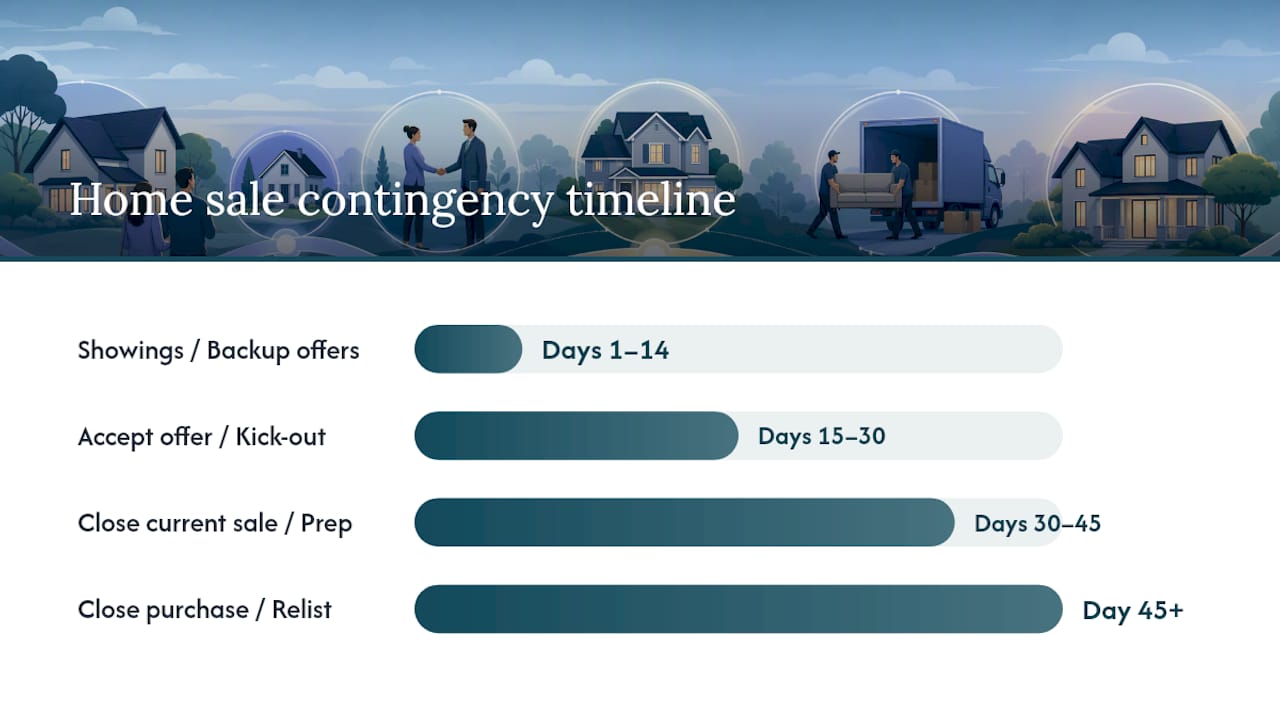
Here's how that timeline typically plays out in a real transaction:
| Timeframe | Buyer's tasks | Seller's tasks |
|---|---|---|
| — | Submit offer with home sale contingency; list current home if not already listed | Review offer, decide whether to accept, negotiate kick-out terms |
| Days 1–14 | Show current home, field offers, update agent on activity | Continue normal marketing; can accept backup offers under kick-out clause |
| Days 15–30 | Accept an offer on current home, move into settlement contingency phase | Monitor buyer's progress; may issue kick-out notice if a stronger offer appears |
| Days 30–45 | Close on current home sale | Prepare for closing on the sale to the contingent buyer |
| Day 45+ (deadline) | Close on new purchase or request extension | Proceed to closing or relist if contingency isn't met |
Pro Tip: Keep a running log of every showing, offer, and price adjustment on your current home, and share it with the listing agent on the house you're trying to buy. Sellers who see real, documented activity treat a contingent offer very differently than one backed by nothing but a promise to "list soon."
Should You Consider a Home Sale Contingency as a Buyer or Seller?
The trade-offs look completely different depending on which side of the contract you're on, and understanding both perspectives helps you negotiate more realistically.
For buyers, the upside is real financial protection: you avoid the nightmare scenario of closing on a new home while your old one sits unsold, draining your savings on two mortgage payments. It also lets you coordinate moving logistics without renting temporary housing in between. The downside is competitive weakness. In any market with multiple offers, a contingent bid almost always loses to a clean, non-contingent one, even at a lower price, because sellers value certainty.
For sellers, accepting a contingent offer introduces delay and uncertainty into your own plans, and it can scare off other interested buyers who assume the home is already "spoken for" even when it isn't legally under a binding sale yet. Sellers often accept these offers anyway when the local market is slow, when the buyer offers a higher price or covers closing costs to offset the risk, or when a kick-out clause gives them an exit ramp if something better comes along.
Lenders sit in the background of all this, and their concerns shape what's actually possible:
- Underwriters look hard at your debt-to-income ratio if you'd theoretically be carrying two mortgages, even temporarily.
- Some lenders will only count your current mortgage payment against your DTI if your home is already under a signed contract to sell.
- A bridge loan or HELOC can bridge the equity gap, but lenders will still evaluate whether you can service that added debt on top of your existing obligations.
Lender concerns to flag early: Most conventional lenders want to see your DTI ratio stay under roughly 43 to 45 percent even in a worst-case scenario where both mortgages are active at once. Ask your loan officer directly how they'd treat your current mortgage in their calculations if your home sale contingency doesn't close on schedule, before you write the offer, not after.
How Do You Make a Home Sale Contingency Offer Stronger?
Sellers don't reject contingent offers because they dislike buyers who own homes. They reject them because the offer feels unreliable, and unreliability is exactly what a few concrete moves can fix.
Before you submit a contingent offer, assemble a package that answers the seller's obvious question: how close are you, really, to selling your own house? That package should include:
- Mortgage preapproval letter from your lender, not just a prequalification, confirming you can finance the new purchase once your equity comes through.
- Proof your current home is listed, ideally with an MLS printout showing days on market, showing activity, and any offers received so far.
- A larger-than-typical earnest money deposit, which signals you're serious enough to put real money on the line.
- Flexible closing date language, giving the seller room to accommodate their own move timeline.
A well-drafted kick-out clause can also make your offer palatable to a seller who'd otherwise reject it outright. Sample language might read something like: "Seller retains the right to continue marketing the property and accept backup offers. If Seller accepts a bona fide offer from another buyer, Seller shall provide written notice to Buyer, who shall have 72 hours to remove the home sale contingency and proceed to closing, or the contract shall terminate and earnest money shall be returned to Buyer." Treat any clause like this as a starting draft; your agent and a real estate attorney should adjust the exact wording and hours to fit your state's practices and your specific transaction.
Beyond paperwork, negotiation posture matters. Offering a shorter contingency window (30 days instead of 60) signals urgency and reduces the seller's exposure. Some buyers also offer to cover a portion of the seller's closing costs or agree to a rent-back arrangement that lets the seller stay in the home briefly after closing, both of which sweeten the deal enough to offset the contingency risk.
Pro Tip: An MLS activity report showing your current home has already had a dozen showings and two offers in the first week is worth more to a skeptical seller than almost anything else you can hand them. It's the closest thing to proof you have that this contingency will actually resolve on schedule.
What Are the Alternatives to a Home Sale Contingency?
If a contingent offer feels too weak for your local market, or your lender won't tolerate the DTI math, several alternatives let you buy before you sell without asking a seller to accept a conditional contract.
A bridge loan gives you short-term financing secured against your current home's equity, letting you close on the new house before your old one sells. A HELOC (home equity line of credit) works similarly but usually costs less and takes longer to set up, since it requires you to already have the line established before you need the cash. According to SmartAsset's comparison of bridge loans and HELOCs, a bridge loan tends to fit buyers who need funds fast and are comfortable paying a premium for speed, while a HELOC suits buyers who can plan further ahead and want lower ongoing costs.

Other alternatives include selling your current home first and negotiating a rent-back so you can stay in it temporarily while you shop, or arranging a short-term rental between closings if you're comfortable moving twice. Some sellers will also agree to a lease-to-own structure on the home you're buying, though this is less common and usually requires a motivated seller.
| Alternative | Typical cost | Best fit |
|---|---|---|
| Bridge loan | Higher interest rate plus origination fees; short repayment term | Buyers who need funds quickly and expect a fast sale on their current home |
| HELOC | Lower interest rate than a bridge loan; requires existing equity and approval time | Buyers who plan ahead and can carry the payment for several months |
| Sell first, rent back | Rent-back fee negotiated with the buyer of your old home; no financing cost | Sellers with strong equity who don't mind a temporary move or short-term rental |
| Home sale contingency | No direct cost, but weakens your offer competitively | Buyers in slower markets who can't otherwise qualify to carry two mortgages |
Your decision usually comes down to three questions: how fast is your local market moving, how much equity do you actually have access to, and how much financing risk are you willing to carry for a few months? A broader look at alternatives to listing with an agent covers additional routes worth weighing if speed matters more to you than maximizing your sale price.
How Do State Rules and Lender Policies Change a Home Sale Contingency?
Contingency language isn't uniform across the country, and the practical customs in your state can matter as much as the contract wording itself. In fast-growing metro markets across states like Texas, agents often build "move-up plans" that combine a shorter contingency window with a pre-negotiated rent-back, because local sellers are used to seeing that structure and won't blink at it the way they might at an open-ended contingency. In Virginia and much of the mid-Atlantic, agents lean more heavily on kick-out clauses paired with fast preapproval documentation, since the market moves quickly enough that sellers rarely want to take a home fully off-market for more than 30 to 45 days.
Before you finalize any contingency clause, run through this checklist with your lender:
- Ask how your current mortgage payment will be treated in your DTI calculation if the contingency doesn't close on time.
- Confirm whether they offer bridge financing in-house or only refer out to third-party lenders.
- Find out if there's a minimum equity threshold required before they'll consider a HELOC or bridge loan on your current property.
- Ask what documentation they need from your listing (contract, MLS activity, closing disclosure) to update their underwriting file as your sale progresses.
Lender variation is real: some regional banks and credit unions are far more flexible about counting contingent income than large national lenders, simply because they can manually underwrite exceptions that automated systems won't allow.
- Get every contingency deadline confirmed in writing by both your buyer's agent and the listing agent.
- Ask your agent directly how many contingent offers have closed successfully in your market over the past six months.
- Never assume a kick-out window from a past transaction (yours or a friend's) applies automatically. Confirm the specific hours in your current contract.
Sample Home Sale Contingency Clause and Submission Checklist
Here's template language you can bring to your agent as a starting point, not a finished legal document. Every state and every brokerage has its own preferred contract forms, so treat this as a framework to adapt with a real estate attorney or your agent's compliance team.
Sample settlement contingency clause:
"This Agreement is contingent upon the closing of the sale of Buyer's property located at [address], currently under contract with an anticipated closing date of [date]. If said sale does not close by [deadline date], either party may terminate this Agreement, and Buyer's earnest money deposit shall be returned in full."
Sample sale-and-settlement contingency clause with kick-out language:
"This Agreement is contingent upon Buyer selling and closing on the property located at [address] on or before [deadline date]. Seller retains the right to continue marketing the Property and to accept a backup offer from another buyer. Should Seller accept such an offer, Seller shall provide Buyer written notice, and Buyer shall have [72] hours from receipt of such notice to waive this contingency in writing or this Agreement shall terminate, with earnest money returned to Buyer."
Poorly worded contingency and right-of-first-refusal language creates exactly the kind of ambiguity that stalls closings or ends up in a dispute. Troutman's analysis of negotiating rights of first refusal points out that vague terms around response timing and what counts as a "matching" offer are among the most common sources of post-contract litigation, which is exactly why this clause deserves attorney eyes rather than a generic template pasted in without review.
Before you submit any contingent offer, gather:
- Signed mortgage preapproval letter, dated within the last 30 to 60 days.
- MLS listing sheet and activity report for your current home, if already listed.
- Signed purchase agreement on your current home, if you're using a settlement (not sale-and-settlement) contingency.
- Proof of earnest money funds available and ready to deposit.
Pro Tip: Never adapt this sample clause word-for-word without review. State contract forms, local customary kick-out windows, and how your state courts interpret "reasonable notice" all vary enough that a clause perfectly standard in one market can be unenforceable or confusing in another.
What Happens If a Home Sale Contingency Isn't Met?
Neither side owes the other anything further once that happens, assuming the contingency deadline was clear and both parties followed the notice procedures in the contract.
A few different paths open up once that deadline arrives:
- The buyer can request an extension, which the seller may or may not grant depending on how motivated they still are and whether backup offers exist.
- The buyer can waive the contingency outright, agreeing to close regardless of whether their current home has sold, usually only viable if they've secured bridge financing or found another funding source.
- The seller can move forward with an existing backup offer if one was secured under a kick-out clause, or relist the home entirely if no backup exists.
- Both parties can renegotiate terms, such as adjusting the purchase price or closing date, to keep the deal alive a little longer.
Whichever direction the deal goes, keep a paper trail. Save every written notice, extension request, and email confirming deadlines, because disputes over "did they tell us in time" are almost always resolved by whoever has better documentation, not whoever remembers the conversation more clearly.
How Beams Realty Group Helps You Navigate a Home Sale Contingency
Getting a contingency clause right takes more than downloading a template. It takes someone who's negotiated kick-out windows with actual sellers in your specific Virginia market and knows which lenders will realistically work with your timeline.

Beams Realty Group works with buyers and sellers on exactly this kind of coordinated move, drafting contingency and kick-out language alongside local counsel so it holds up under your state's contract customs, syncing your sale and purchase closings so you're not carrying two mortgages a day longer than necessary, and connecting you with lenders experienced in bridge loan and HELOC referrals when a contingency isn't the right fit. In one recent Virginia transaction, a move-up buyer with strong equity but a slower-selling starter home used a 45-day sale-and-settlement contingency paired with a documented listing and weekly showing updates. That documentation, combined with a negotiated 72-hour kick-out window, was enough to get the seller comfortable accepting the offer over a competing bid.
If you're weighing whether a contingency, a bridge loan, or a straightforward sell-then-buy sequence fits your situation, talk with Beams Realty Group about your specific timeline and equity position before you write an offer or list your home.
An Agent's Perspective on When a Contingency Actually Makes Sense
I'd recommend a home sale contingency to a client in a slower market, where homes sit for 45 days or more and sellers have grown used to accepting conditional offers because the alternative is no offer at all. I'd also lean toward it for clients with substantial equity in their current home but limited cash reserves. In that situation, waiving the contingency and hoping a bridge loan comes through in time is a bigger gamble than most people realize.
Where I push back hard is in a market running hot with multiple offers inside the first weekend of listing. In that environment, a home sale contingency isn't a negotiating tool. It's a way to lose the house to someone who wrote a clean, non-contingent offer $10,000 lower than yours. Sellers in that kind of market don't need to accept risk, so they won't.
Virginia illustrates both ends of this spectrum well within the same state. In parts of Northern Virginia where inventory turns over in days, I steer clients toward bridge financing or a rent-back arrangement instead. Further out, in slower-moving suburban and exurban markets, a well-documented contingency with an active listing and a tight kick-out window still gets accepted regularly, especially when the buyer's agent has already built a relationship with the listing agent and can vouch for how the sale is progressing.
Where to Find More on Home Sale Contingencies
- HomeLight's guide to home sale contingencies explains the settlement versus sale-and-settlement structures in more depth, useful if you're still deciding which format fits your sale.
- Realtor is a solid starting point for understanding typical seller notice windows.
- Rocket Mortgage's kick-out clause guide covers the lender's angle on how these clauses affect financing timelines.
- The National Association of Realtors' overview of right of first refusal is worth reading if your contract includes ROFR language distinct from a standard kick-out clause.
- Troutman's legal analysis of negotiating rights of first refusal is the better resource for legal questions specifically, since it addresses drafting pitfalls rather than general consumer explanations.
- HUD's Office of Fair Housing and Equal Opportunity is worth reviewing if you have questions about fair housing obligations while marketing a home during a contingent sale.
For financing-specific questions, start with your lender and resources like SmartAsset's bridge loan comparison. For contract language and legal risk, an attorney or the Troutman analysis will serve you better than a general consumer site.
Frequently Asked Questions
How long does a home sale contingency typically last? Most home sale contingencies run 30 to 60 days, though some sellers in slower markets will agree to 90 days. The exact window is negotiable and should reflect a realistic estimate of how long your current home will take to sell and close.
What is a kick-out clause and how is it different from a home sale contingency? A home sale contingency is the buyer's protection, letting them exit the deal if their current home doesn't sell. A kick-out clause is the seller's protection built into that same contingency, letting the seller keep marketing the home and accept a better offer, giving the original buyer a short window (commonly 48 to 72 hours) to waive their contingency or walk away.
Can a seller reject a contingent offer just because it has a home sale contingency? Yes. Sellers have no obligation to accept a contingent offer, and in competitive markets they routinely favor non-contingent offers even at a slightly lower price, because those offers carry less uncertainty.
Is a home sale contingency the same as a right of first refusal? No. A home sale contingency ties your purchase to selling your current home. A right of first refusal is a separate right that lets a specific party match a future offer on a property before the seller accepts it from someone else. The two occasionally appear in the same transaction but solve different problems.
What happens to my earnest money if my home sale contingency isn't met? If the contingency deadline passes and neither side negotiates an extension, the contract typically terminates and your earnest money is returned in full, as long as you followed the notice procedures spelled out in your specific contract.
Are there alternatives if my lender won't approve a home sale contingency? Yes. Bridge loans, HELOCs, and rent-back arrangements after selling your current home first are all common alternatives that avoid the DTI concerns tied to carrying two mortgages, though each comes with its own cost and timing trade-offs worth discussing with your lender directly.
This article is general information, not a substitute for advice from a qualified lawyer. Consult a qualified legal professional about your own circumstances before acting on anything here.