
Negotiating an investment property purchase price is defined as the process of reaching a mutually acceptable price and terms between buyer and seller, using data, strategy, and leverage rather than guesswork. Most investors focus only on the sticker price, but the real gains come from combining price reductions with favorable terms like closing dates, contingencies, and repair credits. Two foundational concepts govern every successful negotiation: the Maximum Allowable Offer (MAO), which sets your ceiling based on income, repair costs, and target return, and the walk-away price, which is the hard limit you set before any conversation begins. Investors who master both concepts consistently close better deals than those who negotiate by feel.
What preparatory steps should you take before negotiating an investment property price?
Preparation is the single biggest advantage you can bring to any property negotiation. Investors who skip this step routinely overpay. Skipping due diligence before making an offer leads to overpaying by 5–12%, which erases months of projected cash flow before you even own the property.
Start by researching comparable sales, also called "comps," within the same submarket. Pull recent closed transactions for similar property types, sizes, and conditions. This gives you an objective baseline to challenge the seller's asking price with data rather than opinion.

Next, calculate your MAO. The MAO formula works backward from your target yield: start with the property's expected after-repair value or stabilized income, subtract repair costs, acquisition costs, and your required profit margin, and the result is the most you can pay. Experienced investors use MAO as a firm ceiling to avoid emotional overbidding, which is one of the most expensive mistakes in real estate.
Understanding seller motivation is equally critical. A seller facing a tax deadline, a divorce, or a need for a fast close will respond to very different offer structures than one who is simply testing the market. Seller motivations unlock hidden leverage that buyers who only focus on price never access.
- Research at least three to five closed comps within the past six months in the same zip code or submarket.
- Calculate your MAO before contacting the seller or their agent.
- Ask the listing agent open-ended questions about the seller's timeline and motivation.
- Review the property's days on market, price reduction history, and any prior failed contracts.
- Set your walk-away price in writing before your first offer, and do not revise it upward under pressure.
Pro Tip: Request the property's rent rolls, utility bills, and maintenance records before making any offer. Gaps or inconsistencies in these documents are negotiation leverage, not just red flags.
How do you structure your initial offer and use anchoring to influence negotiations?
The first number in any negotiation carries disproportionate weight. Anchoring is psychologically powerful; the initial offer shapes the final outcome even when both parties recognize the tactic. This means your opening offer is not just a bid. It is the frame that defines the entire deal.
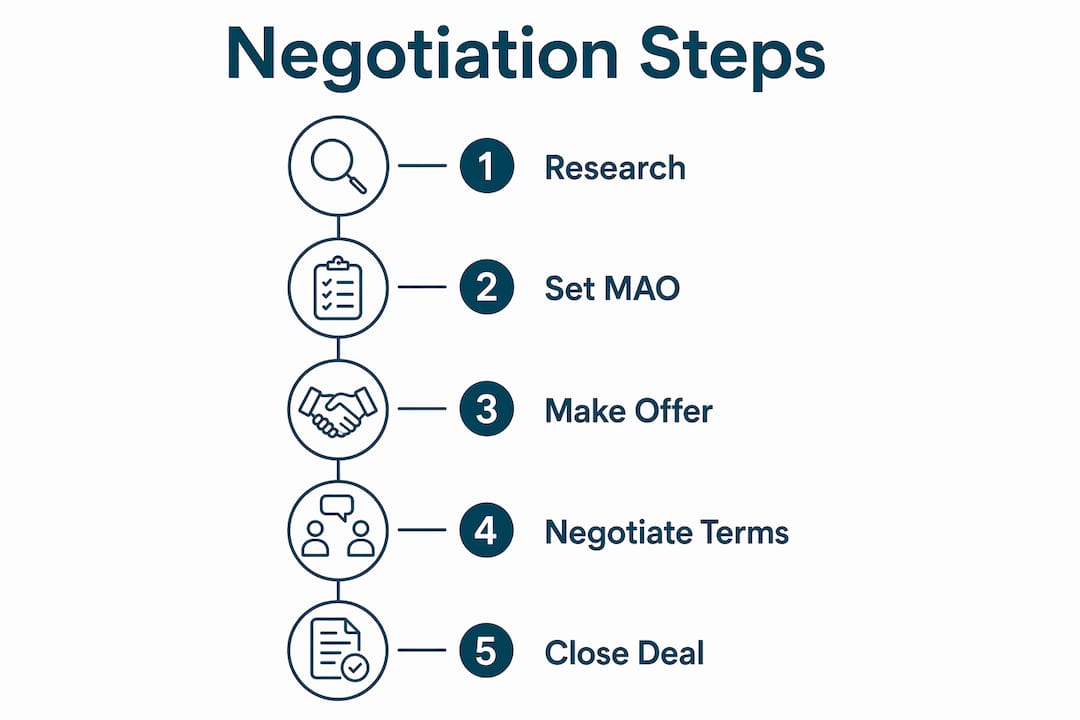
The most effective tool for anchoring an investment property negotiation is a well-crafted Letter of Intent (LOI). The LOI is a non-binding document that outlines your proposed price and all key terms before a formal contract is drafted. A detailed LOI that specifies earnest money, diligence period, and closing timeline resets the negotiation anchor from the seller's asking price to your terms.
Structure your LOI to include:
- Purchase price. Open at 10–15% below asking price in standard markets. In high-vacancy environments, discounts of 10–20% off asking are achievable and expected.
- Earnest money deposit. A larger deposit signals commitment and can offset a lower price offer.
- Due diligence period. Specify the number of days you need for inspections, financial review, and environmental checks.
- Closing date. Align this with the seller's known needs whenever possible.
- Contingencies. Include financing, inspection, and appraisal contingencies to protect your position.
Avoid submitting a lowball offer without supporting data. Unjustified low offers permanently damage broker relationships and reduce your access to future deal flow, particularly in institutional or competitive markets.
Pro Tip: Attach a brief written rationale to your LOI explaining how you arrived at your price. Sellers and their agents respond better to reasoned offers than to bare numbers.
What negotiation tactics help you leverage terms beyond price for a better deal?
Price is only one dimension of a real estate deal. Experienced investors treat every term as a negotiable variable with real dollar value. This approach gives you more room to reach agreement even when a seller refuses to move on price.
Closing date flexibility is one of the most underused tools in property negotiations. Sellers completing a 1031 exchange have strict IRS deadlines. Matching your closing date to their timeline can be worth more to them than a price increase. Sellers often accept 1–3% lower prices in exchange for faster closes or stronger earnest money deposits that reduce their risk.
Inspection results open a second negotiation window after your initial offer is accepted. Request a professional inspection and use documented repair needs to negotiate repair credits, price reductions, or seller-paid remediation. This is standard practice, not aggressive tactics.
Negotiating terms beyond price means treating every variable in the deal as currency. A seller who won't drop the price by $20,000 may readily agree to cover $15,000 in closing costs, include appliances, or offer a home warranty. The total value to you is nearly the same, but the path to agreement is far easier.
Additional levers worth negotiating include:
- Seller credits at closing to cover your loan origination fees or title costs.
- Appliance and equipment inclusion to reduce your post-close capital expenditure.
- Home warranties that protect you from major system failures in the first year.
- Extended rent-back agreements that give the seller time to vacate while you earn rent.
- Shorter due diligence periods offered in exchange for a lower price, signaling confidence and speed.
Never concede a term without receiving something in return. Reciprocal concessions are the foundation of effective negotiation. Every time you give something up, ask for a corresponding benefit.
How do you handle counteroffers, appraisal surprises, and when to walk away?
Counteroffers are where most investors lose discipline. The seller's counter is not a final answer. It is an invitation to continue negotiating. Your response strategy determines how much value you capture.
Use bracketing to control the negotiation range. If you open at $380,000 and the seller counters at $420,000, your next offer should not split the difference at $400,000. Instead, move to $388,000. This keeps the midpoint of the negotiation closer to your target. Smaller incremental concessions signal that you are near your limit and slow the seller's expectations.
- Respond to every counter in writing. Verbal agreements create confusion and erode trust.
- Never accept the first counter. Even a small move signals that you have room, which keeps the conversation alive.
- Bundle concessions. When you agree to a seller's term, attach a condition. "We'll accept the closing date if you cover the title insurance."
- Use appraisal results as a renegotiation trigger. If the property appraises below the agreed price, you have grounds to renegotiate. Propose splitting the appraisal gap or challenge the comps used.
- Know your exit point. Walk-away power protects your returns and often brings sellers back with better terms after you disengage.
Pro Tip: When a deal stalls, try changing one variable rather than reopening the entire negotiation. Adjusting the closing date or earnest money amount can restart momentum without conceding on price.
What common mistakes should you avoid when negotiating investment property purchases?
Most negotiation failures trace back to a small set of repeatable errors. Recognizing them before you sit down at the table is the fastest way to avoid them.
- Accepting the asking price as the anchor. The seller's list price is a starting point, not a fair market value. Always challenge it with your own comp analysis.
- Focusing only on price. Investors who ignore terms leave significant value on the table. Closing costs, repair credits, and timing concessions all affect your net cost.
- Rushing offers without due diligence. Speed feels like confidence, but offers made without financial review lead to overpaying.
- Making one-sided concessions. Every time you give something up without receiving something in return, you weaken your position for the next round.
- Burning broker relationships with insincere offers. Agents remember buyers who waste their time. Protecting those relationships pays dividends in future deal access.
- Ignoring market context. A tactic that works in a buyer's market can backfire in a tight inventory environment. Read the market before choosing your approach.
The most expensive mistake is emotional overbidding. When you fall in love with a property, your MAO becomes a suggestion rather than a rule. Write your walk-away price down before you make your first offer, and treat it as non-negotiable.
Key Takeaways
Effective property price negotiation combines a data-driven MAO, a well-anchored LOI, and disciplined use of terms to maximize deal value beyond the sticker price.
| Point | Details |
|---|---|
| Calculate MAO first | Set your price ceiling using income, repair costs, and target return before any offer. |
| Anchor with a detailed LOI | Include price, earnest money, diligence period, and closing date to frame the deal on your terms. |
| Negotiate terms, not just price | Closing credits, repair allowances, and timing concessions carry real dollar value. |
| Use bracketing on counteroffers | Make smaller incremental moves to keep the negotiation midpoint near your target. |
| Walk away when terms breach your limit | Disciplined exit power protects returns and often brings sellers back with better offers. |
What I've learned about negotiation that most guides won't tell you
Most negotiation advice focuses on tactics. The investors I've seen close the best deals focus on preparation. By the time they sit across from a seller, they already know their MAO, they've researched the seller's timeline, and they've drafted an LOI that makes their offer feel complete and credible. The negotiation itself is almost a formality.
The part that surprises most buyers is how much sellers care about certainty. A clean, fast offer from a buyer who clearly knows what they're doing often beats a higher offer from someone who seems uncertain. Execution certainty can justify paying 1–3% less than competing bids, because sellers price the risk of a deal falling apart.
Walk-away discipline is the hardest skill to build and the most valuable one to have. Every time I've seen an investor overpay, the reason was the same: they stopped treating their walk-away price as a rule. The market always produces another deal. The money you overpay on one property does not come back.
Negotiation is also a relationship game. The broker who brings you a deal today will bring you more deals if you treat them and their clients with respect. Lowball offers without justification close doors. Reasoned, well-supported offers open them, even when the seller says no the first time.
— Myra
How Beamsrealtygroup supports your investment property negotiations
Negotiating an investment property purchase takes preparation, market knowledge, and a clear strategy before the first offer goes out.

Beamsrealtygroup works directly with investors and homebuyers in Virginia to build that foundation. The team helps clients calculate their MAO, research comparable sales, and structure offers that address seller motivations from the start. Whether you are finalizing your first investment purchase or adding to an existing portfolio, Beamsrealtygroup provides the market intelligence and hands-on guidance that turns preparation into results. Connect with the team at Beamsrealtygroup to get personalized support on your next property deal.
FAQ
What is the Maximum Allowable Offer in real estate?
The Maximum Allowable Offer (MAO) is the highest price an investor can pay for a property while still hitting their target return. It is calculated by subtracting repair costs, acquisition expenses, and required profit from the property's projected value or income.
How far below asking price should I offer on an investment property?
Initial offers typically start 10–15% below asking price in standard markets, with discounts of 10–20% possible in high-vacancy or buyer-favoring conditions. Always support your offer with comparable sales data rather than an arbitrary percentage.
What is a Letter of Intent in property negotiation?
A Letter of Intent (LOI) is a non-binding document that outlines your proposed purchase price and key terms, including earnest money, due diligence period, and closing date. It anchors the negotiation on your terms rather than the seller's asking price.
When should I walk away from a property negotiation?
Walk away when the final agreed price or terms breach your pre-set MAO or walk-away criteria. Disciplined exit power protects your investment returns and often prompts sellers to return with improved offers.
How do I negotiate after a low appraisal?
Request a price reduction equal to the appraisal gap, propose splitting the difference, or challenge the comparable sales the appraiser used. A low appraisal is a legitimate renegotiation trigger, and most sellers expect this conversation.