
Search major listing portals, your local MLS through a licensed broker, and government auction channels, then verify the parcel against county assessor records and order a title search before you commit a dollar. That sequence protects you from the most common and expensive mistakes buyers make.
Where to start right now:
- Pull the parcel's record from your county assessor/recorder's office to confirm ownership, legal description, and any outstanding tax liens.
- Cross-check the listing against GSA Auctions, Bureau of Land Management (BLM) public sales, or HUD Home Store if you're pursuing government-owned property.
- Contact a local licensed broker or land attorney before submitting any offer on vacant land for sale.
Pro Tip: The county assessor's parcel number (APN) is your single most useful research tool. Every deed, lien, easement, and tax record ties back to it. Get it from the listing before you do anything else.
Table of Contents
- Where can you find land for sale right now?
- What types of land will you encounter?
- How to evaluate a parcel before you bid or make an offer
- What does buying land actually cost beyond the listing price?
- How does buying government-owned land differ from a private sale?
- How Beamsrealtygroup helps land buyers find and close safely
- Negotiation strategies that work specifically for land
- What are the biggest risks when buying land?
- How do environmental restrictions and land use regulations affect your purchase?
- How do you verify a parcel's development potential?
- What market trends should land buyers watch in 2026?
- What are the tax implications of owning land?
- Key Takeaways
- The mistake most land buyers make before they ever see the parcel
- Beamsrealtygroup gives Virginia land buyers a clear path from search to closing
- Authoritative sources and where to verify public records
Where can you find land for sale right now?
Buyers typically find raw land for sale through four main channels, and each one carries different pricing transparency, buyer protections, and financing availability.
National listing portals and owner-finance marketplaces aggregate private-seller and investor-owned parcels. Some platforms advertise low down payments and monthly owner-financing with minimal underwriting, which sounds appealing until you realize those advertised prices often exclude development costs entirely. The purchase price on a $5,000 parcel can balloon to $30,000 or more once you factor in the cost of installing a well, septic system, and power hookup.
Local MLS listings via a licensed broker give you access to parcels that never appear on national portals. Broker-listed land typically includes more complete disclosure, and a buyer's agent can pull comparable sales data to tell you whether the asking price per acre is realistic for that county.
Government auction and sales portals operate differently from private sales. Federal agencies including GSA Auctions, BLM, U.S. Treasury, and U.S. Marshals Service sell surplus, foreclosed, and public land through competitive bidding and offer-based processes. Deadlines are strict, seller disclosures are limited, and financing contingencies are rarely accepted.
County assessor and recorder offices are not listing portals, but they are the ground truth behind every listing. Deed history, tax status, easements, and legal descriptions all live there. Some volume-seller marketplaces do not perform full local-record verification, so buyers who skip this step can end up purchasing a parcel with a clouded title or an unresolved lien.
- National portals: broad inventory, variable disclosure quality, owner-finance options common
- Local MLS via broker: best disclosure, comparable sales data, financing-friendly
- Government channels (GSA, BLM, HUD, Treasury, Marshals): competitive bidding, limited disclosures, strict timelines
- Owner-finance marketplaces: low entry cost, minimal underwriting, infrastructure often absent
- County records: not a listing source, but mandatory verification for every parcel
Pro Tip: Before you contact a seller, run the APN through your county's online assessor portal. If the tax status shows delinquent or the deed chain has a gap, that is your first red flag — and it costs you nothing to find it.
What types of land will you encounter?
Not all vacant land for sale is the same, and matching parcel type to your goal saves months of wasted due diligence.
- Rural raw land: Typically no utilities on-site. Listings often disclose that buyers must install a well, septic system, and run power from the nearest grid connection. Best for homesteading, hunting, timber, or long-term passive investment where development is years away.
- Residential lots: May be fully platted with utilities stubbed to the lot line. Build-ready lots in established subdivisions carry higher price-per-acre figures but dramatically lower development costs. Best for custom home construction.
- Commercial and industrial parcels: Require specific zoning confirmation, traffic studies, and often environmental review. Infrastructure requirements (three-phase power, municipal water/sewer) are non-negotiable for most uses.
- Agricultural land: Subject to conservation easements, water rights, and soil classification. Productivity ratings (NRCS Web Soil Survey) directly affect value and financing terms.
- Mixed-use and transitional parcels: Zoned for one use but located in a corridor where rezoning is plausible. These carry speculative upside and real risk. Never pay for the rezoning potential unless you have a written pre-application meeting with the local planning department confirming it is feasible.
Matching buyer goals to parcel type:
- Homestead or off-grid living: rural raw land, minimum 5 acres, confirmed legal access
- Custom home construction: residential lot, utilities present, confirmed buildable per county
- Commercial development: commercially zoned parcel, traffic count data, utility capacity confirmed
- Passive investment: agricultural or rural land in a growth corridor, clean title, low carrying cost
- Recreation or hunting: rural acreage, no utility requirement, access road or easement confirmed
How to evaluate a parcel before you bid or make an offer
Every parcel deserves the same checklist, whether it's a $3,000 rural lot or a $300,000 commercial site.
Zoning and permitted uses come first. Call the county planning department and confirm what the parcel is zoned for today, not what the seller says it can be used for. Zoning determines whether you can build, farm, operate a business, or subdivide.

Legal description and parcel size must match the deed exactly. Discrepancies between the listing's stated acreage and the recorded legal description are common on older rural parcels and can indicate boundary disputes or survey errors.
Access and road maintenance matter more than most buyers expect. A parcel without legal access (a recorded easement or deeded road frontage) is effectively landlocked. Confirm whether the access road is publicly maintained or private, and who pays for upkeep.
Utilities are the biggest hidden cost on raw land for sale. Water, sewer, power, and gas each require separate investigation. Owner-financing platforms frequently list parcels with no utility hookups, and development costs for a well and septic alone can run $15,000–$30,000 depending on soil conditions and depth to water.
Floodplain and wetlands designation can kill a development plan entirely. Check FEMA's Flood Map Service Center and the Army Corps of Engineers' National Wetlands Inventory before you spend money on a survey.
Deed and title status require a professional title search, not a quick online lookup. Look for gaps in the deed chain, unresolved liens, and any recorded easements that cross the parcel.
Checklist to run on every parcel:
- Zoning confirmed with county planning (in writing)
- Legal description matches deed and survey
- Legal access confirmed (recorded easement or road frontage)
- Utilities: water source, sewer/septic feasibility, power distance
- FEMA flood zone status
- Wetlands designation (National Wetlands Inventory)
- Title search ordered through a licensed title company
- Outstanding tax liens or delinquencies checked via assessor
- Easements and encroachments reviewed on plat map
- Prior permits or failed septic applications checked
Pro Tip: Order a professional boundary survey before you finalize your offer, not after. Discovering an encroachment or a boundary dispute during the due-diligence period gives you negotiating leverage. Discovering it after closing gives you a lawsuit.
What does buying land actually cost beyond the listing price?
The listing price is the smallest number in the budget for undeveloped land. Here is what the full picture looks like.
Financing shapes matter. Raw land loans carry higher down payment requirements than residential mortgages, often 20%–50% of the purchase price, because lenders view unimproved land as higher risk. Lot loans (for platted residential lots with utilities) are slightly easier to finance. Construction loans fold in the land cost but require approved building plans. Owner-financing, common on no-credit-check platforms, sidesteps traditional underwriting but rarely includes any infrastructure and can carry above-market interest rates.
Common cost line items:
| Cost Item | Typical Range | Notes |
|---|---|---|
| Purchase price | Varies by state/type | Price per acre is the key comparison metric |
| Earnest money deposit | 1%–5% of purchase price | At risk if buyer defaults without contingency |
| Boundary survey | — | Higher for large or irregular parcels |
| Title search and insurance | — | Lender-required; protects against deed defects |
| Recording fees | $50–$300 | County-specific |
| Impact/utility connection fees | $5,000–$30,000+ | Municipal hookup charges for new development |
| Well and septic installation | $15,000–$30,000 | Soil-dependent; required on most rural parcels |
| Annual property taxes | Varies by county | Begins at closing; budget from day one |
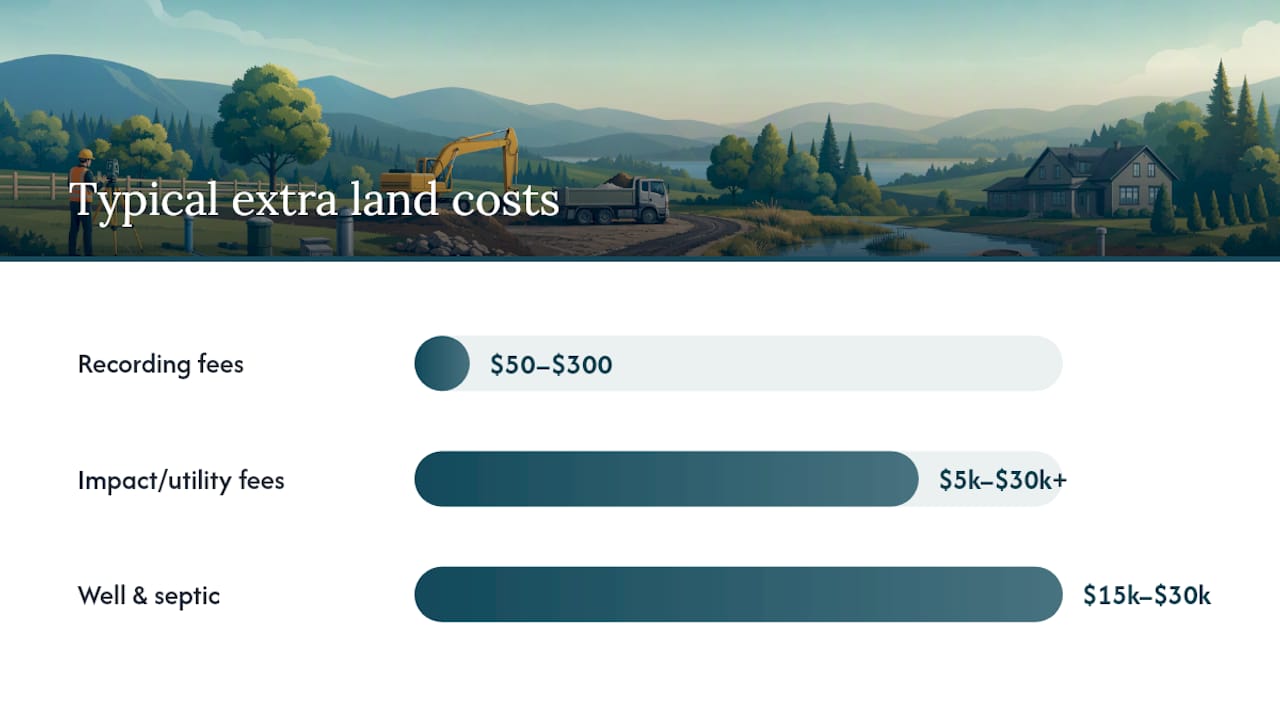
Impact fees can add substantial costs to the development of an undeveloped lot, and they are often omitted from marketplace price summaries.
Pro Tip: When evaluating an owner-financed listing with a "no credit check" headline, ask the seller directly: is there a well, septic, and power connection on the parcel? If the answer is no, add a significant amount to your mental budget before deciding whether the monthly payment is actually affordable.
How does buying government-owned land differ from a private sale?
Federal agencies sell surplus, foreclosed, and public land through several channels, each with its own process and buyer obligations.
| Agency Channel | Sale Method | Key Buyer Consideration |
|---|---|---|
| GSA Auctions | Online competitive bidding | Strict deadlines; limited disclosures; no financing contingencies |
| Bureau of Land Management (BLM) | Direct sale or auction | Public land parcels; environmental restrictions common |
| HUD Home Store | Offer-based (HUD disposition) | Primarily residential; some vacant lots; owner-occupant priority periods |
| U.S. Treasury / IRS | Sealed bid or auction | Forfeiture/seizure origin; title complexity possible |
| U.S. Marshals Service | Auction | Forfeiture origin; title research critical before bidding |
Government sales share several traits that distinguish them from private transactions. Seller disclosures are minimal or absent. Competitive bidding means you cannot negotiate price after the fact. Many parcels originate from foreclosure or seizure, which can create title complexity that a standard title search may not fully resolve without a title attorney's review.
Pro Tip: For any government auction parcel, order a title search and review the deed history before you place a bid. Winning an auction on a parcel with a clouded title means you own the problem. There is no seller to negotiate with after the gavel falls.
How Beamsrealtygroup helps land buyers find and close safely
Finding a parcel online is the easy part. Verifying it, negotiating it, and closing it cleanly is where most buyers need professional support.
Beamsrealtygroup provides local brokerage services that cover the full land-buying process: locating parcels through MLS and off-market sources, pulling and interpreting county assessor and recorder records, coordinating boundary surveys and title insurance, negotiating contingencies that protect your deposit, and managing the closing process from contract to deed recording.
The practical difference between working with a local broker and buying directly through an online portal is local knowledge. A broker who works in the county where the parcel sits knows which planning departments respond quickly, which title companies handle rural closings efficiently, and which sellers have been sitting on a parcel long enough to accept a lower offer.
Services Beamsrealtygroup provides for land buyers:
- Parcel identification and MLS/off-market search
- County records review (deed history, tax status, liens, easements)
- Survey and title insurance coordination
- Zoning and development feasibility review with local planning contacts
- Offer preparation and contingency negotiation
- Closing coordination and post-closing support
Pro Tip: Ask your broker to pull the parcel's permit history from the county building department, not just the assessor record. Failed permits, open violations, or prior unpermitted work show up there and can affect your development plans.
Negotiation strategies that work specifically for land
Land negotiation differs from home negotiation because there is no emotional attachment on either side and no appraisal to anchor the price. That gives buyers more leverage than they often use.
Price per acre is your primary benchmark. Pull three to five comparable sales from the county recorder or ask your broker for MLS comps within the same township and zoning class. If the listing price per acre is above the comp range, that gap is your opening number.
Time on market is the second lever. A parcel that has been listed for 180 days or more signals a motivated seller. Offer below asking and include a short due-diligence period (14–21 days) to show you are serious, not just fishing.
Contingencies are negotiating tools, not just protections. A seller who wants a fast close will often accept a lower price in exchange for a shorter due-diligence window. A seller who needs time to clear a title issue may accept a price reduction in exchange for an extended closing date.
Infrastructure costs discovered during due diligence are legitimate price-reduction grounds. If your survey reveals an encroachment, or your utility feasibility study shows the power connection will cost $15,000, go back to the seller with the contractor estimate in hand.
What are the biggest risks when buying land?
The risks that hurt buyers most are not dramatic. They are quiet and administrative.
Landlocked parcels are more common than buyers expect, particularly on rural land that has been subdivided informally over generations. No legal access means no development and no resale value to most buyers.
Zoning mismatch happens when a buyer assumes a parcel's use based on the seller's description rather than the county's official zoning map. Agricultural zoning does not automatically permit a residential build. Commercial zoning does not guarantee your specific business use is allowed.
Infrastructure cost blindness is the most financially damaging mistake. A parcel listed at $8,000 with no utilities can cost tens of thousands more to make buildable. Owner-financing platforms that advertise low monthly payments rarely disclose this gap prominently.
Title defects on rural land are common because older deeds were often recorded informally, boundaries were described by landmarks that no longer exist, and heirs sometimes sold land without probate. A professional title search catches most of these; skipping it does not.
Floodplain and wetlands surprises can render a parcel unbuildable after purchase. FEMA flood maps are updated periodically, and a parcel that was outside a flood zone five years ago may not be today.
How do environmental restrictions and land use regulations affect your purchase?
Environmental law operates at the federal, state, and local level simultaneously, and all three layers apply to your parcel.
At the federal level, Section 404 of the Clean Water Act requires Army Corps of Engineers permits for any fill or development activity in wetlands or waters of the United States. Violating this without a permit carries significant civil penalties. Before you develop any parcel near a creek, pond, or low-lying area, request a jurisdictional determination from the Army Corps.
State environmental agencies layer additional restrictions on top of federal rules. Coastal states often have shoreline setback requirements. Western states have water rights frameworks that govern whether you can drill a well or divert surface water. Check your state's department of environmental quality or natural resources for parcel-specific restrictions.
At the local level, county and municipal zoning codes set setbacks, lot coverage limits, height restrictions, and use classifications. Some counties also have agricultural preservation programs or conservation easements recorded against parcels that restrict subdivision or development permanently.
The practical step: before you make an offer on any parcel, request a pre-application meeting with the local planning department. Bring the APN and your intended use. Most counties offer this at no cost, and it will tell you within 30 minutes whether your plan is feasible.
How do you verify a parcel's development potential?
Development potential is not a feature of the listing. It is a conclusion you reach after checking four independent sources.
County zoning and planning department: confirms permitted uses, setbacks, minimum lot size for subdivision, and whether a variance or rezoning would be required for your intended use.
County health department: issues septic permits and well permits. A pre-application review tells you whether the soil percolation rate supports a standard system or requires an engineered alternative.
Utility providers: contact the electric cooperative or municipal utility directly to confirm the distance to the nearest connection point and the estimated cost to extend service to the parcel.
FEMA and Army Corps: confirm flood zone status and whether any portion of the parcel falls within a regulated wetland or waterway buffer.
If all four sources confirm your intended use is feasible, you have a buildable parcel. If any one of them raises a constraint, you need to quantify the cost of resolving it before you finalize your offer price.
What market trends should land buyers watch in 2026?
Rural land demand has remained elevated since the early 2020s, driven by remote work flexibility, interest in agricultural self-sufficiency, and investor appetite for hard assets during inflationary periods. Prices per acre in many Sun Belt and Mountain West states reflect that sustained demand.
Interest rate levels directly affect land financing costs. Because land loans carry higher rates than residential mortgages, buyers who finance land purchases feel rate changes more acutely than home buyers. Cash buyers have a structural advantage in land markets, particularly at auction.
Rezoning corridors near growing metros are where speculative value concentrates. Agricultural land within 20–30 miles of a growing secondary city often trades at a premium to its agricultural productivity value because buyers are pricing in eventual rezoning. That premium is real but not guaranteed; municipal growth plans change, and infrastructure timelines slip.
Conservation easement programs at the state and federal level are expanding, which creates both a risk (a parcel you buy may already carry a recorded easement limiting development) and an opportunity (landowners who donate or sell easements can receive significant tax benefits).
What are the tax implications of owning land?
Land ownership carries recurring and transactional tax obligations that buyers often underestimate.
Property taxes begin at closing and are assessed annually by the county. Agricultural land often qualifies for a lower assessed value under state-specific agricultural use exemptions (called "ag exemption," "greenbelt," or "current use" depending on the state). Losing that exemption when you change the land's use can trigger a rollback tax covering several prior years.
Capital gains tax applies when you sell land at a profit. Land held for more than one year qualifies for long-term capital gains rates, which are lower than ordinary income rates for most buyers. A 1031 exchange allows you to defer capital gains by rolling proceeds into a like-kind property, a strategy Beamsrealtygroup has experience coordinating for investment clients.
Deductibility of expenses on investment land is limited. Mortgage interest on land loans may be deductible if the land is held for investment, but the rules depend on your use of the parcel and your overall tax situation. Consult a CPA before assuming deductibility.
Timber and agricultural income from land you own is taxable as ordinary income unless structured through a qualified entity.
This is general information, not tax or legal advice. Confirm current rules with a licensed CPA or tax attorney before making decisions based on your specific situation.
Key Takeaways
Finding and closing on land for sale requires verifying county records, ordering a title search and survey, and confirming zoning and utility feasibility before you commit to any price.
| Point | Details |
|---|---|
| Start with county records | Pull the APN from the assessor/recorder before contacting any seller to check ownership, liens, and tax status. |
| Budget beyond the listing price | Well, septic, power hookup, and impact fees can add considerable expense to the cost of raw land. |
| Government sales need pre-bid research | GSA, BLM, and HUD auctions offer no contingency periods; complete your title research before bidding. |
| Zoning determines feasibility | Confirm permitted uses directly with the county planning department, not from the listing description. |
| Beamsrealtygroup guides the full process | From parcel search and county records review to survey coordination, negotiation, and closing in Virginia. |
The mistake most land buyers make before they ever see the parcel
Most buyers treat the listing price as the starting point for their budget. It is not. On raw or undeveloped land, the listing price is often the smallest line item in the total cost of ownership. The real number is the listing price plus infrastructure, plus carrying costs, plus the time it takes to get a permit.
What surprises me most is how often buyers skip the county records step entirely because the listing looks clean and the seller seems straightforward. A clean-looking listing on a national portal tells you almost nothing about the parcel's actual legal status. I have seen parcels with active tax liens, landlocked access situations, and failed septic permits that looked perfectly normal in the listing photos.
The other mistake is treating government auction parcels like private sales. The absence of a contingency period is not a minor procedural difference. It means you are buying whatever title history comes with that parcel, resolved or not. Buyers who win a GSA or BLM auction without prior title research sometimes discover the problem only when they try to develop or resell the land years later.
A local broker does not just find you listings. The real value is in knowing which questions to ask, which county departments to call, and which red flags in a deed chain are dealbreakers versus negotiable. That local knowledge is what the national portals cannot replicate.
Beamsrealtygroup gives Virginia land buyers a clear path from search to closing
Buying land without local expertise costs more than the broker's commission. Between missed liens, zoning mismatches, and infrastructure surprises, self-directed buyers routinely overpay or close on parcels that cannot support their intended use.
Beamsrealtygroup handles the full process for land buyers in Virginia: parcel identification, county records review, survey and title coordination, zoning feasibility checks, and closing management. The team brings local contacts at county planning departments and title companies that accelerate the due-diligence process and catch problems before they become your problem.
If you are actively searching for vacant land for sale in Virginia, or evaluating a specific parcel, contact Beamsrealtygroup for a parcel review. The conversation costs nothing; closing on the wrong parcel does.
Authoritative sources and where to verify public records
Every land purchase should be verified against primary public records. These are the sources that matter most.