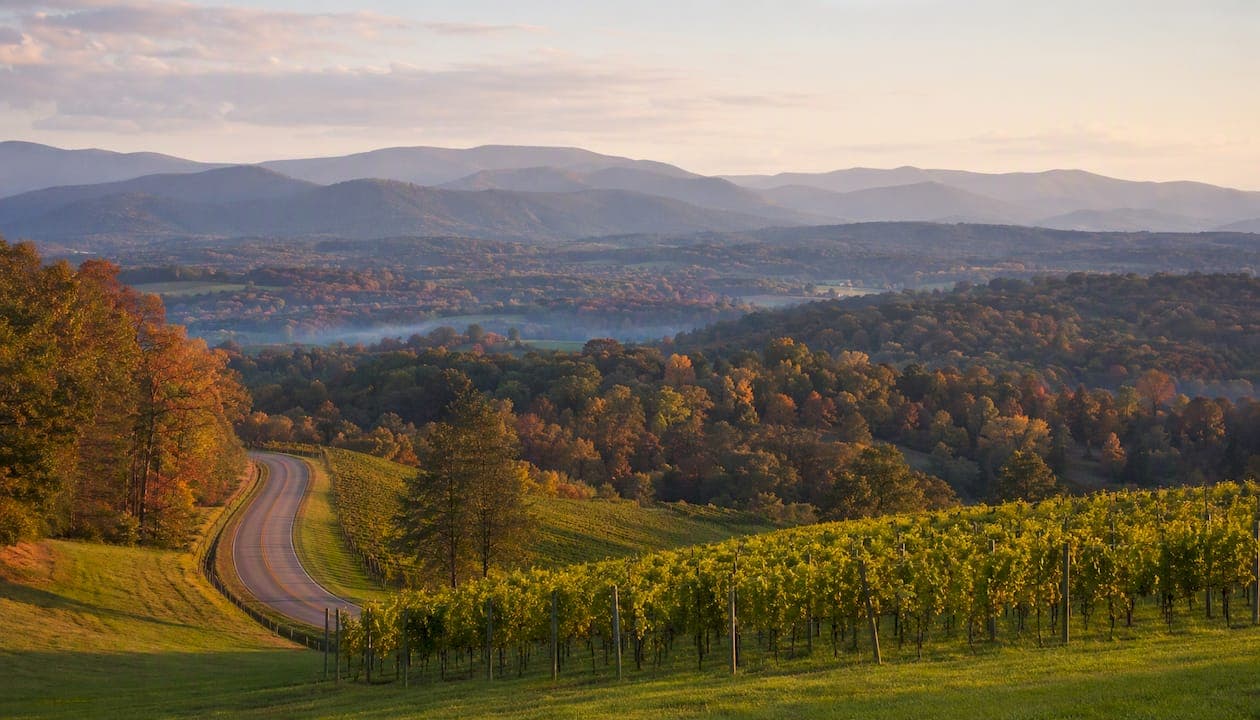
Nelson County, Virginia sits in the heart of central Virginia, roughly 30 miles south of Charlottesville, with the Blue Ridge Mountains forming its northwestern wall and the James River tracing its southeastern edge. The county seat is Lovingston, and the signature draw is Route 151, a state-designated scenic byway packed with wineries, breweries, cideries, and distilleries that locals call the Nelson 151 craft beverage trail. For outdoor visitors, Crabtree Falls and the restored Blue Ridge Tunnel trail are the two landmarks that show up on every itinerary. Official contacts and county services live at Nelsoncounty-va, and visitor planning starts at Nelsoncounty.
Key Takeaways
Nelson County, Virginia is a rural mountain county with a county seat at Lovingston, a population of around fifteen thousand as of the 2020 census, and an economy anchored by the Route 151 craft beverage trail, agriculture, and Wintergreen Resort.
| Point | Details |
|---|---|
| Location and county seat | Central Virginia, 30 miles south of Charlottesville; Lovingston is the official county seat for all legal and civic matters. |
| 2020 population | around fifteen thousand residents, with a median age in the low 50s and low population density across 474 square miles. |
| Signature attractions | Route 151 craft beverage trail, Crabtree Falls, Blue Ridge Tunnel trail, and Wintergreen Resort anchor visitor activity. |
| No incorporated towns | All services, permits, zoning, and taxes are handled at the county level through offices in Lovingston. |
| Beamsrealtygroup | Provides local market analysis, listings, and guided transactions for buyers and sellers in Nelson County, Virginia. |
Table of Contents
- What makes Nelson County VA worth knowing at a glance?
- Nelson County history: from founding to Hurricane Camille
- How does Nelson County's geography shape life there?
- Who lives in Nelson County today?
- How does Nelson County's government work?
- What are the schools and libraries like in Nelson County?
- What drives Nelson County's economy and housing market?
- What are the top things to do in Nelson County?
- What are the main communities in Nelson County?
- How do you get to and around Nelson County?
- Practical tips for visiting or moving to Nelson County
- What local media covers Nelson County?
- Public safety services in Nelson County
- Where do Nelson County residents go for healthcare?
- What cultural events and festivals happen in Nelson County?
- Parks and recreational facilities beyond the major attractions
- What living in Nelson County actually feels like
- Buying or selling property in Nelson County? Beamsrealtygroup can help.
- Sources
What makes Nelson County VA worth knowing at a glance?
| Fact | Detail |
|---|---|
| Founded | 1807, from Amherst County |
| Named for | Thomas Nelson Jr., Virginia governor and Declaration signer |
| County seat | Lovingston |
| Largest community | Nellysford |
| 2020 population | around fifteen thousand |
| Total area | Approx. 474 square miles |
| Time zone | Eastern (ET) |
| Congressional district | Virginia's |
| County website | nelsoncounty-va.gov |
| Courthouse address | 84 Courthouse Square, Lovingston, VA |
By the numbers: Nelson County's 2020 census count of around fifteen thousand makes it one of Virginia's smaller rural counties by population, yet its geographic footprint spans nearly 474 square miles.
Pro Tip: For GIS data, parcel maps, and real-estate records, the county's online GIS portal (linked from the government site) lets you search by address or parcel ID before you ever call the courthouse.
Nelson County history: from founding to Hurricane Camille
Nelson County's story begins in 1807 when the Virginia General Assembly carved it out of Amherst County. The county was named for Thomas Nelson Jr., a signer of the Declaration of Independence who served as Virginia's governor during the Revolutionary War. That founding context matters because the county's civic identity has always been tied to a sense of local self-determination.
Through the 19th century, the economy ran on agriculture. Apple orchards spread across the hillsides, chestnut groves filled the higher elevations before the blight, and the James River and Kanawha Canal moved goods east toward Richmond. When the railroad arrived, it opened markets for timber and farm products, but the county remained rural and relatively isolated.
The 20th century brought one event that permanently shaped how Nelson County sees itself:
Hurricane Camille struck in August 1969 with catastrophic rainfall that triggered flash floods and debris flows across the county. More than 100 residents lost their lives in a single night, and entire communities were swept away. The scale of destruction was unlike anything the region had experienced, and the recovery took years.
The aftermath was not only about rebuilding roads and homes. It reshaped the county's economic trajectory. Wintergreen Resort opened in the 1970s, partly as part of a broader regional investment following Camille. Vineyards began appearing on hillsides that had once grown apples. The Walton's Mountain Museum in Schuyler, which celebrates the legacy of author Earl Hamner Jr. and the television series The Waltons, became a cultural anchor. Long-term residents often describe the post-Camille recovery as the foundation of the community resilience that still defines the county today.
For deeper historical research, the Nelson County Historical Society and the Walton's Mountain Museum in Schuyler are the two best starting points.
How does Nelson County's geography shape life there?
The county's physical layout explains almost everything about how people live, work, and move around. The Blue Ridge Mountains rise along the northwestern boundary, reaching elevations above 4,000 feet in places. The southeastern edge follows the James River. Between those two anchors, the terrain drops through a series of river valleys carved by the Rockfish, Tye, and Piney rivers.
That elevation range, roughly 500 feet near the James River to over 4,000 feet on the Blue Ridge ridgeline, creates distinct microclimates. The valley floors are warmer and more accessible; the higher elevations get more snow and stay cooler through summer. That difference is exactly why Wintergreen Resort works as a ski destination while the Route 151 valley below it hosts outdoor dining and vineyard visits in the same season.
A large portion of the county's western section falls within the George Washington National Forest, which limits private development but provides extensive public land for hiking, camping, and hunting.
Key natural landmarks:
- Afton Mountain sits at the northern end of the county where I-64 crosses the Blue Ridge, a natural gateway between the Shenandoah Valley and Piedmont Virginia.
- Blue Ridge Tunnel, built in the 1850s and now a restored hiking trail, runs nearly a mile through the mountain at Afton.
- Crabtree Falls drops in a series of cascades along the Tye River, frequently cited as the tallest cascading waterfall east of the Mississippi.
- Rockfish Valley runs north-south through the heart of the county, following Route 151 and concentrating most of the craft beverage businesses.
Statistic callout: The county's western section within the George Washington National Forest represents a significant share of its total 474 square miles, keeping population density low and preserving the rural character that attracts both visitors and buyers.
Pro Tip: The county's GIS portal at nelsoncounty-va.gov lets you pull parcel boundaries, topographic overlays, and flood zone data for any property in the county before you visit in person.
Who lives in Nelson County today?
The 2020 U.S. Census counted around fifteen thousand residents in Nelson County, a figure that reflects steady but modest population over recent decades. The median age sits in the low 50s, which is notably higher than Virginia's statewide median, pointing to a county where retirees and long-term residents make up a significant share of the population.
Key demographic highlights:
- Population density is low relative to most Virginia counties, consistent with the large forested and agricultural land base.
- The share of residents under 18 is smaller than the state average, while the share over 65 is higher.
- Household counts reflect a mix of single-family rural properties, farm parcels, and resort-adjacent residential clusters near Wintergreen and Nellysford.
For homebuyers, the demographic profile matters practically. A county with a higher median age and lower density typically means less competition for properties in some price ranges, but also fewer services within the county itself. Schools serve a smaller student population, and most retail and medical services require a drive to Charlottesville or Lynchburg.
How does Nelson County's government work?
Nelson County operates under a Board of Supervisors and County Administrator model. Five supervisors represent the county's five magisterial districts, and a professional County Administrator handles day-to-day operations. Because the county has no incorporated towns, every resident falls under county-level governance. There is no separate city or town hall to deal with for permits, zoning, or taxes.
Key departments and what they handle:
- Commissioner of the Revenue — business licenses, personal property assessments, real estate assessments.
- Treasurer — tax payments, vehicle registration fees, utility billing.
- GIS Department — parcel maps, property data, and spatial analysis for planning and development.
- Broadband Authority — expanding high-speed internet access across the county's rural areas.
- Sheriff's Office — primary law enforcement for the entire county.
- Circuit and General District Courts — located at the Lovingston courthouse.
For permits, tax payments, and records requests, the county's main line is reachable through the contact directory at nelsoncounty-va.gov/government. The courthouse at 84 Courthouse Square in Lovingston handles deed recordings, land records, and court filings.
Pro Tip: Property transactions, title searches, and deed recordings all go through the Lovingston courthouse, not Nellysford. Even though Nellysford feels like the commercial center, Lovingston is where the legal paperwork lives.
What are the schools and libraries like in Nelson County?
Nelson County Public Schools operates four schools serving the entire county:
- Rockfish River Elementary School and Central Elementary School serve the lower grades.
- Nelson County Middle School serves grades 6–8, located near Lovingston.
- Nelson County High School serves grades 9–12 on the same campus as the middle school.
The division is small by Virginia standards, which means class sizes tend to be manageable and teachers often know students across grade levels. School quality profiles and performance data are publicly available through the Virginia Department of Education's School Quality Profiles portal.
Nelson Memorial Library in Lovingston serves as the county's public library, offering standard lending, digital resources, and community programming. GED testing and adult learning programs are available through the library system, making it a practical resource for residents pursuing continuing education.
For higher education, the county's location puts several options within reasonable driving distance:
- University of Virginia in Charlottesville, approximately 30 miles north.
- Piedmont Virginia Community College in Charlottesville, the most accessible two-year option.
- Central Virginia Community College in Lynchburg, roughly 40 miles southeast.
Pro Tip: Families researching schools before a move can pull detailed performance data, teacher qualification rates, and chronic absenteeism figures directly from the Virginia School Quality Profiles site — a more granular source than general real estate listing data.
What drives Nelson County's economy and housing market?
Three industries carry most of the county's economic weight: craft beverage tourism along Route 151, agriculture (primarily orchards and vineyards), and resort-related activity centered on Wintergreen.
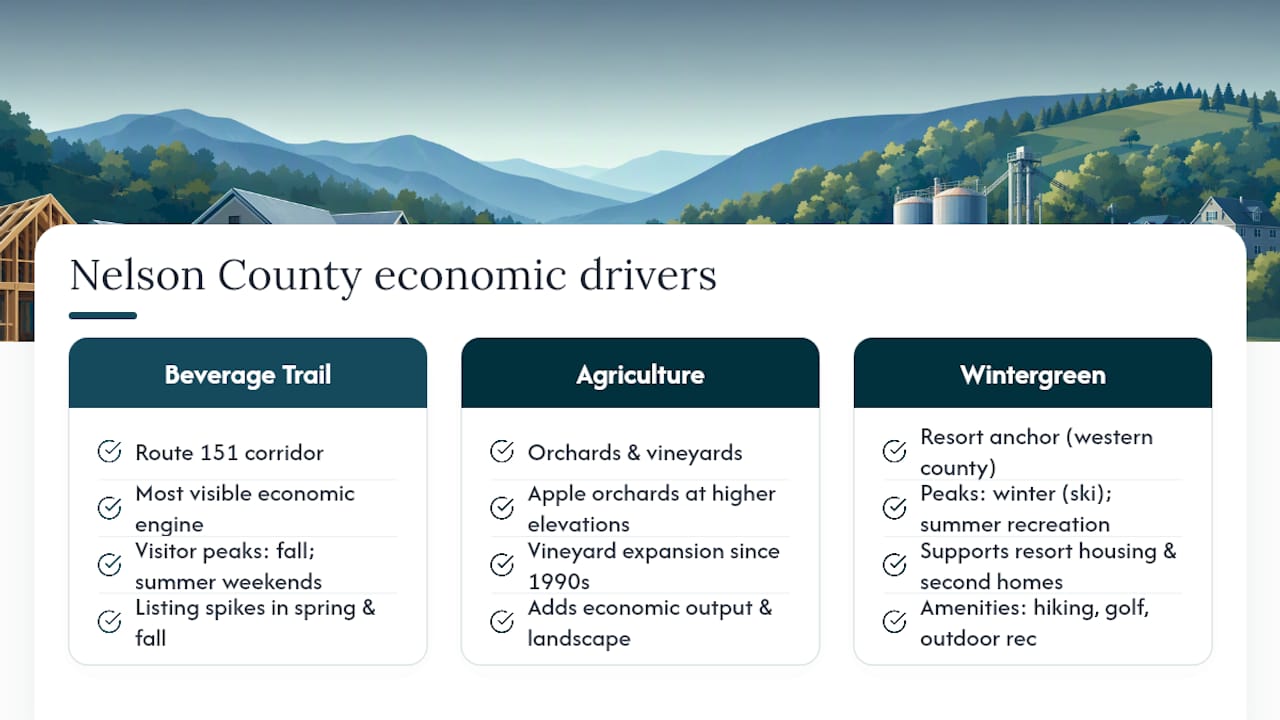
The Nelson 151 craft beverage trail is the most visible economic engine. The corridor concentrates wineries, breweries, cideries, and distilleries along Route 151 through the Rockfish Valley, drawing visitors year-round but peaking hard in fall foliage season and summer weekends. That visitor traffic supports restaurants, lodging, and retail that would not otherwise be viable in a county this size.

Agriculture still matters. Apple orchards remain active in the higher elevations, and the vineyard expansion since the 1990s has added both economic output and landscape character that reinforces the tourism brand.
Wintergreen Resort anchors the western end of the county's economy with ski operations in winter and hiking, golf, and outdoor recreation in warmer months. The resort also supports a residential community of second homes and vacation properties.
Properties near Route 151 and the craft beverage corridor tend to draw stronger buyer interest because of the combination of visitor traffic, scenic character, and short-term rental potential — a pattern that Beamsrealtygroup's team observes consistently in Nelson County market activity.
Common property types buyers find in the county include rural single-family homes on acreage, farmettes, mountain cabins, and resort-adjacent condos and townhomes near Wintergreen.
Pro Tip: Seasonality affects more than visitor counts. Listing activity and buyer inquiries along Route 151 typically spike in spring and fall. If you're buying near the corridor, watching inventory through those windows gives you a clearer picture of true market depth.
What are the top things to do in Nelson County?
The Nelson 151 craft beverage trail is the county's signature visitor experience. Route 151 through the Rockfish Valley connects wineries, breweries, cideries, and distilleries within a compact geographic corridor, making it easy to visit several in a single day. The trail has earned regional and national recognition as one of Virginia's premier agritourism destinations.
Outdoor highlights go well beyond the beverage trail:
- Crabtree Falls on the Tye River offers a 3.6-mile round-trip hike to a series of cascades frequently described as the tallest cascading waterfall east of the Mississippi.
- Blue Ridge Tunnel Trail at Afton runs nearly a mile through a 19th-century railroad tunnel, now open to hikers and cyclists, with dramatic views from both portals.
- Spy Rock provides one of the best 360-degree summit views in the county, accessible via the Appalachian Trail.
- Rockfish Valley Trail is a flat, paved multi-use path through the valley floor, suitable for families and casual cyclists.
- George Washington National Forest access points throughout the western county open up hundreds of miles of backcountry trails.
Visit Nelson County publishes seasonal itineraries that pair outdoor activities with craft beverage stops — a practical planning tool for first-time visitors who want to cover the county's highlights in a weekend.
Wintergreen Resort rounds out the recreation picture with skiing and snowboarding in winter, plus mountain biking, hiking, and a full-service spa and golf course in warmer months. The resort's lodging options range from hotel rooms to multi-bedroom condos, making it a self-contained destination for longer stays.
Pro Tip: Fall weekends along Route 151 get genuinely crowded. If you're visiting wineries or breweries during peak foliage season (mid-October through early November), arrive before noon or plan for a weekday trip to avoid the longest waits.
What are the main communities in Nelson County?
Nelson County has no incorporated towns. Every community is an unincorporated place, which means county government handles all services, zoning, and infrastructure regardless of which part of the county you live in. That distinction matters practically: there is no separate town council, town tax, or town permit office anywhere in the county.
The main communities each serve a distinct role:
- Lovingston is the county seat. Government offices, the courthouse, the library, and most administrative services are here. It's a small crossroads community, not a commercial hub, but it's where legal and civic business gets done.
- Nellysford functions as the county's commercial and recreational center. Route 151 runs through it, and most of the craft beverage businesses, restaurants, and visitor services cluster in and around this community.
- Schuyler is a small community in the southern part of the county, best known as the birthplace of Earl Hamner Jr. and home to the Walton's Mountain Museum.
- Afton sits at the northern end of the county near the I-64 crossing of the Blue Ridge, with mountain overlooks, vineyard country, and the Blue Ridge Tunnel trailhead nearby.
- Arrington is a rural community in the eastern part of the county, quieter and more agricultural in character.
- Wintergreen is the resort community on the western slopes of the Blue Ridge, operating as a largely self-contained residential and recreational enclave.
Pro Tip: When searching for properties online, listings may use community names like Nellysford or Afton as the address locality even though none of these are incorporated towns. All property records are filed at the Nelson County courthouse in Lovingston regardless of which community name appears on the address.
How do you get to and around Nelson County?
Getting to Nelson County is straightforward from most of central Virginia. Getting around once you're there requires a car. Public transit is essentially nonexistent outside of limited regional options, and the county's rural geography means distances between communities are real.
Major routes in and out:
- Route 151 (Nelson 151) is the primary north-south corridor through the Rockfish Valley, connecting Afton in the north to Arrington in the south.
- I-64 crosses the northern tip of the county at Afton Mountain, providing the main east-west connection between Charlottesville and the Shenandoah Valley.
- The Blue Ridge Parkway runs along the western ridge, offering a scenic (but slower) route connecting to Waynesboro and points south.
- Route 29 runs along the eastern edge of the county, connecting Charlottesville to Lynchburg.
Driving times: Charlottesville is approximately 30 miles north via Route 151 and I-64 (roughly 40 minutes). Lynchburg is approximately 40 miles southeast via Route 29 (roughly 50 minutes). Richmond is approximately 100 miles east via I-64 (roughly 1 hour 45 minutes).
The nearest commercial airports are Charlottesville Albemarle Airport (CHO), about 35 miles north, and Roanoke-Blacksburg Regional Airport (ROA), roughly 70 miles southwest. Richmond International (RIC) is the closest major hub at about 100 miles.
VDOT's 511 Virginia traffic system covers Route 151 and I-64 at Afton Mountain, which is worth checking in winter when ice and snow can close the mountain approaches.
Practical tips for visiting or moving to Nelson County
Best seasons by activity:
- Fall (September through November): Peak foliage and the busiest season on Route 151. Wineries and breweries are at full capacity; hiking conditions are excellent.
- Summer (June through August): Outdoor recreation, waterfall hikes, and the full craft beverage season. Wintergreen's non-ski amenities are active.
- Winter (December through March): Ski season at Wintergreen; quieter along Route 151 but many businesses stay open on weekends.
- Spring (April through May): Wildflower season on the trails, fewer crowds, and good weather for property visits.
Accommodation types:
- Wintergreen Resort lodging (hotel rooms, condos, and multi-bedroom units bookable through the resort directly).
- Bed-and-breakfasts and country inns scattered through the Rockfish Valley and Afton area.
- Cabin and vacation rental properties, concentrated near Route 151 and the national forest access points.
Emergency contacts and practical resources:
- Nelson County Sheriff's Office: reachable through the county's main directory at nelsoncounty-va.gov.
- Nearest hospital with emergency care: Martha Jefferson Hospital in Charlottesville (approximately 35 miles north) and Centra Lynchburg General Hospital (approximately 40 miles southeast).
- Tax payments and permit portals: accessible through the Treasurer and Commissioner of the Revenue pages at nelsoncounty-va.gov.
What local media covers Nelson County?
The county's primary print outlet is the Nelson County Times, a community newspaper covering local government, schools, events, and business news. For broader regional coverage, the Daily Progress out of Charlottesville covers Nelson County stories with regional significance, particularly government and development news.
Radio listeners in the county pick up signals from Charlottesville and Lynchburg stations, with no dedicated local AM or FM station based within the county. Television coverage comes from Charlottesville's NBC29 (WVIR) and CBS19 (WVAW), which serve the broader central Virginia market and include Nelson County in their coverage area.
For hyperlocal news and community announcements, the county government's website and social media channels have become increasingly important, particularly for emergency alerts and road closure notices.
Public safety services in Nelson County
The Nelson County Sheriff's Office is the primary law enforcement agency for the entire county, handling patrol, criminal investigations, and civil process. Because there are no incorporated towns with their own police departments, the Sheriff's Office covers all 474 square miles.
Fire and rescue services operate through a network of volunteer fire departments and rescue squads, a common structure in rural Virginia counties. Stations are distributed across the county to reduce response times across the geographic spread. The county's Emergency Management office coordinates disaster response and works with state and federal agencies during major weather events, a function that carries particular weight given the county's history with Hurricane Camille.
The Nelson County 911 Center handles emergency dispatch for law enforcement, fire, and rescue. For non-emergency contacts and department directories, the county government site at nelsoncounty-va.gov/government is the authoritative source.
Where do Nelson County residents go for healthcare?
No hospital operates within Nelson County itself. Residents and visitors rely on facilities in neighboring cities for acute and specialty care.
Martha Jefferson Hospital in Charlottesville, part of the Sentara Health system, is the closest full-service hospital for most of the county, roughly 35 miles north. Centra Lynchburg General Hospital serves residents in the southern and eastern parts of the county, approximately 40 miles away.
Within the county, primary care and urgent care options are limited. A small number of physician practices and family medicine offices operate in the Lovingston and Nellysford areas, but residents with complex medical needs typically travel to Charlottesville or Lynchburg. This is a practical consideration for anyone evaluating a move to the county, particularly retirees or families with ongoing medical needs.
What cultural events and festivals happen in Nelson County?
The county's event calendar clusters around its two strongest identity pillars: craft beverages and outdoor recreation.
The Nelson County Harvest Festival in the fall draws visitors to celebrate the apple and wine harvest, with local vendors, live music, and tastings along Route 151. Individual wineries and breweries along the Nelson 151 trail run their own seasonal release events, harvest dinners, and live music series throughout the year, making the corridor itself a rolling event venue from spring through fall.
The Walton's Mountain Museum in Schuyler hosts events tied to the legacy of Earl Hamner Jr. and the cultural history of the region, drawing fans of The Waltons television series from across the country.
Wintergreen Resort runs its own seasonal event programming, including outdoor concert series in summer and holiday events in winter. The resort's events are largely self-contained but draw visitors who then explore the broader county.
Community events at the county level, including 4-H fairs, school fundraisers, and civic gatherings, are posted through the county government site and local social media groups, which serve as the most reliable real-time calendar for residents.
Parks and recreational facilities beyond the major attractions
Beyond Crabtree Falls and the Blue Ridge Tunnel, the county has a range of recreational infrastructure worth knowing:
Rockfish Valley Foundation manages conservation land and trail access in the valley, including connections to the Appalachian Trail and backcountry routes into the George Washington National Forest.
Sherando Lake Recreation Area, managed by the U.S. Forest Service just over the Augusta County line but easily accessible from Afton, offers swimming, camping, and fishing in a mountain lake setting. Many Nelson County residents treat it as a local resource.
Appalachian Trail access points throughout the western county give hikers entry to one of the country's most iconic long-distance trails, with day-hike options ranging from easy ridge walks to challenging summit routes.
Wintergreen Nature Foundation operates environmental education programs and manages natural areas within the Wintergreen community, including trails open to resort guests and property owners.
The county's river corridors, particularly the James River along the southeastern boundary, support fishing, kayaking, and canoe access at several public put-in points. The James River is a state-designated Scenic River in this stretch, and the fishing for smallmouth bass draws anglers from across the region.
What living in Nelson County actually feels like
The rhythm of life here is seasonal in a way that urban Virginia residents rarely experience. Spring arrives slowly at elevation, summer fills the valley with visitors and activity, fall is genuinely spectacular and genuinely crowded, and winter quiets everything except Wintergreen's slopes. That cycle is not a backdrop; it shapes when neighbors are around, when roads get busy, and when local businesses are flush or lean.
The post-Camille identity runs deeper than most outsiders expect. Longtime residents carry that history as a point of pride, not just grief. It shows up in how the community organizes around emergencies, how neighbors check on each other during storms, and how local institutions talk about resilience. For someone moving in from a city, that culture of mutual reliance is one of the county's genuine assets.
The tradeoff is real, though. Car dependence is not optional here. Medical care, most retail, and many professional services require a 30-to-40-minute drive. The county's broadband expansion is ongoing but uneven, which matters for remote workers evaluating a move. Anyone who goes in with clear eyes about those constraints tends to find the rural mountain setting worth it. Anyone who underestimates them tends to find the adjustment harder than expected.
Buying or selling property in Nelson County? Beamsrealtygroup can help.
Nelson County's real estate market rewards buyers and sellers who understand its local dynamics: the seasonal demand spikes along Route 151, the distinction between Nellysford's commercial energy and Lovingston's civic role, and the way Wintergreen's resort community operates under its own set of pricing patterns.
Beamsrealtygroup brings deep Virginia market knowledge and personalized guidance to every transaction in the county, from rural acreage and farmettes to resort-adjacent condos and Route 151-corridor properties. The team handles market analysis, home valuations, property marketing, and negotiation, with specific experience in probate sales, estate management, and investment properties. If you're ready to explore what's available or want a current market read before you list, connect with Beamsrealtygroup to start the conversation.
Sources
Official and authoritative sources for verifying details and planning next steps: