
Passive income real estate is defined as earnings generated from property investments that require little to no day-to-day active management. Investors collect returns through rental cash flow, property appreciation, and tax advantages without handling daily operations themselves. The most common vehicles include public Real Estate Investment Trusts (REITs), private syndications, and professionally managed rental properties. Average annualized returns typically fall between 7% and 12% depending on the vehicle chosen. The IRS classifies rental income as passive by default, which shapes how gains and losses are taxed. For investors who want steady income without becoming a full-time landlord, passive real estate income is one of the most proven paths available.
What is passive income real estate, and how does it work?
Passive real estate income is income earned from property without the investor managing daily operations. The industry term for this approach is "passive real estate investing," and it covers a wide spectrum of structures, from owning shares in a publicly traded REIT to being a limited partner in a private apartment syndication.
The core mechanic is straightforward. You deploy capital into a real estate asset or fund. A sponsor, operator, or property manager handles the work. You receive distributions, dividends, or appreciation gains in return. The degree of your involvement depends on the vehicle you choose.
Returns come from three sources: rental cash flow, property appreciation, and tax benefits such as depreciation deductions. Each source compounds the others over time. A property that generates modest monthly cash flow can still deliver strong total returns when appreciation and depreciation savings are factored in.

What are the main vehicles for generating passive real estate income?
Four primary structures dominate passive real estate investing. Each carries a different entry cost, risk profile, and liquidity window.
Public REITs
Public REITs trade on stock exchanges like the NYSE and require as little as $5 to start. By law, they must distribute 90% of their taxable net income to shareholders as dividends. That distribution requirement makes them one of the most reliable income vehicles in real estate. You can buy and sell shares any trading day, which gives you liquidity no other real estate structure can match.
Private syndications
Syndications pool capital from multiple investors to acquire large assets like apartment complexes or commercial buildings. Minimum investments range from $25,000 to $100,000. You become a limited partner, meaning you earn income and appreciation without any operational role. The trade-off is illiquidity. Capital is typically locked for five to ten years.
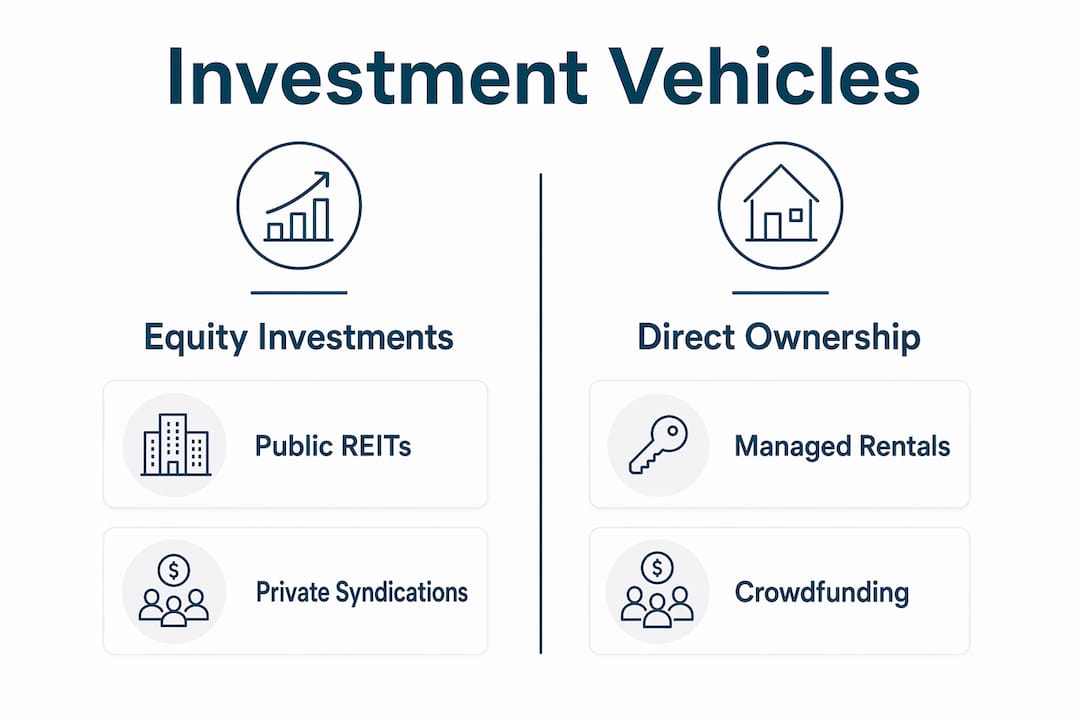
Managed rental properties
Owning a rental property and hiring a property manager delegates the daily work but keeps you as the legal owner. This structure offers the most control and the highest potential cash flow per dollar invested. The catch is that it is not fully passive. You still approve major repairs, review monthly financials, and monitor vacancy rates.
Real estate crowdfunding
Crowdfunding platforms let investors access private real estate deals with lower minimums than traditional syndications. Entry points vary widely by platform and deal type. This option suits investors who want private market exposure without the high minimums of institutional syndications.
Pro Tip: Start with public REITs if you are new to passive real estate investing. They offer instant diversification, daily liquidity, and no minimum beyond the share price. Build familiarity with real estate returns before committing capital to illiquid structures.
How does passive real estate income generate returns?
Passive real estate returns come from three distinct layers working together. Understanding each layer helps you evaluate any deal or fund accurately.
Cash flow is the monthly rental income left after paying the mortgage, taxes, insurance, and management fees. Positive cash flow means the property pays you every month. Negative cash flow means you are subsidizing the asset and betting on appreciation to compensate.
Appreciation is the increase in property value over time. It does not put cash in your pocket monthly, but it builds equity and drives total return. When you sell or refinance, appreciation converts to realized gains.
Depreciation is the most misunderstood benefit in real estate. The IRS allows investors to deduct the cost of a building's wear and tear over 27.5 years for residential properties. This creates a paper loss that shields rental income from taxes even when the property generates positive cash flow. A property earning $12,000 per year in net rent might show a tax loss after depreciation, meaning you owe nothing on that income.
Risks are real and worth naming directly. Market downturns reduce property values and rental demand. Poor management quality erodes cash flow. Private vehicles carry liquidity risk because you cannot exit on short notice. Fees in syndications and funds reduce net returns.
Pro Tip: When evaluating any passive real estate deal, ask for the net return after fees, not the gross return. Sponsor fees, asset management fees, and acquisition fees can reduce a stated 10% return to 6% or 7% in your pocket.
What tax rules affect passive real estate income?
The IRS classifies rental income as passive by default, and that classification carries specific consequences. Passive losses can only offset other passive income. They cannot reduce your salary, business income, or other active earnings. This rule, codified under IRS Section 469, is called the passive activity loss (PAL) rule.
There is one major exception. If you qualify as a real estate professional under IRS guidelines, you can use passive losses to offset active income. Qualifying requires spending more than 750 hours per year in real estate activities and more than half your working time in the field. Most passive investors do not meet this threshold.
IRS passive activity loss rules under Section 469 restrict passive losses to offset only other passive income unless specific qualifications are met. This limits the tax shelter value for investors with high W-2 income.
Tax reporting also differs by vehicle. Public REIT dividends arrive on a 1099-DIV form. Syndication income arrives on a K-1, which often comes late in tax season and may require filing extensions. Budget for that timing difference when planning your taxes.
Pro Tip: Work with a CPA who specializes in real estate before committing to any passive vehicle. The depreciation benefits are real, but the PAL rules can trap losses you cannot use for years.
How much involvement does passive real estate investing actually require?
"Passive" does not mean zero involvement. Every passive real estate structure requires some level of ongoing oversight from the investor.
With managed rental properties, hiring a property manager does not make the investment fully hands-off. You still review monthly financial reports, approve major repairs, and track vacancy rates. Neglecting these duties leads to eroded cash flow and deferred maintenance problems.
With syndications, your role is lighter but not absent. You need to review quarterly reports from the sponsor, compare actual performance against the original projections, and stay informed about the asset's market conditions. Sponsors who miss targets early rarely recover without investor pressure.
With public REITs, involvement is minimal. You monitor the fund's performance, dividend history, and portfolio composition the same way you would any stock holding. The liquidity means you can exit if performance deteriorates.
Liquidity is the clearest dividing line between passive vehicles. Public REITs offer daily liquidity because shares trade on exchanges. Non-traded REITs and private syndications often lock capital for five to ten years. That lock-up period is not a flaw. It is the structure that allows sponsors to execute long-term business plans. But you must plan your personal finances around it.
Pro Tip: Before committing to any private syndication, ask the sponsor for their track record on previous deals, including deals that underperformed. A sponsor who cannot share that history is a red flag.
How do you start earning passive income through real estate?
Starting with passive real estate investing requires honest self-assessment before selecting any vehicle.
- Assess your financial position. Pay down high-interest debt before allocating capital to illiquid investments. High leverage combined with locked capital creates serious financial risk if your income changes.
- Define your liquidity needs. If you may need the capital within three years, public REITs are your only realistic passive real estate option. Private vehicles require a five to ten year commitment.
- Start with low-entry options. Public REITs and crowdfunding platforms let you learn how real estate returns work before committing large sums to private deals.
- Research sponsors and funds thoroughly. Check track records, fee structures, and past investor communications. A sponsor's behavior during a previous downturn tells you more than their pitch deck.
- Understand fees and legal structures. Syndication agreements include preferred returns, waterfall structures, and promote fees. Read the private placement memorandum before signing anything.
- Build reserves. Keep three to six months of personal expenses liquid regardless of how passive your investments are. Real estate returns are not guaranteed, and distributions can be suspended during downturns.
Key Takeaways
Passive real estate income delivers the strongest results when investors choose the right vehicle for their liquidity needs, understand the tax rules, and maintain consistent oversight of their investments.
| Point | Details |
|---|---|
| Returns range 7%–12% annually | Average annualized returns depend on the vehicle, from REITs to syndications. |
| REITs distribute 90% of taxable income | This legal requirement makes public REITs one of the most reliable income vehicles. |
| Depreciation shields rental income | Paper losses from depreciation reduce taxable income even when cash flow is positive. |
| PAL rules limit loss offsets | IRS Section 469 restricts passive losses to offset only other passive income. |
| Liquidity varies widely | Public REITs trade daily; private syndications lock capital for five to ten years. |
What I have learned after years of watching passive real estate investors succeed and fail
The biggest mistake I see new passive investors make is treating "passive" as a synonym for "effortless." The word describes your operational role, not your mental engagement. The investors who build real wealth through passive real estate are the ones who read every quarterly report, ask hard questions of their sponsors, and exit deals that underperform rather than hoping things improve.
The tax benefits are genuinely powerful. Depreciation is one of the few legal tools that lets you earn income and pay little or no tax on it. But the IRS passive activity loss rules catch most investors off guard. If you have a high salary and no other passive income, your paper losses may sit unused for years. That does not make the strategy wrong. It means you need a tax plan before you invest, not after.
I am also cautious about any pitch that leads with guaranteed returns or unusually high yields. Real estate returns are driven by rent growth, occupancy, and interest rates. None of those are guaranteed. The sponsors who promise 15% or 20% returns with no downside scenario are either taking on extreme leverage or not being honest with you.
The investors I respect most in this space treat passive real estate like a business they own but do not operate. They stay informed, they diversify across vehicles, and they never put capital into a deal they do not understand. That discipline is what separates the investors who build lasting income from those who learn expensive lessons.
— Myra
How Beamsrealtygroup supports your passive real estate goals
Real estate investing works best with guidance from people who know the local market and the investment structures available to you.

Beamsrealtygroup brings deep market knowledge and personalized service to investors in Virginia who want to build passive income through real estate. Whether you are evaluating your first rental property or looking for guidance on investment structures that fit your financial goals, the Beamsrealtygroup team provides clarity at every step. Their track record of successful transactions and direct communication style means you get honest answers, not sales pitches. Visit Beamsrealtygroup to connect with a team that treats your investment goals as seriously as you do.
FAQ
What is passive income in real estate?
Passive income in real estate is earnings generated from property investments with minimal day-to-day involvement. Common vehicles include public REITs, private syndications, and professionally managed rental properties.
How much can you earn from passive real estate investing?
Average annualized returns typically range between 7% and 12% depending on the vehicle and market conditions. Returns come from rental cash flow, property appreciation, and tax benefits like depreciation.
Are passive real estate losses tax deductible?
Passive losses can only offset other passive income under IRS Section 469. They cannot reduce salary or active business income unless you qualify as a real estate professional under IRS guidelines.
How liquid are passive real estate investments?
Public REITs offer daily liquidity because shares trade on stock exchanges. Private syndications and non-traded REITs typically lock capital for five to ten years.
Do you need a lot of money to start passive real estate investing?
Public REITs require as little as $5 to start. Private syndications typically require minimum investments between $25,000 and $100,000, making them better suited for investors with established capital reserves.