
A real estate purchase agreement is the legally binding contract that locks in the terms, obligations, and contingencies between a buyer and a seller for a property transaction. You'll also hear it called a Purchase and Sale Agreement (PSA), a sales contract, or an offer to purchase. Whatever the name, it serves one purpose: to spell out exactly what each party is agreeing to before the deal closes. The agreement covers the purchase price, financing details, contingencies, earnest money, closing date, and what stays with the house. Both parties must sign it for it to be legally enforceable, and vague or missing terms can void the contract entirely.
Core elements you'll find in a standard purchase agreement:
- Legal names of all buyers and sellers
- Full property description, including the legal description on file with the county
- Purchase price and payment method
- Earnest money amount, holder, and refund conditions
- Financing type and loan details
- Contingencies and their deadlines
- Closing date and possession date
- Inclusions and exclusions (appliances, fixtures, personal property)
- Default and termination provisions
Table of Contents
- What are the key components of a real estate purchase agreement?
- How do contingencies protect you in a purchase agreement?
- What is earnest money and how does it work?
- Who prepares the purchase agreement, and what about closing costs?
- What happens after you sign the purchase agreement?
- What roles do real estate agents and attorneys play in the agreement?
- Expert tips for navigating your purchase agreement with confidence
- Ready to navigate your next transaction with confidence?
- Key Takeaways
What are the key components of a real estate purchase agreement?
Every purchase agreement, regardless of state, is built around the same core sections. Getting these right protects both parties. Getting them wrong delays closings or, in the worst cases, unravels the deal.

Identification of parties and property. The contract must name every buyer and every seller using their full legal names, exactly as they appear on a government-issued ID. It also needs the property's legal description, not just the street address. A legal description is recorded in the county recorder's office and is the only description that definitively identifies the parcel. Errors here — a misspelled name, a missing co-owner, or a vague address with no legal description — can delay or invalidate the closing.
Purchase price and payment terms. This section states the total agreed price and how the buyer plans to pay: cash, conventional loan, FHA, VA, or another financing type. It also specifies the down payment amount and the loan amount. The financing type must match the buyer's pre-approval letter. If those details conflict, the contract can fall apart at the lender stage.
Earnest money. The contract spells out the deposit amount, when it's due, who holds it, and the exact conditions under which it gets refunded or forfeited. Leaving this language vague is one of the most common and costly mistakes in residential contracts.
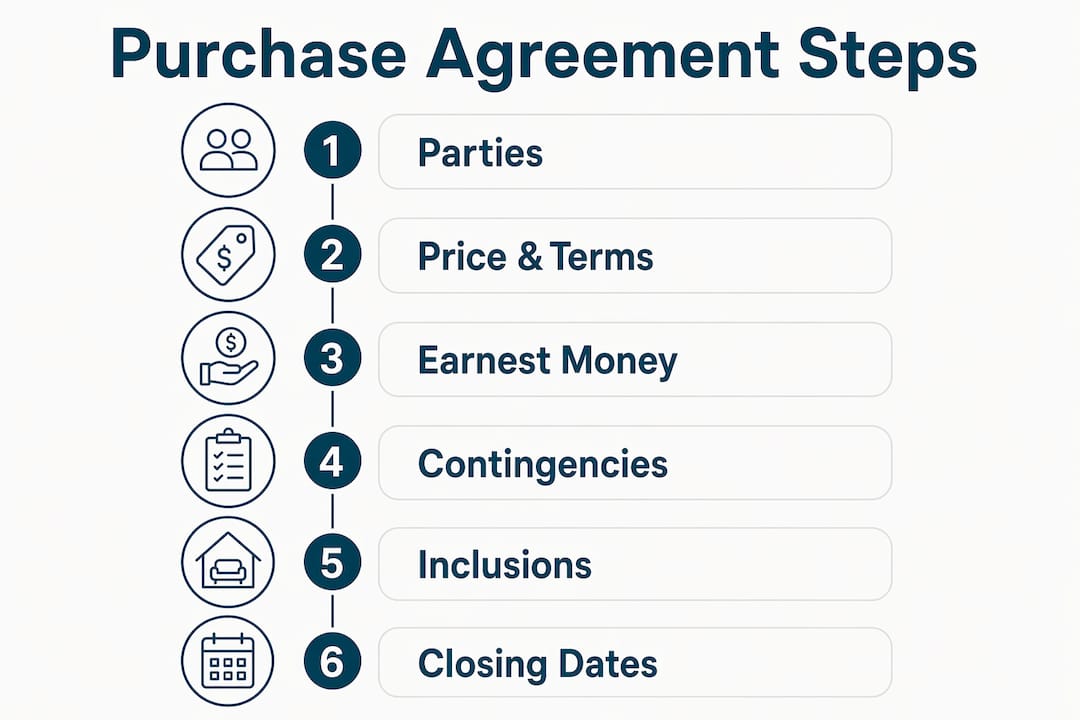
Contingencies. These are the protective clauses that allow either party to exit the contract without penalty if specific conditions aren't met. They get their own full section below because they're that consequential.

Inclusions and exclusions. "All appliances" is not specific enough. A well-drafted agreement lists items by make and model when there's any chance of dispute. If the seller plans to take a mounted TV bracket or a custom light fixture, that exclusion needs to be in writing.
Closing and possession dates. These are often the same day, but not always. When the seller needs extra time after closing, a post-closing occupancy agreement (sometimes called a rent-back) governs that arrangement. The contract should state the exact date and time of possession transfer.
| Component | What it covers | Why it matters |
|---|---|---|
| Party identification | Full legal names of all buyers and sellers | Errors can delay or void the closing |
| Property description | Legal description plus street address | Definitively identifies the parcel |
| Purchase price | Total price, down payment, loan amount | Sets the financial foundation of the deal |
| Earnest money | Amount, holder, refund conditions | Defines financial risk if the deal falls through |
| Contingencies | Inspection, financing, appraisal, home sale | Protects parties if conditions aren't met |
| Inclusions/exclusions | Specific items staying or leaving | Prevents disputes at walkthrough |
| Closing/possession dates | When title transfers and buyer takes possession | Avoids holdover disputes |
How do contingencies protect you in a purchase agreement?
Contingencies are escape clauses that allow a buyer (and sometimes a seller) to exit the contract without penalty if certain conditions aren't satisfied. They're not optional fine print. They're the mechanism that determines whether your earnest money comes back if something goes wrong.
The four most common contingencies in U.S. residential transactions:
- Inspection contingency: Gives the buyer a set number of days, typically 7–14, to have the property professionally inspected. If the inspection turns up problems the buyer can't accept, they can request repairs, ask for a credit, or walk away with their deposit intact.
- Financing contingency: Protects the buyer if the mortgage isn't approved within a specified timeframe. Without this clause, a buyer whose loan falls through could lose their earnest money. The contract should name the loan type, the maximum interest rate, and the approval deadline.
- Appraisal contingency: Kicks in if the property appraises below the purchase price. The buyer can renegotiate, cover the gap in cash, or exit. This contingency is separate from the financing contingency — a lender can approve a loan even on a low appraisal if the buyer makes up the difference.
- Home sale contingency: Makes the purchase conditional on the buyer selling their current home first. Sellers in competitive markets often reject this one, or counter with a kick-out clause that lets them accept a better offer if one comes along.
Every contingency comes with a deadline. Miss that deadline and the contingency is typically considered waived, meaning you've given up your right to exit under that clause. First-time buyers frequently don't realize this until it's too late.
Pro Tip: If you're buying in a competitive market and considering waiving contingencies to strengthen your offer, talk to a real estate attorney first. Waiving a financing or inspection contingency without fully understanding the risk can cost you your deposit or more.
What is earnest money and how does it work?
Earnest money is a good faith deposit the buyer submits shortly after the seller accepts the offer. It signals that the buyer is serious, and it gives the seller some financial assurance while the property is off the market. Earnest money deposits in 2026 typically range from 1% to 3% of the purchase price, and are agreed upon by the buyer and seller depending on the market conditions and agreement.
Key facts about how earnest money works:
- The deposit is usually due shortly after contract acceptance, within a timeframe specified in the agreement.
- A neutral third party holds the funds: typically the listing brokerage, a title company, or an escrow agent
- The contract must specify the exact conditions under which the buyer gets the money back
- If the buyer exits through a valid contingency, the deposit is refunded
- If the buyer backs out without a valid contingency, the seller usually keeps the deposit as liquidated damages
Earnest money shows buyer intent and is held by a neutral third party until closing or termination. The critical detail is always the refund language. Vague contracts that don't specify conditions for forfeiture or return create disputes that can end up in mediation or court.
Earnest money is not legally required in every state, but skipping it or offering a token amount in a seller's market sends a signal that buyers rarely intend. Sellers notice.
Who prepares the purchase agreement, and what about closing costs?
Real estate agents typically prepare purchase agreements using standard forms provided by state or local broker associations. These forms are designed to cover the most common transaction scenarios, but agents are not licensed to practice law. They can fill in the blanks; they can't give legal advice on complex or unusual terms.
When you need an attorney involved:
- The property has non-standard ownership (trust, LLC, estate sale)
- The terms deviate significantly from the standard form
- You're negotiating unusual contingencies or seller concessions
- The transaction involves commercial elements or mixed-use property
Closing costs are a separate but related piece of the financial picture. They include lender fees, title insurance, appraisal fees, transfer taxes, and escrow services, and the purchase agreement specifies who pays what. Buyers and sellers can negotiate the allocation of these costs, and in some markets, sellers routinely offer concessions to cover a portion of the buyer's closing costs. Understanding these costs early prevents surprises at the closing table.
Pro Tip: Ask your agent for a net sheet or closing cost estimate as soon as you're under contract. Waiting until a few days before closing to review these numbers is one of the most stressful mistakes first-time buyers make.
What happens after you sign the purchase agreement?
Signing the purchase agreement is the beginning of your contractual obligations, not the end of the process. The Colorado Division of Real Estate describes it plainly: all dates and deadlines in the contract are strict and absolute. Missing one can trigger penalties, forfeiture, or breach.
Here's what typically follows signing:
- Earnest money deposit is submitted within the timeframe stated in the contract, usually 1–3 business days.
- Inspections are scheduled and completed within the inspection contingency window.
- Loan application moves forward; the lender orders the appraisal.
- Title search is conducted to confirm the seller has clear, marketable title.
- Contingencies are resolved — either satisfied, waived, or used to exit the contract.
- Final walkthrough happens shortly before closing to confirm the property's condition matches what was agreed.
- Closing disclosure is reviewed; buyers typically receive this at least three business days before closing.
- Closing day: funds are transferred, documents are signed, and title passes to the buyer.
First-time buyers often treat the purchase agreement as a formality and the closing as the "real" event. The agreement is the controlling document. Closing simply executes its terms.
What roles do real estate agents and attorneys play in the agreement?
Real estate agents and attorneys serve different functions in the purchase agreement process, and understanding the distinction helps you know when you need which one.
Real estate agents guide you through the transaction, prepare the standard contract forms, negotiate on your behalf, and manage deadlines and communications between parties. A good agent catches problems before they become contract issues. What they can't do is interpret complex legal language, advise you on legal risk, or draft custom contract provisions.
Real estate attorneys review or draft the contract, advise on legal implications, handle title issues, and represent your interests if a dispute arises. In some states, attorney involvement at closing is required by law. In others, it's optional but often worth the cost, particularly for buyers navigating mortgage contingency terms or unusual property situations.
The practical split: your agent handles the transaction; your attorney protects your legal position. For a straightforward purchase of a standard residential property, an experienced agent and a title company can often handle the process without attorney involvement. For anything outside the norm, get an attorney.
Expert tips for navigating your purchase agreement with confidence
The single biggest misconception buyers and sellers carry into a transaction is that the standard form is fixed. Every clause is negotiable. Assuming otherwise means leaving protections on the table.
A few things professionals wish every client understood:
- The contract is a roadmap, not a formality. Once both parties sign, every date and dollar amount carries legal weight. Treat deadlines like court dates.
- Vague language is your enemy. Specific, unambiguous terms protect both sides. If a clause is unclear, ask for it to be rewritten before you sign, not after.
- Contingency deadlines are real. Missing an inspection or financing deadline can waive your right to exit, even if the underlying problem is legitimate.
- Read the default provisions. These clauses explain what happens if either party fails to perform. Knowing your remedies before something goes wrong puts you in a stronger position.
- Don't confuse the offer with the agreement. An accepted offer becomes the purchase agreement. That's when the clock starts on every deadline.
- Get everything in writing. Verbal agreements between agents don't modify the contract. Any change requires a signed amendment from all parties.
- Know when to call an attorney. Complex ownership, unusual financing terms, or a contentious inspection negotiation are all situations where an hour of legal review can save thousands.
The purchase agreement is the most consequential document in a real estate transaction. Reading it carefully, asking questions, and working with experienced professionals aren't optional steps. They're how you protect yourself.
Ready to navigate your next transaction with confidence?

Whether you're buying your first home or selling a property you've held for years, having the right team behind you changes everything. Beamsrealtygroup brings deep market knowledge and clear, direct guidance to every transaction, so you understand exactly what you're signing and why. Connect with the Beamsrealtygroup team today and get the personalized support your transaction deserves.
Key Takeaways
A real estate purchase agreement is a legally binding contract that controls every deadline, dollar, and obligation from the moment both parties sign until the closing table.
| Point | Details |
|---|---|
| Earnest money range | Deposits typically run 1%–3% of the purchase price in 2026, held by a neutral third party. |
| Contingencies protect you | Inspection, financing, appraisal, and home sale contingencies let you exit without penalty if conditions aren't met. |
| Every clause is negotiable | Standard forms are starting points, not fixed law; buyers and sellers can modify any term before signing. |
| Deadlines are absolute | Missing a contingency or closing deadline can trigger forfeiture, penalties, or breach of contract. |
| Agents draft, attorneys advise | Agents prepare standard forms; attorneys handle complex terms, legal risk, and disputes. |