
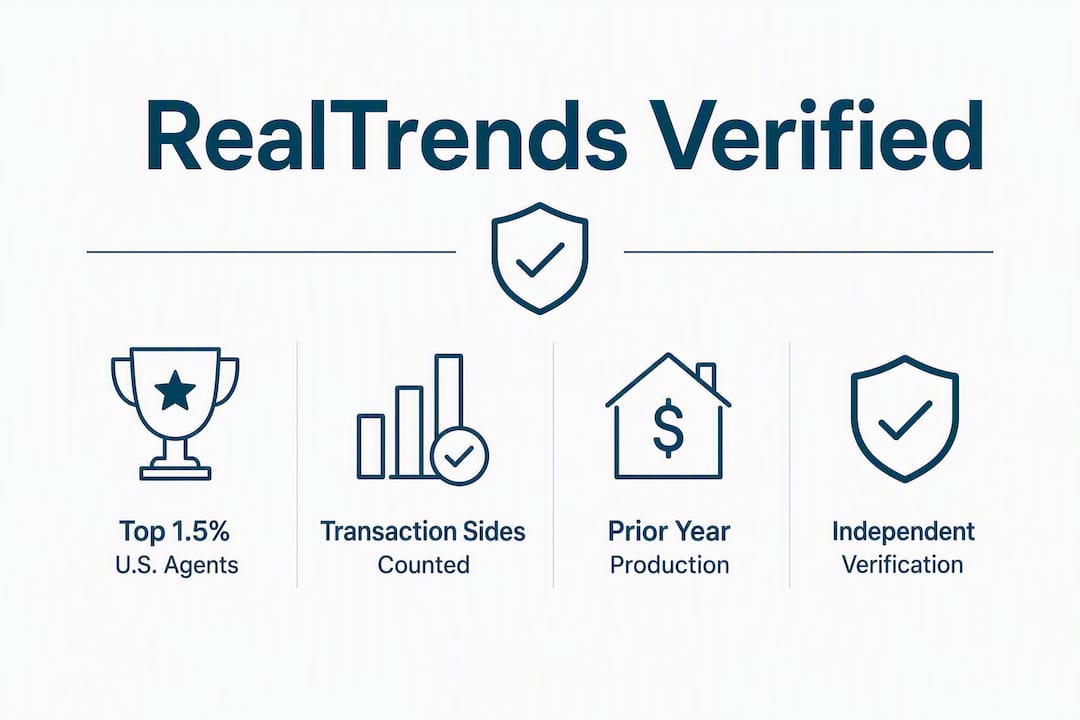
RealTrends Verified is a legitimate, third-party, production-based ranking program that independently validates the closed transaction output of the top agents, teams, and brokerages in the United States. It is not a review platform, a satisfaction survey, or a self-reported list. The badge means one thing: verified production numbers, checked by a third party before publication.
The short version:
- Ranks the top 1.5% of U.S. real estate professionals by verified closed production
- Metrics used: transaction sides and sales volume from the prior calendar year
- Useful for: brokerage benchmarking, recruiting conversations, and consumer trust signals
- Does NOT measure: service quality, client satisfaction, or niche expertise
Table of Contents
- What does RealTrends Verified actually measure?
- Why Verified status matters for agents, teams, and brokerages
- How should consumers use RealTrends Verified rankings?
- How to verify a RealTrends Verified claim and where to find the data
- How much does an agent make on a $300,000 sale?
- How is the #1 agent determined, and where do you find them?
- Key Takeaways
- The benchmark is a starting point, not the whole story
- Verified-level service in Virginia, without the guesswork
- Useful sources for rankings, data, and market context
What does RealTrends Verified actually measure?
The program ranks professionals on two core production metrics: transaction sides (each side of a closed deal counts as one) and sales volume (total dollar value of closed transactions). Gross commission income is sometimes referenced for context, but sides and volume drive the rankings.
Rankings reflect the prior calendar year's closed production, not current pipeline or pending deals. An agent ranked in 2026 earned that position based on what they closed in 2025. That retrospective structure is a deliberate design choice: it forces documentation of completed work rather than projected activity.
Eligibility thresholds vary by category. For top brokerage recognition, example floors include 500 transaction sides or $350 million in sales volume. Individual agent and team thresholds are lower but still require verifiable documentation submitted directly to RealTrends.
The verification process itself involves:
- Submitting production documentation (MLS records, brokerage reports, or audited figures)
- Third-party review of submitted data before any listing is published
- Publication only after vetting clears
That independent vetting step is what separates RealTrends Verified from self-reported "top producer" claims that proliferate on agent websites. Industry analysts describe the program as a gold standard for production metrics precisely because the process reduces the risk of inflated numbers.
Pro Tip: When reviewing a Verified listing, note the production year stated on the RealTrends page. A badge earned on 2023 production is now three years old. Always confirm the year before citing it in marketing materials.
Why Verified status matters for agents, teams, and brokerages
For professionals, the badge does several things that a self-written bio cannot.

Marketing and credibility. Third-party validation carries weight with clients who have learned to be skeptical of agent self-promotion. Citing a RealTrends Verified ranking in a listing presentation or recruiting pitch gives the claim a source that prospects can check independently.
Benchmarking. Multi-year historical production datasets let brokerages track their own trajectory against national peers. A brokerage that ranked 400th three years ago and now ranks 180th has a concrete, defensible story to tell investors and referral partners.
Recruiting. Verified status signals scale and proven production capacity, which matters when recruiting experienced agents who want to join a team with demonstrated market presence. It also helps in conversations with lenders and institutional partners who want data-backed evidence of transaction volume before committing to co-marketing agreements.
Where it falls short. Small teams and niche specialists — probate, 1031 exchanges, estate sales, pre-foreclosures — often serve markets where transaction count is structurally limited. A probate specialist closing 30 complex transactions a year may deliver more value to a specific client than a high-volume generalist closing 200. Volume rankings do not capture that distinction.
- Verified rankings are production-only; they carry no service-quality signal
- Niche expertise (probate, divorce sales, 1031 exchanges) is invisible in the data
- A team in a high-price market will rank higher on volume than an equally skilled team in a mid-price market, purely due to price levels
Pro Tip: When using a Verified ranking in advertising or your bio, always include the specific year and the metric (e.g., "Ranked top 1.5% by transaction sides, 2024 production year, RealTrends Verified"). Omitting the year or metric invites scrutiny and may run afoul of advertising standards.
How should consumers use RealTrends Verified rankings?
A high ranking reliably signals one thing: the agent or brokerage closed a large number of transactions. That translates to experience with contracts, negotiations, lender timelines, and the procedural side of deals. For a consumer buying or selling a standard residential property in an active market, that experience has real value.

What it does not signal: how that agent treats clients, whether they specialize in your neighborhood, or whether they have handled a transaction type like yours before. Volume rankings carry no service-quality, client-satisfaction, or niche-expertise measures. A Verified agent who closed 300 transactions last year may have done none of them in your zip code.
Questions to ask a Verified agent before hiring:
- How many transactions did you close in my specific neighborhood or price range last year?
- Can you share references from clients with a similar transaction type (first-time buyer, estate sale, investment property)?
- What is your current active client load, and who handles day-to-day communication?
- What is your average sales-to-list ratio and days on market for listings in my area?
Combine RealTrends data with local market metrics from sources like Realtor.com research — sales-to-list ratio, median days on market, price-cut frequency — to build a fuller picture. A Verified agent with strong local metrics is a much more defensible choice than one whose volume came entirely from a different market segment.
Pro Tip: Ask the agent for their most recent three closed transactions in your area. If those transactions are more than 12 months old, the Verified badge may not reflect current local activity.
How to verify a RealTrends Verified claim and where to find the data
Anyone can claim to be "RealTrends Verified." Here is how to confirm it independently.
- Go to RealTrends.com and use the rankings search to find the agent, team, or brokerage by name.
- Confirm the production year listed. The ranking page will show which calendar year the production data covers.
- Note the specific metric (sides or volume) and the category (individual agent, team, or brokerage).
- If you need deeper confirmation, ask the agent for their specific RealTrends listing URL and the documentation they submitted during verification.
- For brokerage-level verification, cross-reference the official brokerage rankings page.
Where to access the data:
- RealTrends data downloads page offers downloadable datasets with columns for agent/team name, sides, volume, company, and location across multiple years
- The 2026 Best Real Estate Agents rankings are searchable by state
One important restriction: RealTrends datasets are licensed for personal, non-commercial use. Commercial reuse — publishing the data in a competing product, incorporating it into a paid analytics platform, or redistributing it — requires a separate agreement with RealTrends. Citing a ranking in your own marketing materials is generally considered personal use, but check directly with RealTrends if your use case is ambiguous.
How much does an agent make on a $300,000 sale?
The direct answer: on a $300,000 sale, a typical agent nets somewhere between $2,625 and $6,750 after the brokerage split, depending on the commission rate and split structure. Here is the math across three common scenarios.
| Scenario | Commission Rate | Agent's Side | Brokerage Split | Net to Agent |
|---|---|---|---|---|
| Conservative | Commission percentages vary widely | — | — | $2,625 |
| Typical | 3% total (1.5% per side) | — | — | — |
| Higher-earning | 3% total (1.5% per side) | — | 100% (flat fee model) | — |
Variables that shift the number significantly:
- Listing agent vs. buyer's agent (listing agents sometimes negotiate a higher share)
- Referral fees (a 25% referral fee off the top cuts net income by roughly $900 on the typical scenario above)
- Transaction fees, E&O insurance, and marketing costs charged by the brokerage
- Negotiated commission rates, which have become more variable following recent industry changes
This is an illustrative example. Local market norms, brokerage models, and negotiated terms cause wide variance. Never use this table as a projection for a specific transaction.
How is the #1 agent determined, and where do you find them?
The #1 ranking is straightforward: it goes to the professional with the highest figure in the ranked metric (sides or volume) for the specified production year. There is no subjective scoring, no panel vote, and no weighting for market conditions.
- To find the current leader, visit the RealTrends data downloads page and sort the relevant dataset by the metric column
- The rankings are released annually; the 2026 list reflects 2025 closed production
- Leaders change year to year as market conditions, team size, and geographic focus shift
Being #1 by volume in a high-price coastal market is a different achievement than being #1 by sides in a mid-price Midwest market. Both are legitimate rankings; neither is universally "better." For a consumer, the more relevant question is whether the top-ranked agent operates in your market and handles your transaction type.
Pro Tip: If an agent claims to be "#1 in the country," ask them to show you the specific RealTrends dataset, the production year, and the metric. A #1 claim without those three details is unverifiable.
Key Takeaways
RealTrends Verified is a legitimate, third-party production ranking that covers the top ~1.5% of U.S. real estate professionals, based on verified prior-year closed transaction data.
| Point | Details |
|---|---|
| Legitimate and third-party | RealTrends requires documentation and independent vetting before publishing any ranking. |
| Top 1.5% scope | The program spotlights only the highest-producing agents, teams, and brokerages nationwide. |
| Prior-year production only | Rankings reflect closed deals from the previous calendar year, not current activity. |
| Volume does not equal fit | Supplement Verified data with local metrics, references, and direct interviews for niche needs. |
| Beamsrealtygroup in Virginia | Beamsrealtygroup pairs production-level expertise with local market knowledge and specialized transaction experience across Virginia. |
The benchmark is a starting point, not the whole story
Production rankings like RealTrends Verified serve a real purpose. They cut through the noise of self-promotion and give buyers, sellers, and recruiting managers a verified baseline. That is genuinely useful.
Where I think the industry sometimes gets it wrong is treating the badge as a proxy for quality. A brokerage that closes 2,000 transactions a year is not automatically better for a client navigating a probate sale in a specific Virginia county than a smaller firm with deep local roots and specialized experience. The Verified ranking tells you what happened last year at scale. It does not tell you who will pick up the phone on a Saturday when the deal gets complicated.
At Beamsrealtygroup, production benchmarks inform how we approach recruiting, pricing strategy, and client onboarding. We use the data to understand where we stand relative to the market and to have honest conversations with clients about what the numbers mean. But the work that actually matters to a client — understanding local absorption rates, knowing which contingencies to push back on, managing a 1031 exchange timeline — does not show up in a sides column.
The most useful thing a consumer can do with a Verified ranking is treat it as a floor, not a ceiling. It confirms the agent has done the volume. Your job is to find out whether they have done your kind of deal.
Verified-level service in Virginia, without the guesswork
Beamsrealtygroup brings production-caliber expertise to buyers, sellers, and investors across Virginia, with the kind of personalized attention that high-volume rankings cannot measure.
Whether you are buying your first home, selling an estate property, or structuring a 1031 exchange, the team at Beamsrealtygroup combines local market analysis with hands-on negotiation and specialized transaction experience. No hand-off to a junior agent mid-deal. No generic advice that ignores your specific situation.
- Local market analysis and accurate home valuations grounded in current Virginia data
- Negotiation support and transaction management for standard and complex deals (probate, divorce sales, pre-foreclosures, 1031 exchanges)
- Clear communication at every stage, from first showing to closing table
Contact Beamsrealtygroup to schedule a consultation or request a home valuation.
Useful sources for rankings, data, and market context
- RealTrends Verified — official rankings and program overview
- RealTrends data downloads — agent, team, and brokerage datasets
- 2026 Best Real Estate Agents in the United States — searchable by state
- 2026 Top Performing Real Estate Brokerages — brokerage rankings and thresholds
- NAR Housing Statistics — national and regional production context
A note on dataset reuse: RealTrends distributes its downloadable data for personal, non-commercial use. If you plan to incorporate the data into a commercial product or publication, contact RealTrends directly to discuss licensing terms before publishing.