
Relocation real estate transactions are employer- or Relocation Management Company (RMC)-driven moves that compress the typical home-sale and home-buying steps into firm timelines, pre-approved vendor workflows, and non-negotiable reporting requirements. If your employer is moving you, the process looks nothing like a standard sale. Here is what you need to know before you sign anything.
The three things to do right now:
- Confirm your relocation benefits in writing. Employer relocation budgets vary widely depending on program components, so knowing exactly what is covered changes every financial decision that follows.
- Get fully pre-approved for financing with a lender licensed in your destination state. Your lender must be licensed where the property sits, not where you currently live.
- Plan for a remote closing. RON is legal in more than 45 states plus DC, meaning you may never need to fly back to sign closing documents.
The key players in any relocation transaction: your employer, the RMC (companies like Cartus, SIRVA, Aires, and Graebel manage the majority of corporate moves in the U.S.), a listing agent approved by the RMC, your buyer's agent, a preferred title or closing provider, and your lender.
Table of Contents
- What does a relocation management company actually do?
- How the relocation sale timeline actually unfolds
- How a relocation sale differs from a standard transaction
- Paperwork, fees, and who pays what
- How to prepare and protect yourself before the move
- Why you need an agent with actual relocation experience
- Key Takeaways
- The part most relocation guides get wrong
- Beamsrealtygroup helps relocating families move with confidence
- Useful sources for further reading
What does a relocation management company actually do?
An RMC is a third-party firm your employer contracts to manage the logistics of moving employees. The RMC does not just arrange moving trucks. It controls the entire home-sale process: it sets pricing guidelines, approves the listing agent, manages offer review, holds escrow funds, and enforces closing timelines tied to your employer's departure date.
Primary players and what each one controls:
- Employer: Sets the relocation policy, funds the program, and defines which benefits you receive (home sale assistance, temporary housing, moving allowance).
- RMC (Cartus, SIRVA, Aires, Graebel): Manages day-to-day execution. The RMC approves vendors, reviews offers, and signs off on closing documents. Their performance standards and reporting formats are non-negotiable.
- Relocation specialist: Your assigned contact inside the RMC. This person is your primary point of contact for paperwork, deadlines, and benefit questions.
- Listing agent (RMC-approved): Must be on the RMC's approved vendor list. They follow RMC pricing and marketing protocols, not just local MLS norms.
- Buyer's agent: Represents you as the purchasing party. In a relocation sale, the buyer's agent must be prepared to work within the RMC's addenda and timeline.
- Preferred title/closing provider: RMCs often designate specific title companies or closing attorneys to ensure consistent reporting and documentation.
- Lender: Must be licensed in the destination state and capable of meeting the RMC's closing timeline.
Managed vs. company-owned sales. In a managed relocation sale, the employee still owns the home but the RMC coordinates the process. In a company-owned sale (often called a Guaranteed Buyout or GBO), the employer or RMC purchases the home from the employee at an appraised value, then resells it on the open market. For buyers, a company-owned listing means the seller is a corporation, not an individual, which changes disclosure obligations and negotiation dynamics significantly.
How the relocation sale timeline actually unfolds

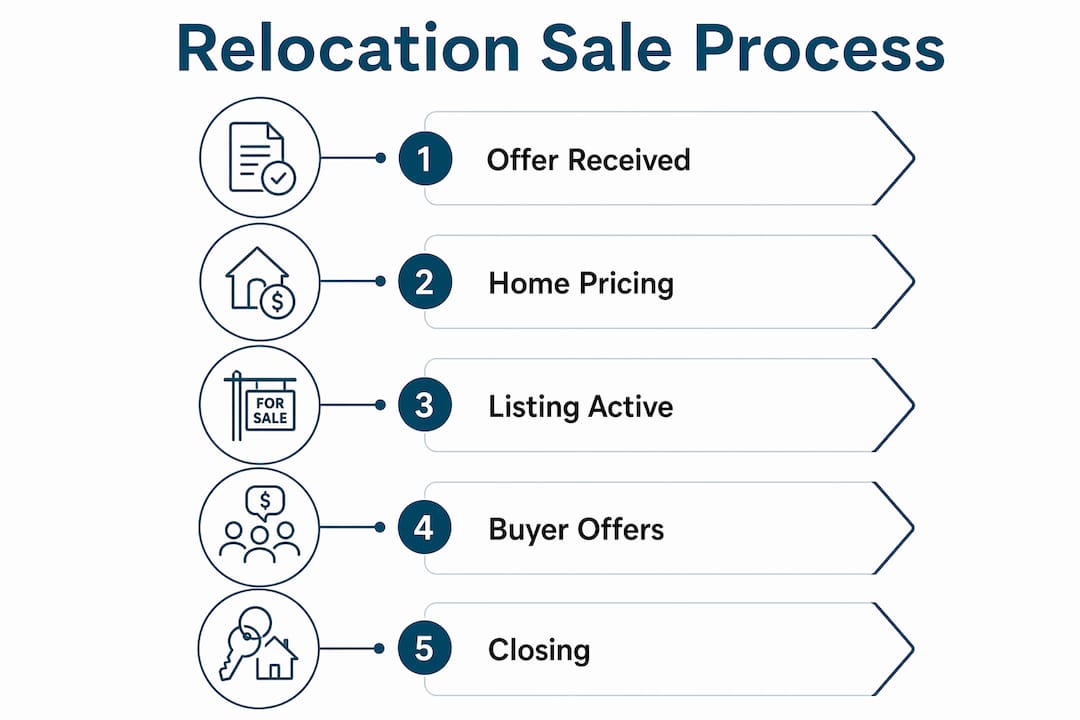
Relocation timelines prioritize employer departure dates and RMC reporting requirements, making rapid pricing and speedy marketing non-negotiable. Below is a realistic map of both sides.
Seller-side milestones
| Stage | What happens | Typical duration |
|---|---|---|
| Employer notification | Employee receives transfer offer; RMC intake begins | Days 1–7 |
| RMC intake and benefit confirmation | Benefits verified, relocation specialist assigned, GBO/BVO/AVO options presented | Week 1–2 |
| Pricing and pre-listing | RMC orders Comparative Market Analysis (CMA); listing agent approved and engaged | Week 2–3 |
| Active marketing | Home listed on MLS; open market period begins | Week 3–6 |
| Offer review and GBO decision | Offers reviewed by RMC; seller chooses open-market offer or triggers GBO | Week 4 |
| Inspection and due diligence | Buyer inspection; limited repair negotiations | 3–5 days |
| Closing | Title work, RMC sign-off, funds disbursed | Week 8 |
Buyer-side milestones
| Stage | What happens | Typical duration |
|---|---|---|
| Pre-approval | Lender licensed in destination state; budget confirmed | Week 1–2 |
| Search (virtual + in-person) | Virtual tours via Matterport or agent video; at least one in-person visit recommended | Week 2–6 |
| Offer submission | Offer drafted with RMC addenda; earnest money wired to escrow | Week 4 |
| Inspection | Local inspector hired; agent present if buyer is remote | 3–5 days post-offer |
| Mortgage underwriting and appraisal | Lender orders appraisal; appraisal gaps can delay closing if value differs from contract price | Week 6 |
| Closing | RON or in-person; Power of Attorney (POA) as fallback | Week 8 |
Decision deadlines transferees commonly miss:
- The GBO election window. If you do not trigger the Guaranteed Buyout within the RMC's specified open-market period, you may lose the option entirely.
- The inspection response deadline. RMCs often allow only 3–5 days for repair request responses, far shorter than the 7–14 days typical in standard transactions.
- The mortgage contingency deadline. With compressed timelines, appraisal delays can blow past contingency windows if the lender is not actively managed.
How a relocation sale differs from a standard transaction

The differences are not cosmetic. They affect your negotiating power, your due diligence window, and who you can even hire.
Speed. A standard home sale might take 30–90 days from listing to close. A relocation sale is built around the employer's departure date, which means the RMC will push for the fastest defensible timeline at every stage.
"As is" sales. Relocation firms prioritize a fast, uncomplicated sale and typically prefer limited repair negotiations so closings run on the RMC's schedule. Buyers should expect to receive an inspection report but face resistance on repair credits or price reductions.
Disclosure differences. When the RMC or employer owns the property, standard seller disclosure forms may be replaced by corporate disclosure addenda. These often contain less detail about the property's history because the corporate seller has no personal knowledge of it.
Vendor and attorney lists. The RMC controls which title companies, closing attorneys, and sometimes lenders are on the approved list. Buyers cannot always choose their own closing provider.
Pros and cons at a glance:
| Buyers | Sellers (transferees) | |
|---|---|---|
| Pros | Clear process, defined timelines, motivated seller | Guaranteed Buyout eliminates market-timing risk; employer covers many costs |
| Cons | Limited repair negotiation; preset vendor lists; compressed due diligence | May sell below market value via GBO; limited control over marketing decisions |
Pro Tip: Buyers can often negotiate closing cost credits, appliance inclusions, or a specific closing date without threatening the deal. These concessions do not require repair work, so the RMC is more likely to approve them. Ask your agent to frame any request around speed and certainty, not price reduction.
Paperwork, fees, and who pays what
Relocation transactions carry a distinct document stack. Knowing what to expect prevents last-minute surprises at the closing table.
Key documents unique to relocation sales:
- Relocation addendum: Supersedes or modifies the standard purchase agreement. It typically includes "as is" language, RMC approval requirements for any counter-offer, and specific closing date requirements.
- Vendor authorization forms: Authorize the RMC to communicate directly with the listing agent, title company, and lender on the seller's behalf.
- Limited seller disclosure: Corporate sellers often use a modified disclosure form that acknowledges no personal knowledge of the property's condition.
- GBO/AVO documentation: If a Guaranteed Buyout or Amended Value Option is triggered, the RMC documents the open-market pricing effort and the appraised value used for the buyout.
Who typically pays which fees:
| Fee | Who pays |
|---|---|
| Listing agent commission | Employer/RMC (in most managed programs) |
| Buyer's agent commission | Negotiated; often paid by seller/RMC per program terms |
| Closing costs (seller side) | Employer/RMC covers most in full-service programs |
| Closing costs (buyer side) | Buyer, unless employer benefit covers a portion |
| Title and escrow fees | Varies; preferred provider may bundle fees |
| Relocation program administration fee | Employer absorbs; not typically passed to employee |
Remote closings. RON is legal in many states plus DC, enabling fully remote real estate closings via secure video notarization. If your state or your lender does not support RON, a limited Power of Attorney allows a trusted party to sign on your behalf. Confirm RON availability with your title company and lender early, not the week before closing.
Mortgage context. With the median existing-home price at $408,800 and 30-year fixed mortgage rates around 6.18%, buyers need a firm pre-approval before entering a relocation transaction. There is no room to restart lender shopping once an RMC-driven timeline is running.
How to prepare and protect yourself before the move
Preparation is the only real leverage you have in a process the RMC controls. These checklists are organized by role.
For relocating sellers
- Confirm GBO/AVO/BVO terms in writing before the home is listed. Know the election window, the appraisal methodology, and the net proceeds calculation.
- Authorize pre-listing improvements carefully. Some RMC programs allow minor repairs or staging; others do not. Get written approval before spending money.
- Request the CMA documentation the RMC uses to set list price. You have the right to understand how your home was priced.
- Secure temporary housing before listing. Once the home is under contract, timelines move fast. Do not be caught scrambling for short-term accommodations.
- Understand what your employer covers. Benefits vary widely by program tier, so read the policy document, not just the summary.
For relocating buyers
- Get full mortgage pre-approval with a lender licensed in the destination state before you make any offers. National lenders and large online lenders are typically licensed in all 50 states; a local credit union may not be.
- Schedule virtual tours first, then at least one in-person visit if at all possible. Virtual walk-throughs, Matterport, and agent-led live video tours are standard tools, but cameras cannot convey noise levels, odors, or neighborhood feel.
- Arrange RON or POA logistics early. Do not wait until closing week to discover your lender does not support remote notarization.
- Use a lender who can close on the RMC's timeline. Appraisal delays are one of the most common causes of closing friction in relocation transactions.
- Hire a buyer's agent with relocation experience. A generalist agent who has never worked with RMC addenda will slow you down.
Red flags and negotiation watch-outs
- Addenda that waive all inspection contingencies entirely (not just repair negotiations).
- Vendor restriction clauses that prevent you from using your own lender.
- Unusually short earnest money deposit windows (less than 24 hours).
- No written confirmation of which closing costs the employer is covering.
Questions to ask your RMC coordinator:
- What is the exact GBO election deadline?
- Which vendors are on the approved list, and can I request additions?
- What reporting format does the RMC require from my listing agent?
- How are repair requests handled after inspection?
Why you need an agent with actual relocation experience
A relocation transaction is not a standard sale with extra paperwork. The agent you hire needs to have worked inside RMC systems before, not just heard of them.
What relocation experience looks like in practice:
- The agent has been on an RMC's approved vendor list and understands the reporting cadence those firms require.
- They can produce a CMA formatted to RMC standards, which is different from a standard listing presentation.
- They have handled GBO documentation and know how to present open-market evidence that satisfies the RMC's pricing review.
- They understand how to coordinate agents in origin and destination markets and set a joint communication protocol that keeps contingencies, appraisal windows, and closing dates aligned.
Credentials and signals to look for:
- History of closed relocation transactions (ask for a count, not just a claim).
- Familiarity with the specific RMC managing your move (Cartus, SIRVA, Aires, or Graebel each have slightly different documentation requirements).
- Clear communication about response-time standards. RMC deadlines can be 24–48 hours; an agent who checks email once a day is a liability.
- Experience with RON and POA logistics for cross-state closings.
Pro Tip: Ask any agent candidate: "Have you closed a transaction where the seller was a corporate entity through an RMC?" If they pause or pivot to general relocation experience, keep looking. The corporate-seller dynamic changes disclosure, negotiation, and closing logistics in ways that only hands-on experience prepares you for. For destination-market context, understanding why certain markets attract corporate relocations can also help you anticipate competition and pricing pressure in your target area.
Key Takeaways
The relocation real estate process is RMC-driven, timeline-compressed, and document-heavy — confirming your benefits, securing pre-approval, and hiring experienced agents on both sides are the three moves that protect you most.
| Point | Details |
|---|---|
| Confirm benefits first | Employer relocation budgets vary widely; know exactly what is covered before any decision. |
| GBO protects sellers | A Guaranteed Buyout eliminates market-timing risk but may cap your net proceeds; elect it within the RMC's window or lose the option. |
| Remote closings are real | RON is legal in many states plus DC; arrange it with your title company and lender early, not at the last minute. |
| Hire for RMC experience | Agents and attorneys who have worked inside RMC systems prevent missed deadlines and documentation rework. |
| Beamsrealtygroup | Beamsrealtygroup's Virginia-based team handles RMC coordination, local pricing, and remote-closing logistics for relocating families. |
The part most relocation guides get wrong
The conventional wisdom says the biggest risk in a relocation sale is selling below market value. That is a real concern, but it is not the most common way transferees lose money. The real losses happen in the paperwork gaps: an employee who does not read the GBO election window and misses it by three days, a buyer who hires a lender not licensed in the destination state and loses two weeks restarting the process, or a seller who authorizes pre-listing repairs without written RMC approval and gets reimbursed for none of it.
The GBO is genuinely valuable, and the insight holds up: for many transferees, the guaranteed buyout is the most valuable benefit in the package because it removes market-timing risk entirely. But it only works if you elect it correctly and on time. The RMC's timeline is not a suggestion. It is a contractual framework, and every party in the transaction, including your agent, your lender, and your title company, needs to operate inside it.
What I tell every relocating family: slow down on the benefit confirmation step, even when the employer is pushing you to move fast. Thirty minutes with your RMC coordinator and your HR contact, going line by line through the policy document, is worth more than any amount of negotiation leverage later. Once the listing is live and the clock is running, your options narrow quickly.
Beamsrealtygroup helps relocating families move with confidence
Relocation transactions move on someone else's schedule, and the cost of a misstep, a missed GBO window, a lender not licensed in Virginia, a closing delayed by RON confusion, falls on you, not the RMC.

Beamsrealtygroup works directly with relocating families in Virginia, handling RMC coordination, local market pricing, and remote-closing logistics so the process does not stall at the details. The team knows how to produce RMC-formatted CMAs, work within approved vendor lists, and keep both sides of a relocation transaction on the same timeline. Whether you are selling a Virginia home through a corporate program or buying in the area as part of a job transfer, the next step is a straightforward conversation. Schedule a consultation with Beamsrealtygroup to get a market briefing and a pre-move checklist built around your specific relocation program.
Useful sources for further reading
These are the primary references cited throughout this article. Each one covers a specific part of the relocation real estate process in more depth.
- Mortgage Bankers Association — RON legal landscape overview: Explains which states have enacted permanent RON laws and what the remote closing process requires from lenders and title companies.
- ARC Relocation — Guaranteed Buyout program overview: Covers how GBO, AVO, and BVO programs work, including how RMCs document open-market pricing efforts and calculate buyout values.
- EffectiveAgents — How to buy and sell a home when relocating for work: Practical guidance on coordinating origin and destination agents, confirming relocation budgets, and managing dual timelines.
- Relo.ai — Home buying guide for relocating buyers: Covers virtual tour tools, lender licensing requirements, appraisal timing, and current market pricing context.
- Rocket Mortgage — Buying real estate from a relocation company: Explains the "as is" sale dynamic, limited repair negotiations, and what buyers should expect from corporate-seller disclosures.
- EffectiveAgents — How to buy a house in another state: Step-by-step long-distance buying playbook, including RON logistics, lender licensing, and the in-person visit recommendation.
- Creegan Group — Corporate relocation real estate guide for transferees: Explains how RMC reporting requirements and employer departure dates compress relocation timelines and affect pricing decisions.