
Professional property management converts a rental property from an active obligation into a genuinely passive, risk-mitigated income stream. For investors, the difference between self-managing and hiring a skilled operator often shows up directly in net operating income, time recovered, and legal exposure avoided.
Here is what that looks like in practice:
- Time savings: Self-managing one property typically requires 5 to 20 hours per month, with turnover cycles adding approximately 2.5 weeks of work per year.
- Eviction risk reduction: A single eviction costs landlords around $3,500 when legal fees, lost rent, and turnover are combined.
- Revenue optimization: Managers set competitive rents, recover vacancies faster, and reduce costly turnover.
- Capital preservation: Preventive maintenance and scheduled inspections protect long-term asset value.
Table of Contents
- What does a property manager actually do for investors?
- Why property management matters: the real financial and time stakes
- How property management fees work — and what a real cost looks like
- Property management vs. asset management: who handles what?
- How to choose a property manager: a working checklist
- Contract terms that can cost you if you miss them
- Self-manage or hire? A simple breakeven approach
- Key Takeaways
- Why most investors underestimate the operator question
- Beamsrealtygroup helps you get this right from the start
- Useful sources
What does a property manager actually do for investors?
The job is not just collecting rent. A capable manager runs the full operational lifecycle of a rental, and each function maps directly to an investor outcome.
- Tenant sourcing and screening: Background checks, credit pulls, and income verification reduce the probability of defaults and evictions before a lease is ever signed.
- Lease administration: Managers draft, renew, and terminate leases in compliance with state and local law, protecting owners from costly documentation errors.
- Rent collection: Consistent collection with late-payment enforcement keeps cash flow predictable.
- Maintenance and repairs: Proactive maintenance preserves capital value; in-house maintenance teams typically deliver better cost control and faster response times than fully outsourced models.
- Financial reporting: Monthly owner statements and year-end summaries give investors the clean data they need for tax prep and portfolio decisions.
- Legal and compliance monitoring: Managers track Fair Housing Act requirements, local ordinances, security deposit rules, and habitability standards, reducing owner exposure to penalties.
Practical signals of a capable manager: demonstrated local market knowledge, a modern property management software platform (AppFolio, Buildium, or Yardi), and either an in-house maintenance crew or tightly managed vendor relationships.
Why property management matters: the real financial and time stakes
The importance of property management becomes clearest when you price the risks of going without it.
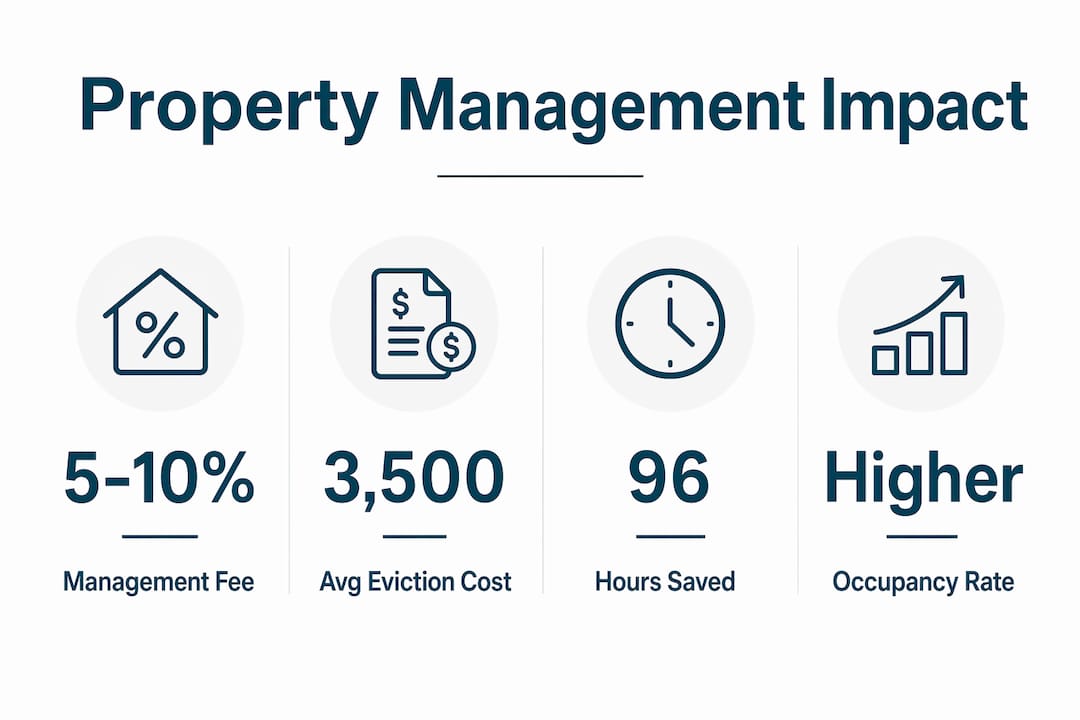
Headline figures: Self-managing one rental demands close to 96 hours per year when turnover is included. A single eviction costs approximately $3,500 in legal fees, lost rent, and turnover expenses.
An eviction can erase an entire year's worth of management fee savings on a mid-range rental. Add a turnover cycle on top, and the math shifts decisively toward professional management.
| Risk Factor | Self-Managed Cost | Managed Property Impact |
|---|---|---|
| Eviction (legal + lost rent + turnover) | ~$3,500 per eviction | Reduced through rigorous screening |
| Owner time (annual, one property) | ~96 hours/year | Recovered for higher-value activity |
| Vacancy recovery speed | Depends on owner availability | Faster through professional marketing |
| Maintenance cost control | Variable, reactive | Improved with preventive protocols |

Professional management typically improves occupancy rates and shortens vacancy periods, which compounds positively on net operating income over time.
How property management fees work — and what a real cost looks like
Fee structures vary more than most investors expect, and the base percentage is rarely the whole story.
| Fee Model | Typical Range | Best For |
|---|---|---|
| Percentage of collected rent (long-term) | 5–10% of monthly rent | Single-family and small multifamily |
| Percentage of revenue (short-term/vacation) | 20–35% of revenue | STR/vacation rental portfolios |
| Flat monthly fee | Fixed dollar amount | Stable, low-maintenance properties |
| Leasing/placement fee | — | Charged at each new tenant placement |
Beyond the base fee, watch for vendor markups, turnover charges, and maintenance coordination fees. The cheapest manager by percentage often becomes the most expensive over a full year once add-ons are counted.
Quick example: On a property renting for $1,800/month, a 10% management fee costs $2,160 annually. Compare that to the opportunity cost of 96 hours of owner time at even $30/hour ($2,880), plus the risk buffer for one eviction event ($3,500). The fee often wins the breakeven calculation before risk is even factored in.
Pro Tip: Ask every manager candidate for a sample owner statement and a full fee schedule in writing. If they hesitate, that hesitation is the answer.
Property management vs. asset management: who handles what?
These two roles operate at different altitudes, and confusing them is one of the most common mistakes growing investors make.
Property management covers daily execution: tenant relations, rent collection, maintenance, and compliance. Asset management operates at the portfolio level, handling capital planning, financing decisions, acquisition and disposition strategy, and long-term return optimization.
As Andrew Berg of InvestNext notes, the two disciplines work best in tandem: property managers handle operational excellence at the property level while asset managers drive strategic decisions across the portfolio. For a single-property owner, a skilled property manager often covers enough ground to make a separate asset manager unnecessary. Once a portfolio grows beyond three or four properties, the distinction starts to matter.
How to choose a property manager: a working checklist
Use this sequence before signing any management agreement.
- Verify licensing and credentials. Confirm the manager holds a valid real estate broker's license in your state. Look for National Association of Residential Property Managers (NARPM) designations as a signal of professional standards.
- Request comparable owner references. Ask specifically for references from owners with similar property types and price points, not just the manager's best clients.
- Examine the technology stack. A manager running on AppFolio, Buildium, or Yardi with clean reporting is a different operation than one using spreadsheets. Weak software usually means slow vacancy recovery and opaque financials.
- Inspect the maintenance approach. Ask whether they use in-house technicians or third-party vendors, and how vendor invoices are billed to owners. For multifamily communities, package room management and resident service operations are worth reviewing as part of the broader vendor oversight picture.
- Test communication responsiveness. Send an inquiry before the interview. Response time and quality tell you more than any sales pitch.
Interview questions worth asking:
- What is your current vacancy rate across your portfolio?
- How do you handle repair authorizations above a set dollar threshold?
- Can I see a sample monthly owner statement?
- What is your tenant retention rate over the past 12 months?
Red flags:
- Opaque vendor markups or refusal to share itemized maintenance invoices
- Unwillingness to provide sample profit-and-loss statements
- One-person operation with no backup coverage
- Placement fees above one full month's rent with no performance guarantee
Contract terms that can cost you if you miss them
The management agreement is where most investors lose negotiating leverage, usually because they sign without reading the fine print.
- Term length and auto-renewal: Many agreements run 12 months and renew automatically. Push for a 30–60 day written notice requirement before renewal.
- Termination fees: Some contracts charge 1–3 months of management fees for early termination. Negotiate a performance-based exit clause instead.
- Repair authorization limits: Know the dollar threshold above which the manager must get your approval before authorizing work. A $500 limit is reasonable; an unlimited authorization is not.
- Vendor billing and markups: Require that all vendor invoices be passed through at cost, or capped at a stated markup percentage.
- Indemnification clauses: Understand what the manager is and is not liable for. You should not be indemnifying a manager against their own negligence.
Ask for a 90-day trial period with a clean exit if performance benchmarks are not met. Most reputable managers will agree.
Self-manage or hire? A simple breakeven approach
The decision comes down to three inputs: your time, the fee, and your risk exposure.
Breakeven formula:
(Hours/month × 12 × your hourly value) + risk buffer = annual opportunity cost of self-managing
Using the research figures: 96 hours/year at $35/hour equals $3,360 in time cost. Add a one-eviction risk buffer of $3,500 (even at a 20% probability, that is $700 in expected annual cost). Total opportunity cost: roughly $4,060.
On a $1,800/month rental, a 10% management fee runs $2,160/year. The fee wins by nearly $1,900 before accounting for the manager's ability to reduce vacancy and improve tenant quality.
Self-managing makes sense when: you own a single property, you live nearby, your rent is low enough that the fee percentage bites hard, and you genuinely have the time and skills to handle tenant issues without stress.
Pro Tip: If you are on the fence, ask a local manager about partial-service or leasing-only arrangements. Paying a placement fee for tenant sourcing while handling day-to-day management yourself is a legitimate middle path for single-property owners.
Key Takeaways
Professional property management is a risk-mitigation and return-optimization function, not just an administrative convenience, and the breakeven math favors hiring a manager in most multi-property scenarios.
| Point | Details |
|---|---|
| Eviction cost benchmark | A single eviction averages ~$3,500; rigorous tenant screening is the primary defense. |
| Time cost of self-managing | One rental demands roughly 96 hours per year; that time has real dollar value in the breakeven. |
| Fee range to expect | Long-term rental management typically runs a moderate percentage of collected rent, plus placement and add-on fees. |
| Management vs. asset management | Property managers handle daily operations; asset managers drive portfolio strategy. Both matter as a portfolio grows. |
| Beamsrealtygroup's role | Beamsrealtygroup helps buyers and sellers in Virginia evaluate operators and management structures before and after closing. |
Why most investors underestimate the operator question
The conventional wisdom treats property management as a cost to minimize. That framing is wrong, and it costs investors money.
The real question is not whether a manager is worth the fee. It is whether the manager's execution is good enough to protect the returns you underwrote when you bought the property. Weak screening, slow vacancy recovery, and reactive maintenance do not just create friction. They erode NOI quarter by quarter in ways that rarely show up as a single line-item loss.
Investors routinely spend months on acquisition underwriting and an afternoon vetting the operator who will determine whether those projections materialize. That imbalance is where most real estate returns quietly disappear.
The managers worth hiring think about their job the way a good asset manager does: as a function of long-term asset performance, not a checklist of monthly tasks. Ask any candidate how they think about tenant retention as a capital preservation strategy. The answer will tell you everything.
Beamsrealtygroup helps you get this right from the start
Buying an investment property without a clear management plan is like underwriting a deal with a blank expense line. Beamsrealtygroup works with buyers and sellers in Virginia to evaluate not just the property, but the operational structure around it.

In a first consultation, Beamsrealtygroup walks you through a quick breakeven review using your specific rent and time assumptions, a management checklist review against local operators, and a sample reporting walkthrough so you know what good financial transparency looks like before you sign anything. The goal is to make sure the management layer you put in place actually protects the returns you expect.
Ready to invest with a clearer picture? Connect with Beamsrealtygroup to get personalized guidance on your next property decision.
Useful sources
- Average cost to evict a tenant — ClearScreening
- Landlord's guide to stress-free property management — HAO Finder
- Is property management worth it? — MRI Software
- Property management for real estate investors: 2026 guide — Awning
- The role of property management in multifamily investing — EMARET Capital Group
- Asset management vs. property management — InvestNext
- The difference between managing a property and managing an investment — Jennifer DeJesus
- Fair Housing Act overview — HUD