
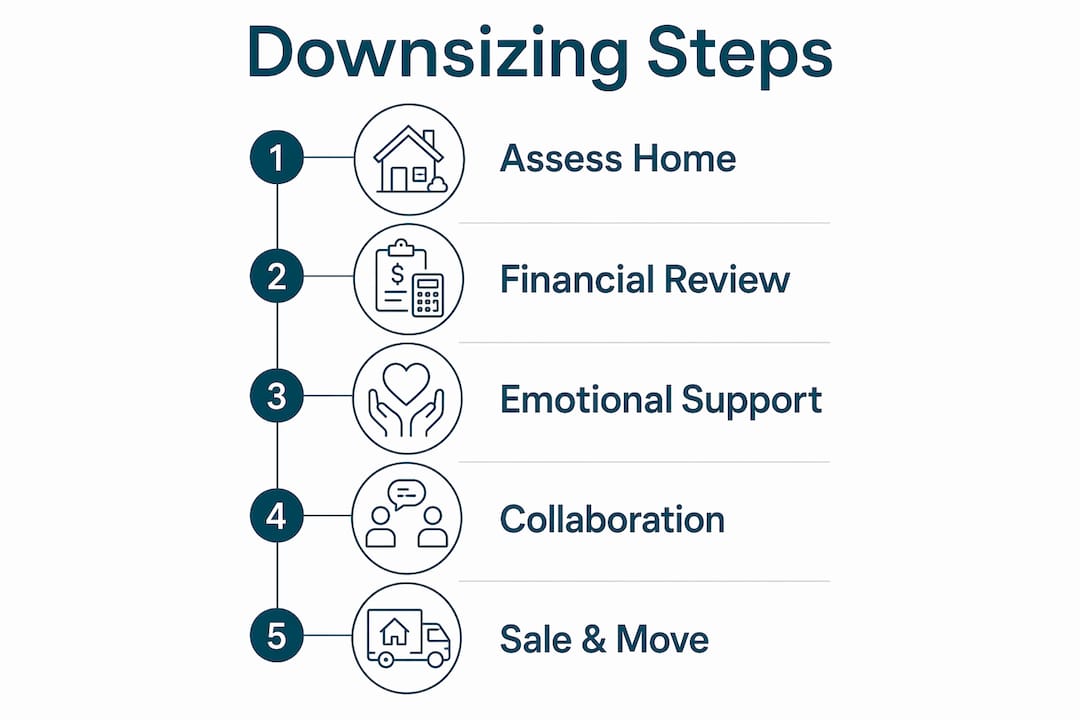
A skilled real estate agent does far more than list your home when you're downsizing. The role of a real estate agent in downsizing covers emotional support, financial modeling, logistics coordination, and finding you the right smaller property, all at once. Here's what that actually looks like in practice:
- Listing and marketing the current home to attract qualified buyers at the right price
- Providing emotional support through one of the most personally significant moves of your life
- Coordinating logistics including decluttering, estate liquidation, and moving timelines
- Building detailed net sheets that account for commissions, repairs, closing costs, and taxes
- Negotiating contracts and managing communication with all parties involved
- Searching for suitable smaller properties that match your health, lifestyle, and budget needs
- Connecting you with allied professionals such as financial planners, senior move managers, and contractors
Agents who specialize in this work often hold the Seniors Real Estate Specialist (SRES) designation, which provides specific training for the financial and emotional complexities unique to downsizing clients.
How agents provide emotional and logistical support during downsizing
Leaving a home where you raised children or spent decades of your life is not a straightforward transaction. Downsizing demands next-level empathy and patience from agents, because clients are parting with far more than square footage.
- Active listening and rapport-building: Agents sit with clients, hear their stories, and understand the history behind the home before ever discussing price.
- Flexible timelines: Longer meetings, more frequent check-ins, and extended decision windows are standard practice with downsizing clients, not exceptions.
- Decluttering coordination: Agents connect clients with estate liquidators, charitable donation organizations, and junk haulers to clear decades of accumulated belongings.
- Managing family dynamics: Adult children often have strong opinions. Experienced agents navigate third-party involvement without letting it derail the client's own wishes.
- Adjusted communication methods: Some clients prefer phone calls over email, or paper documents over digital signatures. Good agents adapt without friction.
Pro Tip: If a client is moving to a care facility, consider having them move first and then emptying the home before listing it. Trying to photograph and market a home while someone is still sorting through a lifetime of belongings rarely goes smoothly.
What financial guidance looks like when an agent helps you downsize
The financial picture of downsizing surprises more people than it should. Transaction costs can erode expected savings quickly, and agents who skip the detailed math do their clients a real disservice.
- Net sheet preparation: A thorough net sheet covers real estate commissions, closing costs, repair expenses, and estimated taxes so you know your actual proceeds, not a ballpark.
- Capital gains tax awareness: The IRS allows homeowners to exclude up to $250,000 in capital gains (or $500,000 for married couples filing jointly) on a primary residence sale, provided they lived there for at least two of the last five years. That exemption applies once every two years.
- Ongoing cost analysis: A smaller home is not automatically cheaper. HOA fees, insurance premiums, and property taxes in the new location can offset savings from a lower mortgage.
- Reverse mortgage guidance: For retirees on fixed incomes, agents like those at Beamsrealtygroup often recommend discussing reverse mortgage options with a lender and CPA, since they can provide meaningful financial flexibility without requiring a large cash outlay.
- Scenario modeling: Agents stress-test multiple outcomes, including a multiple-offer sale, a standard market sale, and a price reduction, so clients understand their range of net proceeds before committing.
Retirees who skip this analysis sometimes discover, too late, that a move they expected to free up six figures of equity actually netted far less after all costs were counted.
How agents collaborate with allied professionals to support downsizing clients
No agent handles a downsizing transaction alone. Effective agents act as connectors to a trusted network of specialists, and that network is often what separates a smooth transition from a stressful one.
- Financial advisors: Help clients understand how sale proceeds fit into retirement income plans and investment strategies.
- Senior move managers: Specialists who handle the physical and emotional work of sorting, packing, and relocating older adults.
- Estate liquidators: Manage the sale of furniture, art, and household goods that won't fit in the new home. Agents keep multiple contacts because availability varies.
- Contractors and stagers: Prepare the current home for sale with repairs and presentation work that maximizes the sale price.
- Long-term care planners: For clients whose health needs are changing, agents facilitate introductions to professionals who can assess assisted living or continuing care retirement community options.
Agents who build these networks become informal project managers, a role that goes well beyond brokerage but directly determines whether a client's transition succeeds. Tools like NestNoted can help clients and their families track listings and stay organized throughout the process.
Aligning your downsizing decision with long-term retirement goals
The best downsizing outcomes happen when the move is treated as a retirement decision, not just a real estate transaction. Agents who understand this ask different questions from the start.
- Health and independence: Can you age in place in the new home? Single-level layouts, proximity to medical facilities, and walkable neighborhoods matter more as mobility changes.
- Social environment: Isolation is a real risk for older adults who move away from established communities. Agents factor in access to social activities, friends, and family when recommending locations.
- Financial fit: Does the move actually improve monthly cash flow? The right answer aligns net proceeds, new housing costs, and retirement income into a plan that reduces financial pressure rather than shifting it.
- Buy First, Then Sell strategy: This approach minimizes temporary housing needs and reduces the pressure of rushed purchasing decisions, though it requires careful coordination with lenders to avoid cash flow strain.
- Location flexibility: Some clients discover that renting in a target area for a few months before buying gives them confidence that the lifestyle actually fits before committing capital.
How agents assess and value your current home
Accurate pricing is the foundation of a successful downsizing sale. Agents approach this with a structured process rather than a gut estimate.

A comparative market analysis (CMA) pulls recent sales of similar homes in your neighborhood, adjusting for size, condition, upgrades, and lot characteristics. Agents also walk the property to identify deferred maintenance or cosmetic issues that could affect buyer perception or appraisal value. Items like outdated kitchens, aging roofs, or HVAC systems near end of life get flagged early, because addressing them before listing typically returns more than their cost.
Agents also consider current market conditions, including inventory levels, average days on market, and buyer demand in your specific price range. In a tight market, pricing slightly below peak can generate multiple offers and drive the final sale price higher. In a slower market, pricing accurately from day one prevents the stigma of repeated reductions.
Communication and negotiation tactics agents use in downsizing transactions
Downsizing clients often haven't sold a home in decades. Clear, consistent communication from the agent prevents confusion and builds the confidence clients need to make good decisions under pressure.
Experienced agents set expectations early: what the timeline looks like, when offers typically arrive, and what a counteroffer process involves. They translate contract language into plain terms and never assume a client remembers how escrow or contingencies work. When offers come in, agents present the full picture, not just the headline price. A lower offer with fewer contingencies and a flexible closing date can be worth more to a downsizer than a higher offer with financing uncertainty.
Negotiation in downsizing transactions also involves managing the emotional stakes. Clients sometimes reject reasonable offers because the number feels like an insult to a home they love. Agents who have built real rapport can reframe the conversation around net proceeds and next-chapter goals rather than letting sentiment drive a poor financial decision.
Common challenges downsizing clients face and how agents help
The most common sticking point is belongings. Clients who have lived in a home for 30 or 40 years often cannot clear it fast enough to meet a listing or closing timeline. Agents who anticipate this start the decluttering conversation at the first meeting, not two weeks before closing.
Pricing disagreements are another frequent challenge. Clients sometimes anchor to a number based on what a neighbor sold for years ago, or what they feel the home is worth emotionally. A well-prepared CMA, presented with patience, usually resolves this, but it takes an agent willing to have an honest conversation rather than agree to an unrealistic price just to win the listing.
Family conflict can slow or derail transactions entirely. Adult children may disagree with each other or with the client about timing, price, or destination. Agents at Beamsrealtygroup treat the client as the decision-maker and work to keep family input constructive rather than controlling, which protects both the relationship and the transaction.
Finally, the gap between expected and actual net proceeds catches many clients off guard. The net sheet, built early and updated as costs become clearer, is the single most effective tool for preventing that surprise.
Key Takeaways
A real estate agent's role in downsizing extends well beyond listing a home. It covers financial modeling, emotional support, professional coordination, and long-term goal alignment.
| Point | Details |
|---|---|
| Net sheet is non-optional | Build it early with all costs and taxes to know your true proceeds before committing to a move. |
| Capital gains exemption | The IRS allows homeowners to exclude up to $250,000 in capital gains (or $500,000 for married couples filing jointly) on a primary residence sale, provided they lived there for at least two of the last five years. Exemption allowed once every two years. |
| Emotional support is part of the job | Agents allow longer timelines, more check-ins, and adapt communication to each client's needs. |
| Professional networks matter | Agents connect clients with estate liquidators, senior move managers, financial advisors, and contractors. |
| Buy First, Then Sell reduces pressure | This strategy minimizes temporary housing needs but requires coordinated financial planning with lenders. |

Planning to downsize in Virginia? Beamsrealtygroup brings the financial expertise, professional network, and clear communication that make this transition work. Visit Beamsrealtygroup to connect with an agent who understands what downsizing actually involves, and what it takes to get it right.