
For most sellers, listing on the open market with an experienced local agent and full MLS exposure delivers the best net proceeds and the fewest surprises. Before you do anything else, take these three steps:
- Get a price check. Pull a Zestimate or request a comparative market analysis (CMA) from a local agent. This sets realistic expectations before you commit to a strategy.
- Schedule professional photos. Nearly all buyers start their search online, so screen appeal drives your first impression. Book a photographer before the listing goes live.
- Interview a few local agents or build your FSBO plan. If you want full-service representation, talk to agents who know your neighborhood. If you're going solo, map out your marketing channels and disclosure requirements now.
Homes listed on the MLS have historically sold for a price premium compared to private or pocket listings. The typical timeline runs several weeks from preparation to listing, then several more weeks to closing. Seller closing costs have historically run in the single-digit percentages of sale price, with commissions making up the largest share. Everything below shows you exactly how to execute.
Table of Contents
- What does the week-by-week selling timeline look like?
- Which selling route is right for you: agent, FSBO, flat-fee MLS, or iBuyer?
- How do you set a realistic list price?
- How should you prepare the property before listing?
- What makes a listing actually attract buyers?
- How do you handle offers, negotiations, inspections, and closing costs?
- How do you interview and select a listing agent?
- What does a FSBO seller need to do, step by step?
- How Beams Realty Group helps Virginia sellers get results
- Key Takeaways
- What sellers consistently get wrong (and how to fix it)
- Ready to sell? Here's how Beams Realty Group gets you started
- Useful sources and further reading
What does the week-by-week selling timeline look like?
Selling a house is not a single event. It's a sequence of overlapping phases, and knowing what happens when lets you plan your move, your finances, and your repairs without scrambling.
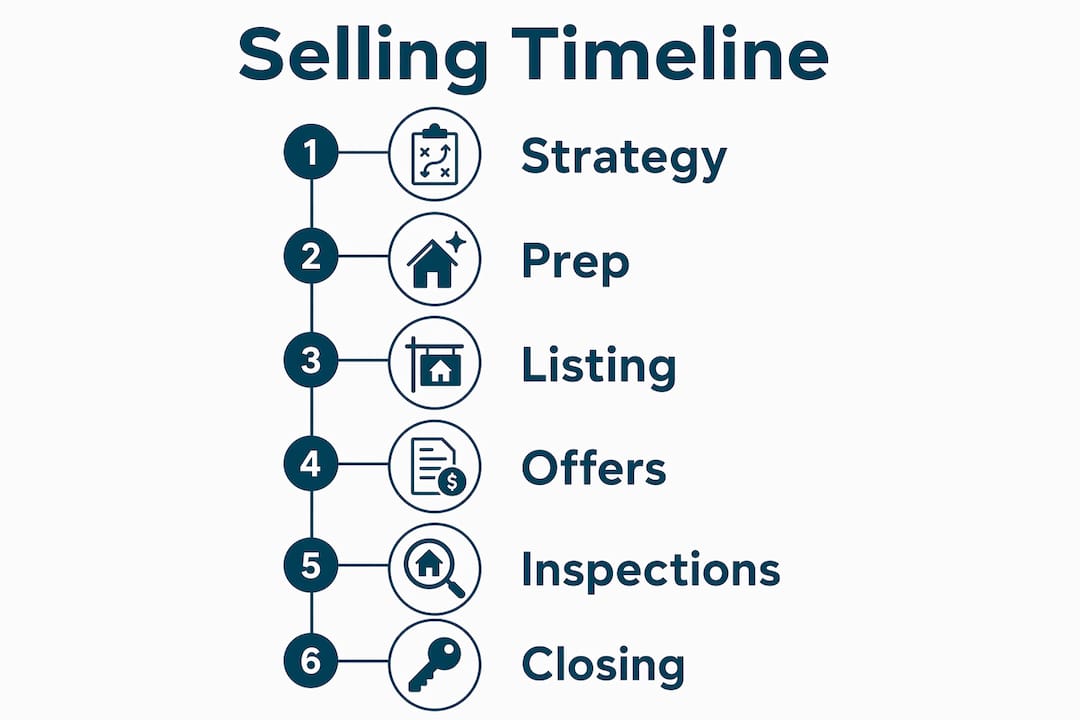
Phase 1: Strategy and agent selection (weeks 1–2)
Decide on your selling route, interview agents or research flat-fee MLS options, and get a CMA. This is also when you order a pre-listing inspection if the home is older or has known issues. A pre-sale inspection typically runs $300–$600 and surfaces problems before a buyer's inspector does, which gives you control over how to handle them.
Phase 2: Prep and photography (weeks 3–5)
Declutter, deep clean, complete small repairs, and stage. Book your photographer for the end of this phase so the home is photo-ready. Professional photos and 3D tours should be in hand before the listing goes live.

Phase 3: Listing and showings (weeks 5–8)
The listing hits the MLS and syndicates to major portals. Showings begin, and you may hold one or two open houses. Expect the most activity in the first 7–10 days. If offers don't arrive in that window, revisit your price.
Phase 4: Offer review, negotiation, and under contract (week 8–9)
Review offers, counter if needed, and accept. The clock starts on contingency deadlines once you're under contract.
Phase 5: Inspections, appraisal, and contingency clearance (weeks 9–12)
The buyer's inspector visits, the lender orders an appraisal, and both parties negotiate any repair credits or price adjustments. Preparation and marketing typically take 6–8 weeks, with an additional 30–45 days from offer acceptance to closing depending on buyer financing.
Phase 6: Closing and move-out (days 30–45 post-contract)
Final walkthrough, sign documents, hand over keys. Cash buyers can compress this to days or weeks; financed buyers need the full appraisal and underwriting cycle.
Weekly priority checklist:
- Week 1: Choose your selling route; request CMAs from 2–3 agents; order pre-listing inspection.
- Week 2: Review inspection results; set list price; sign listing agreement or prepare FSBO plan.
- Week 3: Declutter every room; donate or store excess furniture; schedule repairs.
- Week 4: Complete repairs; deep clean; touch up paint and curb appeal.
- Week 5: Stage the home; book professional photographer and 3D tour.
- Week 6: Review and approve listing photos and copy; confirm MLS go-live date.
- Week 7: Listing goes live; hold first open house; track showing feedback.
- Week 8: Review offers; negotiate; execute purchase agreement.
Seasonal timing matters too. Zillow data show the last two weeks of May have historically yielded about a 1.6% price premium on a typical home, though the best window varies by local market. In Virginia, spring and early summer tend to move inventory fastest, but a well-priced home in any month will attract buyers.
Which selling route is right for you: agent, FSBO, flat-fee MLS, or iBuyer?
The right route depends on four things: how quickly you need to close, how much net proceeds matter, how much time you're willing to spend managing the process, and how complex your local market is. Here's how the options stack up.
| Route | Best for | Key advantage | Key trade-off |
|---|---|---|---|
| Full-service agent | Most sellers | Maximum exposure, negotiation support, full transaction management | Commission cost (typically 5–6% total) |
| FSBO | Experienced sellers with marketing reach | No listing-side commission | Lower sale prices on average; full workload on seller |
| Flat-fee MLS | Sellers who want MLS access without full service | MLS exposure at lower cost | Seller handles showings, negotiation, and paperwork |
| iBuyer / cash buyer | Sellers who prioritize speed and certainty | Fast close, no showings | Often lower net price than open-market sale |
Decision rules:
- Pick a full-service agent if you want the highest probable net proceeds and don't want to manage marketing, showings, or contract negotiations yourself. Agent-assisted sales have averaged higher prices compared to FSBO transactions according to referenced studies.
- Pick FSBO only if you have genuine marketing reach, negotiation experience, and time to manage showings and paperwork. The commission savings can evaporate quickly if the home sits or sells below market.
- Pick flat-fee MLS if you're comfortable handling the buyer-side of the transaction but want the distribution advantage of MLS listing. You'll pay a flat fee (often a few hundred dollars) for MLS access and handle everything else.
- Pick an iBuyer or cash buyer if speed and certainty matter more than price. You'll likely leave money on the table, but you'll close fast with no showings or contingencies.
How do you set a realistic list price?
Pricing is where most sellers make their biggest mistake. Overpricing at launch is the single most costly error you can make, and the data backs that up. Listings that sit too long lose momentum and often sell for less after reductions than they would have at a competitive price from day one.
What goes into a CMA
A comparative market analysis compares your home to recently sold properties that are similar in size, condition, age, and location. A solid CMA covers:
- Sold comps from the last 90 days: These are the most reliable indicators of what buyers are actually paying right now.
- Active competition: What are buyers comparing your home to today? If similar homes are priced lower, yours needs to compete.
- Price reductions: A high number of reductions in your neighborhood signals an overheated list-price environment.
- Days on market (DOM): Homes sitting 60+ days are usually overpriced. Homes selling in under 10 days suggest you may have room to price at the top of the range.
- Price per square foot trends: Useful for cross-checking a price, but never use it in isolation. Condition, lot size, and finishes matter more than raw square footage.
Pricing strategies that work
Competitive list pricing means coming in at or just below the market's natural clearing price. This generates early showing traffic and, in active markets, can produce multiple offers above list. Psychological price points (listing at $399,000 instead of $405,000) can expand your buyer pool by catching searches set at round-number ceilings. Pre-market pricing tests through agent networks or coming-soon listings let you gauge interest before committing publicly.
What to avoid: relying solely on an automated estimate without local adjustments. Automated valuations are useful starting points, but they don't account for recent renovations, lot premiums, or hyper-local demand shifts. Always cross-check with a CMA from an agent who knows your specific neighborhood.
How should you prepare the property before listing?
Preparation is where you earn your sale price before a single buyer walks through the door. The goal is not to renovate. It's to remove every reason a buyer might discount their offer.
Priorities in order
Start with curb appeal: mow, edge, mulch, and power-wash the driveway. Buyers form an opinion before they open the front door. Inside, declutter aggressively — remove at least a third of your furniture and all personal photos. Then deep clean every surface, including inside appliances, windows, and grout lines. A professional pre-listing deep clean is worth every dollar; buyers notice smells and grime immediately, and both kill offers.
For repairs, prioritize safety and major systems first: fix leaky faucets, replace burned-out bulbs, patch holes in walls, and address any HVAC, roof, or electrical issues flagged in your pre-listing inspection. Skip over-improving kitchens and bathrooms with full remodels. In most markets, you won't recoup a $30,000 kitchen renovation in the sale price. Neutral paint, updated hardware, and clean grout will do more for less money.
Professional media: the highest-ROI investment
Nearly all buyers start their home search online, which means your photos are your first showing. Listings with high-resolution photos and 3D tours have sold for a small price premium on average, enhancing the property's perceived value. That's not a rounding error.
Statistic: Staged homes sell faster than non-staged homes, and professional staging costs vary depending on the size of the home.
Pro Tip: If full professional staging is outside your budget, focus on the living room, primary bedroom, and kitchen. These three rooms appear in the most listing photos and carry the most weight with buyers browsing online.
For media, the minimum package is professional photography (20–30 images), a floor plan, and a 3D tour. Twilight exterior shots are a strong add-on for homes with good curb appeal. DIY phone photos are not a substitute, regardless of how good your phone camera is.
What makes a listing actually attract buyers?
Getting on the MLS is necessary but not sufficient. The listing itself — photos, copy, and distribution — determines whether buyers schedule a showing or scroll past.
Why MLS exposure matters
The MLS feeds your listing to every buyer's agent in the market and syndicates it to major portals. Homes listed on the MLS have sold for a price premium compared to private or pocket listings. That distribution advantage is the primary reason full-service agents earn their commission for most sellers.
Listing copy essentials
Strong listing copy does three things: it highlights the features buyers search for, it creates a sense of place, and it's accurate. Specifics matter. "Updated kitchen with quartz countertops and stainless appliances" outperforms "beautiful kitchen." Include:
- Accurate square footage, bedroom and bathroom count, and lot size
- Standout features (recent roof, new HVAC, finished basement, walkability)
- Neighborhood cues: school district, proximity to commuter routes or amenities
- A clear call to action: "Schedule your private tour today"
Photo and media checklist
- 20–30 high-resolution images minimum
- Lead with the best exterior shot, then the living room, kitchen, and primary bedroom
- Include at least one twilight or dusk exterior if the home has curb appeal
- Add a 3D tour link in the listing description
- Floor plan image for buyers who want to visualize furniture placement
Offline tactics
Targeted broker opens (an agent-only preview before the public listing) generate early buzz and agent referrals. Neighborhood outreach — a simple postcard or door-knock to nearby homeowners — often surfaces buyers who have friends or family wanting to move into the area. Open houses work best in the first two weekends after listing, when traffic is highest.

How do you handle offers, negotiations, inspections, and closing costs?
An offer is not just a number. The terms around it often matter as much as the price.
Evaluating offers beyond price
When you receive an offer, look at the full picture:
- Financing type: Cash offers close faster and carry no appraisal risk. Conventional financing is standard. FHA and VA loans have specific appraisal requirements that can complicate repairs.
- Contingencies: Inspection, financing, and appraisal contingencies are standard. A buyer waiving the inspection contingency takes on more risk, which can be a signal of motivation. An appraisal gap clause (where the buyer agrees to cover a gap between appraised value and purchase price) protects you in a competitive market.
- Closing date: Does it align with your move-out timeline? A buyer who needs 60 days may cost you less in carrying costs than one who wants to close in 15.
- Earnest money deposit: A larger deposit signals serious intent.
Negotiation priorities
Counter-offers should prioritize the items with the most financial impact first: price, then appraisal gap coverage, then contingency timelines. In a multiple-offer situation, ask for highest and best by a set deadline. Escalation clauses (where a buyer automatically beats competing offers up to a cap) can work in your favor but require careful review.
Inspection and appraisal stage
After the buyer's inspection, you'll likely receive a repair request. You have three options: fix the items, offer a credit at closing, or decline and let the buyer decide whether to proceed. Credits are often cleaner than repairs you manage under time pressure. If the appraisal comes in below the purchase price, you can negotiate a price reduction, ask the buyer to cover the gap, or, in rare cases, challenge the appraisal with additional comps.
Typical seller closing costs
| Cost category | Typical range |
|---|---|
| Listing agent commission | single-digit percentage of sale price |
| Buyer's agent commission | single-digit percentage of sale price |
| Title and escrow fees | $300–$600 |
| Transfer taxes and recording fees | Varies by state/county |
| Prorated property taxes | Depends on closing date |
| Home warranty (optional) | $300–$600 |
| Seller concessions (if negotiated) | Varies |
Seller closing costs have historically run in the single-digit percentages of sale price, with commissions making up the largest share. Have your net sheet calculated before you accept any offer so you know exactly what you'll walk away with.
How do you interview and select a listing agent?
The agent you choose controls your marketing, your negotiation, and your timeline. Picking the wrong one is expensive.
What to request before the interview
Ask each agent for a sample marketing plan, a list of comparable homes they've sold in the last 12 months, and at least two seller references. An agent who can't produce these quickly is telling you something.
Questions that actually reveal competence
- "Walk me through how you priced your last three listings and how they performed relative to list price." This reveals whether they price to sell or price to win the listing.
- "What's your average days on market for listings in this price range?" Compare it to the local market average.
- "What does your marketing budget cover, and who pays for photography and 3D tours?" Some agents absorb these costs; others pass them to the seller.
- "How do you handle multiple offers, and can you give me an example?" You want specifics, not generalities.
- "What's your commission structure, and what's negotiable?" Everything is negotiable. A good agent will explain their fee clearly.
Red flags to watch for
- Vague marketing promises ("I'll get the word out") with no specific plan
- Poor listing photos on their current or recent listings — this is the fastest way to evaluate their standards
- Limited knowledge of recent local comps when you ask specific questions
- Reluctance to provide references or a track record
- Pressure to sign immediately without reviewing the listing agreement
Commission norms
Total commission in the U.S. has traditionally been a percentage of the sale price, split between the listing and buyer's agents. Post-NAR settlement changes have shifted how buyer's agent compensation is structured, so ask your agent to explain the current local practice clearly. Flat-fee MLS services charge a set fee for MLS access and let you handle the rest. Neither model is universally better; the right choice depends on your comfort level and the complexity of your market.
What does a FSBO seller need to do, step by step?
Selling without an agent is a legitimate option for the right seller. It requires more work, more knowledge, and more tolerance for risk, but the commission savings can be meaningful if you execute well.
FSBO step-by-step checklist
- Prepare the property: Complete all repairs, staging, and professional photography before listing.
The same preparation standards apply whether you have an agent or not.
- Set your price: Pull your own comps from public records, Zillow, or Redfin. Cross-check with a flat-fee CMA service or a one-time agent consultation if you're unsure.
- Create a professional listing: Write accurate, detailed copy. Hire a professional photographer. A weak listing is the fastest way to lose buyers.
- Get MLS exposure: Use a flat-fee MLS service to list on the MLS and syndicate to major portals. Without MLS access, your buyer pool shrinks dramatically.
- Host showings safely: Pre-qualify buyers before letting strangers into your home. Request proof of pre-approval or proof of funds before scheduling.
- Handle offers and paperwork: Use your state's standard real estate purchase contract. Most states have these available through the state association of realtors or a real estate attorney.
Required paperwork and disclosures
Every state requires sellers to disclose known material defects. Common disclosure forms cover: lead paint (for homes built before 1978), structural issues, water damage, HVAC condition, and any known environmental hazards. Consult a real estate attorney for complex title issues, probate sales, or any situation where ownership is disputed or unclear.
Common FSBO pitfalls
- Limited MLS exposure without a flat-fee service means fewer buyers and lower offers.
- Negotiation challenges: Buyers' agents negotiate daily. Most FSBO sellers do not. This gap shows up in final sale prices.
- Paperwork mistakes: A missed disclosure or an improperly executed contract can delay closing or expose you to liability.
When to switch to an agent
If your home has been on the market for 3–4 weeks with no serious offers, if you're receiving lowball offers consistently, or if a legal complexity surfaces (estate sale, title dispute, divorce), bring in a licensed agent. The commission cost is almost always less than the cost of a failed transaction.
How Beams Realty Group helps Virginia sellers get results
Beamsrealtygroup is a full-service real estate team based in Virginia, built specifically for sellers who want expert guidance without the friction of a large, impersonal brokerage.
What Beams Realty Group handles for sellers:
- Local market analysis and CMA: Beamsrealtygroup provides a detailed comparative market analysis before you commit to a price, grounded in current Virginia market data.
- Staging coordination and preparation guidance: The team advises on which repairs and upgrades will move the needle and connects sellers with trusted local vendors for photography, cleaning, and staging.
- MLS listing and marketing: Your home gets full MLS exposure plus a targeted digital marketing strategy to reach qualified buyers.
- Negotiation and contract management: Beamsrealtygroup handles offer review, counter-offers, inspection negotiations, and closing coordination so you're not managing it alone.
- Specialty transaction expertise: The team has experience in probate sales, divorce transactions, estate management, 1031 exchanges, and pre-foreclosures — situations where a generalist agent often falls short.
When to call Beams Realty Group:
- You want to maximize proceeds and don't want to leave money on the table with a DIY approach.
- Your transaction has complexity: estate, divorce, investment property, or a tight timeline.
- You want a team that knows Virginia's specific market conditions, not a national platform that treats every market the same.
Sellers in Virginia can connect with Beamsrealtygroup at beamsrealtygroup.com for a no-obligation consultation.
Key Takeaways
Selling a home successfully comes down to five decisions: choosing the right route, pricing accurately from day one, investing in professional media, understanding your true net proceeds, and picking an agent who can execute.
| Point | Details |
|---|---|
| Price accurately at launch | Overpriced listings lose momentum and often sell for less after reductions than a competitive initial price would have yielded. |
| MLS exposure drives value | Homes listed on the MLS have sold for about 17.5% more than private listings — full market exposure is the single biggest lever most sellers have. |
| Professional media pays for itself | Listings with professional photos and 3D tours have sold for about 2% more on average, roughly a $9,000 premium on a typical U.S. home. |
| Know your closing costs | Seller closing costs typically run in the single-digit percentages of sale price; calculate your net sheet before accepting any offer. |
| Beamsrealtygroup for Virginia sellers | Beams Realty Group offers full-service listing, local CMA, staging coordination, and specialty transaction expertise for sellers across Virginia. |
What sellers consistently get wrong (and how to fix it)
The two mistakes I see most often are overpricing at launch and underinvesting in online presentation. Both are avoidable, and both cost sellers real money.
Overpricing feels safe. It seems logical to leave room to negotiate. But buyers and their agents are watching days on market closely. A home that sits for 45 days in a market where well-priced homes move in 10 carries a stigma. Buyers assume something is wrong. When the price finally drops, you've already lost the most motivated buyers who saw it early and moved on. The data on this is consistent: competitive pricing at launch produces better outcomes than chasing the market down.
The online presentation problem is subtler but just as costly. Sellers spend weeks on repairs and staging, then list with photos taken on a phone in bad lighting. Buyers are making shortlist decisions from a 4-inch screen. If your photos don't stop the scroll, the showing never happens. Professional photography is not a luxury for high-end listings. It's the baseline for any home in any price range.
What actually works is the combination: price it right, show it beautifully, and get it in front of every buyer in the market through MLS and syndication. That's the formula. Everything else is execution detail. Beamsrealtygroup's approach is built around exactly that sequence, which is why their Virginia sellers consistently move homes without the extended market time that drains both price and patience.
Ready to sell? Here's how Beams Realty Group gets you started
Selling a home in Virginia means competing in a market where buyers are informed, well-represented, and moving fast. Beamsrealtygroup gives you the full-service advantage without the impersonal experience of a large national brokerage. The difference is specific: a local CMA before you commit to a price, a vetted vendor network for photography and staging, and an agent who handles negotiations and closing paperwork so you don't have to.
Getting started takes one conversation. Contact Beams Realty Group to schedule your seller consultation. Come with your address, a rough sense of your timeline, and any questions about repairs or pricing. The team will walk you through a CMA, a recommended prep plan, and a clear fee discussion — no pressure, no obligation. From there, you decide the pace.
This article provides general information for educational purposes and does not constitute legal, tax, or financial advice. Consult a qualified professional or your state's primary regulatory sources for guidance specific to your situation.
Useful sources and further reading
The sources below back the key claims in this article and are worth bookmarking for your own research.
- Zillow: 14 Tips for Selling Your Home Fast and for More Money — The source for MLS price premium data (17.5% more vs. private listings), professional media uplift ($9,000 on a typical home), and seasonal timing data. Useful for pricing and marketing decisions.
- Zillow: Your Go-To Checklist for Selling a House — Covers staging ROI (staged homes sell 73% faster) and professional staging cost ranges ($1,000–$5,000). Good reference for preparation planning.
- Zillow: How Do You Sell Your House? — Step-by-step overview with seller closing cost context. Use this for a plain-language walkthrough of the full transaction.
- FastExpert: Week-by-Week Home Selling Guide — Detailed timeline data (6–8 weeks prep, 30–45 days to close), FSBO vs. agent sale price comparison, and pre-listing inspection guidance. Practical for timeline planning.
- Bankrate: How to Sell Your House — Covers iBuyer trade-offs, online-first buyer behavior, and pre-sale inspection value. Good for sellers weighing speed vs. proceeds.
- IRS Publication 523: Selling Your Home — The authoritative source on capital gains exclusions ($250,000 for single filers, $500,000 for married filing jointly) and tax obligations when selling a primary residence. Consult this before closing.
- IRS Topic 701: Sale of Your Home — Companion to Publication 523; covers eligibility rules for the home sale exclusion and how to report the sale. Check this if you've owned the home for less than two years or rented it at any point.
- Local county records and title companies — For final verification of deed history, lien status, and transfer tax rates in your specific Virginia county, contact your local circuit court clerk's office or the title company handling your closing. These sources are more current and jurisdiction-specific than any national guide.