
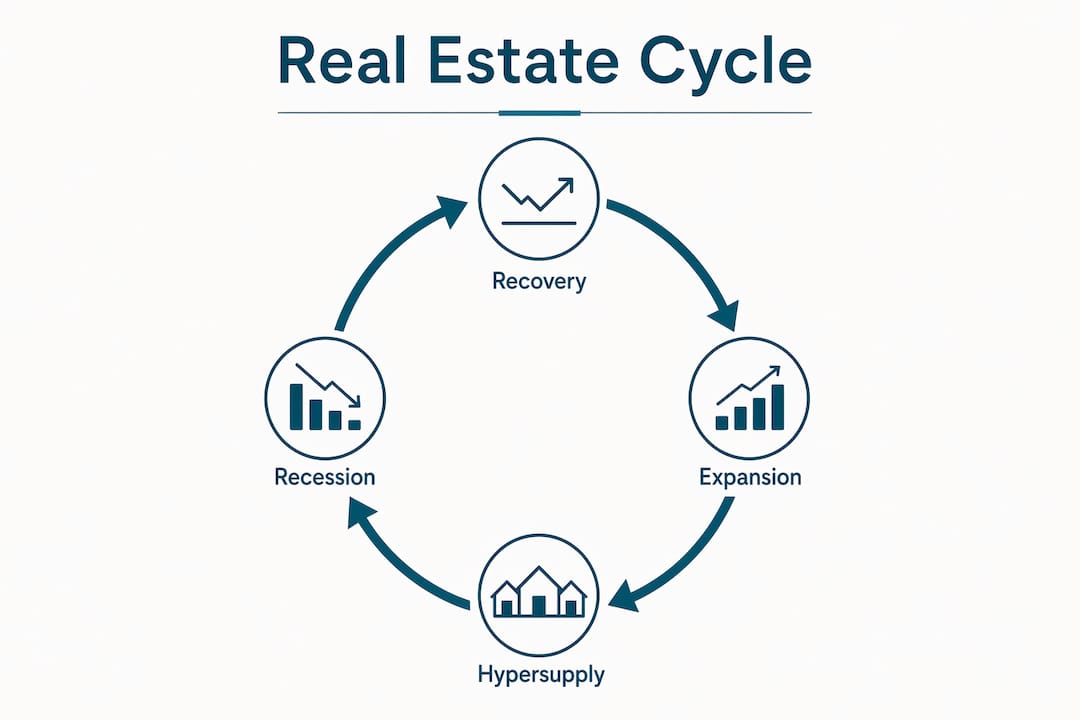
A real estate cycle is the recurring sequence of four market phases — recovery, expansion, hypersupply, and recession — that drives fluctuations in property values, demand, and investment opportunity. Understanding what is a real estate cycle gives buyers, sellers, and investors a framework for reading market conditions rather than reacting to them blindly. Dr. Glenn Mueller's widely cited model defines real estate cycles lasting 7–10 years, with each phase shaped by the interplay of supply, demand, occupancy rates, and rental growth. In june 2026, the U.S. median listing price fell 2.5% year-over-year to $430,000, the steepest annual drop since 2017. That single data point signals a market correction phase in real time.
What is a real estate cycle and its four phases?
A real estate cycle is defined as a repeated pattern of four distinct phases, each with measurable characteristics in supply, demand, occupancy, and rent growth. Recognizing which phase a market occupies tells you more about risk and opportunity than any single price point.
Recovery
Recovery is the floor of the cycle. Prices have bottomed, occupancy begins to rise from its lowest point, and rents stabilize after falling. New construction is minimal because lenders remain cautious and developers lack confidence. Vacancy is still elevated, but absorption is quietly improving. This phase is the hardest to spot in real time because the data still looks bad even as conditions are turning.
Expansion
Expansion is the most visible phase. Demand outpaces supply, rents rise, and developers respond by breaking ground on new projects. Lending conditions loosen as lenders gain confidence in rising asset values. This is the phase most investors associate with a "hot market," and it is where the seeds of the next problem are planted. Construction pipelines fill up during expansion, setting the stage for future oversupply.

Hypersupply
Hypersupply begins when new supply exceeds demand. Rent growth slows, vacancy rates climb, and asset values plateau or soften. The hypersupply phase typically lasts 6–18 months before transitioning into recession. Developers who started projects during expansion are now delivering units into a market that no longer needs them.
Recession
Recession is the contraction phase. Rents fall, occupancy drops, and distressed sales rise as owners struggle to service debt on declining assets. Financing tightens sharply during this phase, and many sellers are forced to accept below-market prices. Patient investors with available capital can acquire undervalued assets during recession, but the risk tolerance required is significant.
| Phase | Supply trend | Demand trend | Occupancy | Rent growth |
|---|---|---|---|---|
| Recovery | Flat | Rising | Low but improving | Stabilizing |
| Expansion | Rising | Strong | High | Accelerating |
| Hypersupply | Oversupply | Slowing | Declining | Decelerating |
| Recession | Excess supply | Weak | Low | Negative |
Pro Tip: Track absorption rates alongside vacancy data. Absorption measures how fast available space is being leased or sold. Rising absorption with still-high vacancy is the clearest early signal of recovery.
What drives real estate cycles? The role of delivery lag
The primary engine behind property cycles is the 18–36 month delivery lag between when a developer breaks ground and when a building is ready for occupancy. This lag is structural. It cannot be shortened by market enthusiasm or developer urgency. It means supply adjustments to demand are always delayed, making real estate cycles longer and more volatile than stock market cycles.
Here is how the sequence unfolds:
- Demand rises and vacancy falls during expansion, pushing rents higher.
- Developers respond by starting new projects to capture rising rents.
- Construction takes 18–36 months, sometimes longer for specialized assets.
- By the time new supply arrives, demand has often peaked or softened.
- Excess supply hits the market, vacancy rises, and rents stall or fall.
- Developers pull back, but the damage is already done for the current cycle.
The lag varies by asset type. Multifamily and office projects require 18–36 months from groundbreaking to occupancy. Industrial projects run shorter at 12–18 months. Specialized assets like data centers or medical facilities can take up to 60 months. This means industrial markets can overshoot and correct faster than office markets, which is one reason the two asset classes rarely move in lockstep.
Credit availability amplifies the lag effect. When lenders are generous during expansion, developers build more than the market needs. When credit tightens in recession, even viable projects stall. Employment trends add another layer. A metro that loses a major employer mid-construction cycle can tip into oversupply faster than any model predicts.
Pro Tip: Watch construction permit velocity in your target market. A sudden spike in permits today means new supply arrives in 18–36 months. If demand signals are already softening, that pipeline is a warning, not a sign of health.
How do real estate cycles vary by asset class and location?
Local markets and asset classes behave as distinct micro-cycles that frequently diverge from national trends. A city can simultaneously host an industrial market in full expansion and an office market in recession. National averages hide these divergences entirely, which is why relying on headline data alone produces poor investment decisions.
Several factors cause cycles to vary across asset classes and geographies:
- Demand drivers differ by asset type. Industrial demand tracks e-commerce and logistics growth. Office demand tracks white-collar employment. Multifamily demand tracks household formation and migration patterns. Retail demand tracks consumer spending and foot traffic.
- Local employment concentration matters. A tech-heavy metro like Austin or Seattle reacts differently to a national slowdown than a manufacturing-heavy market in the Midwest.
- Zoning and land constraints shape supply response. Markets with restrictive zoning, such as coastal California cities, suppress new supply even during expansion, which extends that phase longer than the national average.
- Investor capital flows create local distortions. Heavy institutional investment in Sun Belt multifamily markets during 2021 and 2022 created localized hypersupply conditions by 2024 and 2025, even as other regions remained undersupplied.
Analyzing specific submarkets independently is not optional for serious investors. It is the baseline requirement for accurate cycle reading. A national "expansion" headline means nothing if your target submarket is already deep in hypersupply.
How do you recognize and respond to each phase?
Recognizing a cycle phase requires tracking leading indicators, not lagging ones. Price changes are lagging indicators. They confirm what already happened. Construction permit velocity, absorption rates, and lender appetite are leading indicators. They signal what is coming.
The 2026 U.S. market illustrates this clearly. Mortgage rates are averaging 6.3% and existing home sales are forecast to rise just 1.7%, with home price growth projected at 0–2.2% nationwide. Pending sales are rising even as listing prices fall. That combination points to a market in late correction, with buyers returning cautiously while sellers adjust expectations.
Here is how to align your actions with each phase:
- Recovery: Buy selectively. Focus on assets with strong fundamentals in undersupplied submarkets. Financing is harder to secure, but pricing is most favorable.
- Expansion: Acquire early in the phase. As the phase matures, shift toward locking in gains or refinancing to pull equity. Avoid overpaying for assets priced on peak-cycle assumptions.
- Hypersupply: Reduce exposure. Vacancy rates rising and rent growth decelerating are the clearest signals to exit or hold defensively. Avoid new acquisitions unless the price reflects the deteriorating fundamentals.
- Recession: Preserve capital first. Distressed assets become available, but underwriting discipline is critical. Only buy if the asset can survive further deterioration in rents and occupancy.
Timing peaks and bottoms precisely is not the goal. Following indicator patterns consistently is. Investors who wait for certainty before acting always arrive late to recovery and early to recession.
Pro Tip: Build a simple dashboard tracking three metrics for your target market: monthly absorption rate, active construction permits, and 90-day rent change. Update it quarterly. Those three numbers will tell you more about cycle position than any forecast report.
Key Takeaways
Real estate cycles repeat across four measurable phases, and investors who track leading indicators rather than price headlines consistently outperform those who react to market headlines after the fact.
| Point | Details |
|---|---|
| Four-phase cycle structure | Recovery, expansion, hypersupply, and recession each carry distinct supply, demand, and rent signals. |
| Delivery lag drives cycles | The 18–36 month construction lag creates structural oversupply that no developer can avoid once projects are underway. |
| Cycles vary by asset and location | Industrial, office, and multifamily markets in the same city can occupy different cycle phases simultaneously. |
| Lead with indicators, not prices | Permit velocity, absorption rates, and lender appetite signal phase shifts months before prices move. |
| 2026 market context | Falling listing prices and rising pending sales point to a late-correction phase with cautious buyer re-entry. |
Why cycle knowledge beats market timing every time
I have watched investors make the same mistake repeatedly: they wait for the market to feel safe before buying, which means they buy at the top of expansion. Then they panic when hypersupply arrives and sell at the worst moment. The cycle was never the problem. The problem was not knowing where they were in it.
What changed my thinking was focusing on leading indicators instead of sentiment. When permit velocity spikes and absorption starts softening in the same quarter, that tells you hypersupply is coming whether or not prices have moved yet. That signal gives you 12–18 months of runway to reposition. Most investors never act on it because the market still feels good.
The 2026 data reinforces this. Listing prices are falling while pending sales are rising. That is not a contradiction. That is recovery behavior. Buyers are returning because prices have adjusted. Sellers who understand the cycle are pricing to move. Sellers who do not are sitting on stale listings wondering why nothing is happening.
The most underrated skill in real estate is not deal sourcing or negotiation. It is knowing which phase you are in and having the discipline to act accordingly, even when the headlines say the opposite. Beamsrealtygroup's approach to market analysis is built on exactly this kind of cycle-aware thinking, and it is what separates clients who build wealth from those who just participate.
— Myra
How Beamsrealtygroup helps you read the market
Understanding property cycles is one thing. Knowing how to act on that understanding in a specific market, with a specific budget and timeline, is where most investors get stuck.
Beamsrealtygroup combines deep local market knowledge with personalized guidance to help buyers, sellers, and investors in Virginia make decisions grounded in real cycle data, not headlines. Whether you are looking to buy during a correction or sell before hypersupply takes hold, the team at Beamsrealtygroup provides the market context and transaction support to act with confidence. The process is clear, the communication is direct, and the goal is always your outcome.
FAQ
What is a real estate cycle in simple terms?
A real estate cycle is a repeating pattern of four phases — recovery, expansion, hypersupply, and recession — that shapes property prices, vacancy rates, and rental income over time. Cycles typically last 7–10 years from start to finish.
How long does a real estate cycle last?
Most real estate cycles run 7–10 years, though individual phases vary. The hypersupply phase typically lasts 6–18 months, while recovery and expansion phases can each last several years depending on local supply and demand conditions.
What phase is the U.S. real estate market in right now?
As of june 2026, the U.S. market shows signs of late-stage correction, with the median listing price down 2.5% year-over-year while pending sales rise 3.7%, suggesting buyers are returning as prices adjust.
Why do real estate cycles happen?
Real estate cycles form primarily because of the 18–36 month delivery lag between construction start and completion. New supply consistently arrives after demand has already shifted, creating structural oversupply or undersupply that drives the cycle forward.
How should investors respond to different cycle phases?
Investors should buy selectively during recovery, acquire early in expansion, reduce exposure during hypersupply, and preserve capital in recession. Following leading indicators like permit velocity and absorption rates is more reliable than trying to time market peaks or bottoms.