
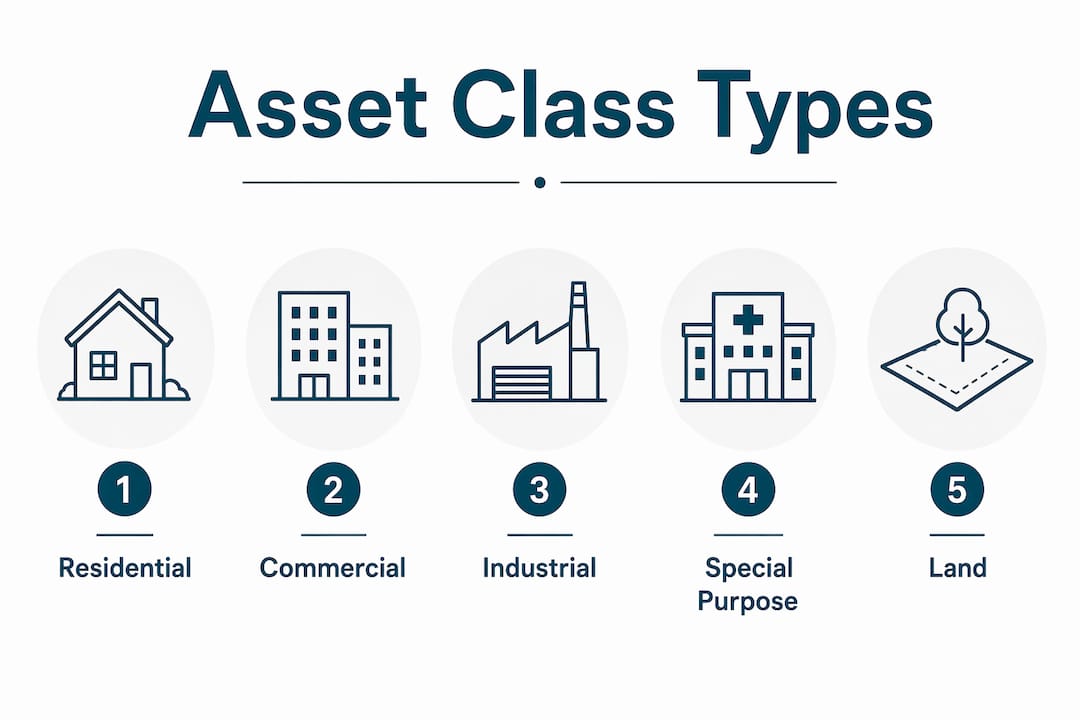
A real estate asset class is tangible property — land plus permanent structures — grouped by how it generates value and how it behaves across market cycles. Investopedia defines real estate as land and permanent improvements, categorized into five primary classes: residential, commercial, industrial, land, and special-purpose. Add indirect vehicles like REITs and private funds, and you have the full investable universe most practitioners work with.
Why does this matter if you are buying or selling a home? Because the class your property falls into shapes pricing logic, financing terms, buyer pool size, and how long a transaction takes.
Primary real estate categories at a glance:
- Residential — single-family homes, condos, townhouses, multifamily up to four units
- Commercial — office, retail, apartment buildings of five or more units
- Industrial — warehouses, manufacturing facilities, distribution centers
- Land — raw, undeveloped, or agricultural parcels
- Special-purpose — schools, parks, senior housing, data centers
- Indirect vehicles — REITs, private real estate funds, CMBS
MSCI's Global Real Asset Classification Standards (GRACS) formalizes this taxonomy for institutional investors. Beamsrealtygroup uses the same framework to advise clients on which class fits their goals before a transaction begins.
Table of Contents
- What the real estate asset class actually includes
- How the major asset classes compare side by side
- How real estate behaves inside a diversified portfolio
- Key metrics every buyer and seller should understand
- How to choose the right asset class for your situation
- Key Takeaways
- Why asset-class thinking changes how Beamsrealtygroup advises clients
- Useful sources and next steps
What the real estate asset class actually includes
The phrase "asset class" describes how a property generates returns — rent, lease income, or appreciation. "Property type" describes the physical form. Confusing the two is one of the most common mistakes first-time investors make.
Direct ownership means you hold title: you are the owner-occupier living in a single-family home, or the landlord collecting rent on a duplex. Indirect exposure means you own a share of a vehicle that holds property — a publicly traded REIT you can sell on any trading day, or a private fund with a multi-year lock-up.
Common property types nested under each class:
- Residential: single-family homes, condos, townhouses, multifamily (2–4 units)
- Commercial: office buildings, retail strips, apartment complexes (5+ units)
- Industrial: warehouses, fulfillment centers, flex space
- Land: raw acreage, infill lots, farmland
- Special-purpose: senior housing, self-storage, data centers, medical facilities
Yieldstreet notes that Class A, B, and C designations are a separate quality grading used by brokers and lenders — not an official asset-class taxonomy. A Class B warehouse and a Class B apartment building are in different asset classes despite sharing the same letter grade.
Pro Tip: If you are selling a rental property, identify your asset class before pricing it. A small multifamily building (2–4 units) is underwritten like residential; five units and above shifts to commercial underwriting, which changes your buyer pool and financing terms entirely.

How the major asset classes compare side by side
| Asset class | Typical buyer/use | Liquidity | Income profile | Volatility | Barriers to entry | Time horizon |
|---|---|---|---|---|---|---|
| Residential (single-family) | Owner-occupier, small landlord | High | Appreciation-led; modest rent | Low–moderate | Low capital; standard mortgage | 3 years |
| Multifamily (2–4 units) | Small investor, house-hacker | High | Rent income + appreciation | Low–moderate | Low–moderate; residential financing | — |
| Commercial office | Institutional, REIT | Low–moderate | Lease income | Moderate–high | High capital; specialized underwriting | — |
| Industrial/warehouse | Institutional, regional investor | Moderate | Long-term lease income | Low–moderate | Moderate–high capital | — |
| Land | Speculative investor, developer | Low | Minimal until developed | High | Low purchase price; high carry cost | 5–20+ years |
| Special-purpose | Institutional, operator | Very low | Operational income | High | Very high; operational expertise required | — |
| Indirect (REITs/funds) | Any investor | Very high (public REITs) | Dividends + NAV growth | Moderate (public) | Very low; no minimum for public REITs | Flexible |
For most U.S. homebuyers and sellers, residential single-family and small multifamily are the relevant rows. PREA's four-quadrant framework — private equity, public equity, private debt, public debt — is the lens institutional investors use to balance liquidity and return objectives across all classes.
Special-purpose assets like data centers and senior housing can offer demographic-driven growth, but they carry narrow buyer pools and require operational expertise most individual buyers do not have. Proceed carefully.
How real estate behaves inside a diversified portfolio
Real estate's portfolio role comes down to three things: income, inflation protection, and low correlation to stocks.
DWS institutional research finds that commercial real estate has historically shown lower volatility than public equities while producing attractive risk-adjusted returns. Two structural reasons explain this: leases lock in cash flows for months or years, and appraisal-based valuations smooth out the price swings that mark-to-market assets experience daily.
Key insight: Private real estate historically has lower correlation to stocks and bonds, driven by appraisal smoothing and lease cash flows — making it a core diversifier for institutional portfolios.
For buyers and sellers, this has practical implications:
- Listing timing: National headlines about rate moves matter less than local absorption rates and active inventory in your zip code.
- Lease rollover awareness: Sellers of rental property should know when leases expire. A building with leases rolling over in six months is priced differently than one with three-year terms in place.
- Appraisal smoothing: Appraised values lag market peaks and troughs. Do not assume a recent appraisal reflects today's market if conditions have shifted sharply.
Pro Tip: When valuing your property, pull rental comps and days-on-market data for your specific neighborhood — not the metro average. Local fundamentals diverge from national trends more often than most sellers expect.
Key metrics every buyer and seller should understand
You do not need to master every metric, but knowing what they measure tells you when a deal is priced right or when something is off.
- Cap rate — Net operating income divided by purchase price. Used for income-producing properties; a higher cap rate signals either higher income or higher perceived risk.
- Net operating income (NOI) — Gross rental income minus operating expenses, before debt service. The core profitability figure for any rental property.
- Cash-on-cash return — Annual pre-tax cash flow divided by total cash invested. Tells you what your actual dollars are earning, not what the property earns on paper.
- Vacancy rate — Percentage of rentable units sitting empty. Rising vacancy in a market is an early warning sign for sellers and a negotiating lever for buyers.
- Loan-to-value (LTV) — Loan balance divided by appraised value. Lenders use this to set rates and terms; mortgage eligibility thresholds vary by property type.
- Gross rent multiplier (GRM) — Purchase price divided by annual gross rent. A quick screening tool, not a substitute for full underwriting.
For owner-occupied single-family transactions, cap rate and NOI are largely irrelevant — you are buying a home, not underwriting a cash flow stream. They become critical the moment you cross into landlord territory. SmartAsset's breakdown of asset classes by property type is a useful reference for seeing which metrics apply to which class.
Red flags these metrics expose: negative NOI after realistic vacancy, cap rates far below local market averages (suggesting overpricing), and LTV above 80% on commercial deals without strong lease coverage.
How to choose the right asset class for your situation
Pick the class that matches your primary goal and your real constraints — capital available, time horizon, and willingness to manage an asset actively.
- Define your goal. Owner-occupancy, cash flow, long-term appreciation, or portfolio diversification each point to a different class.
- Set your time horizon. Need proceeds within 12 months? Land and special-purpose assets are the wrong answer. Residential and public REITs offer the fastest exit.
- Calculate available capital and leverage tolerance. Residential financing is accessible with standard credit and 3–20% down. Commercial loan rates and underwriting standards differ substantially from residential mortgages.
- Evaluate local demand and supply. A warehouse in a logistics corridor and a warehouse in a shrinking industrial town are not the same investment despite sharing an asset class.
- Check operational requirements. Can you manage tenants, or will you hire a property manager? Special-purpose assets often require an operator, not just an owner.
- Choose direct vs. indirect exposure. If you want real estate in your portfolio without the transaction friction, a publicly traded REIT gives you daily liquidity. Direct ownership gives you control and leverage but locks up capital.
Questions worth asking before you commit:
- Do you need sale proceeds within 12 months?
- Are you prepared to handle tenant turnover, maintenance calls, and lease renewals?
- Does your target market have enough comparable sales to support your exit price?
Stepstone Group's real estate primer makes the point plainly: disciplined framework-based selection outperforms market timing. Pick the class that fits your situation, then find the best asset within it.
Pro Tip: Align your expected holding period with the liquidity profile of the asset class before you sign. Buying a special-purpose property when you might need to sell in three years is a structural mismatch that no amount of negotiation skill will fix.
Key Takeaways
Real estate asset classes group property by how value is generated — rent, leases, or appreciation — and that distinction drives every pricing, financing, and timing decision in a transaction.
| Point | Details |
|---|---|
| Asset class vs. property type | Asset class describes return behavior; property type describes physical form — knowing the difference prevents mispricing. |
| Residential dominates for most buyers | Single-family and small multifamily use residential financing, have the highest liquidity, and suit most U.S. owner-occupiers and small landlords. |
| Direct vs. indirect exposure | Direct ownership gives control; REITs give daily liquidity — match the vehicle to your time horizon and capital. |
| Liquidity varies widely | Land and special-purpose assets can take years to sell; residential and public REITs offer the fastest exits. |
| Use local data, not national headlines | Neighborhood absorption rates and rental comps are more reliable pricing signals than metro-wide or national averages. |
Why asset-class thinking changes how Beamsrealtygroup advises clients
Most buyers walk in asking about neighborhoods. Beamsrealtygroup starts one step earlier: what is the property supposed to do for you?
That question changes everything. An owner-occupier buying a single-family home in Virginia needs guidance on school districts, commute corridors, and resale comparables. A buyer acquiring a small multifamily building needs NOI validation, lease review, and a realistic vacancy assumption for that specific submarket. Same transaction process on the surface; completely different advisory work underneath.
During intake, Beamsrealtygroup asks three questions that most agents skip: What is your intended holding period? Do you plan to self-manage or hire out? And do you need the equity liquid within a defined window? The answers determine whether a client belongs in residential, small commercial, or should be redirected toward an indirect vehicle entirely.
For sellers, asset-class framing shapes listing strategy. A landlord selling a stabilized rental with long-term leases in place should lead with income documentation, not curb appeal photos. That property is being bought as a cash flow asset, and the buyer's underwriting will reflect it. Highlighting stable lease income rather than short-term appreciation attracts the right buyer pool and shortens time on market.
Beamsrealtygroup brings this practitioner lens to every transaction — translating institutional concepts into decisions that actually move deals forward for Virginia buyers and sellers.
Useful sources and next steps
- Investopedia — Real Estate Definition: Clear baseline definition of real estate and its five primary categories.
- MSCI GRACS: The institutional taxonomy standard for real estate sub-sectors and property types.
- DWS — Real Estate as an Asset Class: Institutional research on volatility, income, and diversification benefits.
- PREA / IPD U.S. Property Fund Index: Four-quadrant exposure framework used by practitioners.
- Stepstone Group — Real Estate Primer: Investor-focused overview of return drivers and selection frameworks.
- SmartAsset — Real Estate Asset Classes: Accessible breakdown of asset classes, property types, and specialization differences.
- Yieldstreet — Asset Classes and Property Types: Explains Class A/B/C quality grading versus formal asset-class taxonomy.
- Beamsrealtygroup: Local resource for Virginia buyers and sellers seeking personalized transaction guidance.