
Off-market listings are properties sold without public advertisement, giving buyers access to homes that never appear on the MLS or major listing portals. This private channel, sometimes called a "pocket listing," delivers three core advantages: reduced competition, greater negotiation flexibility, and stronger privacy for both parties. Specialized firms report that over 30% of client purchases occur through off-market channels. That figure signals a substantial private inventory that most buyers never see. Understanding why off-market listings benefit buyers starts with recognizing what happens when a property never hits the open market.
Why off-market listings benefit buyers through reduced competition
The most immediate advantage of an off-market deal is the absence of a bidding war. On the public market, a desirable home can attract dozens of offers within 48 hours. Off-market, you are typically one of a handful of buyers, or the only one.
This shift changes the entire dynamic of the purchase. Buyers report calmer, more direct communication with sellers in off-market deals, which lowers both emotional and financial strain. When you are not watching a competing offer push the price beyond your budget, you think more clearly and negotiate more effectively.

Consider the difference in a practical scenario. At a public auction, you commit to a price under pressure, often waiving conditions to stay competitive. In a private sale, you set the pace. You ask questions. You request a second inspection. You propose terms that work for your situation.
The benefits of reduced competition include:
- No auction pressure. You avoid the psychological trap of overbidding to "win."
- More time to assess. You can review the property without a competing clock running.
- Direct seller access. Conversations happen between principals, not through competing agents managing multiple offers.
- Stronger buyer leverage. Sellers who choose privacy often prioritize a smooth deal over maximum price.
Pro Tip: Before approaching an off-market seller, know your absolute ceiling price and your ideal terms. Walking in without that clarity hands leverage back to the seller.
What negotiation advantages do off-market listings provide?
Off-market deals open negotiation territory that public sales rarely allow. Price is only one variable. In a private transaction, buyers regularly negotiate settlement timelines, rent-back agreements, and customized financing clauses that would be dismissed outright in a competitive public sale.
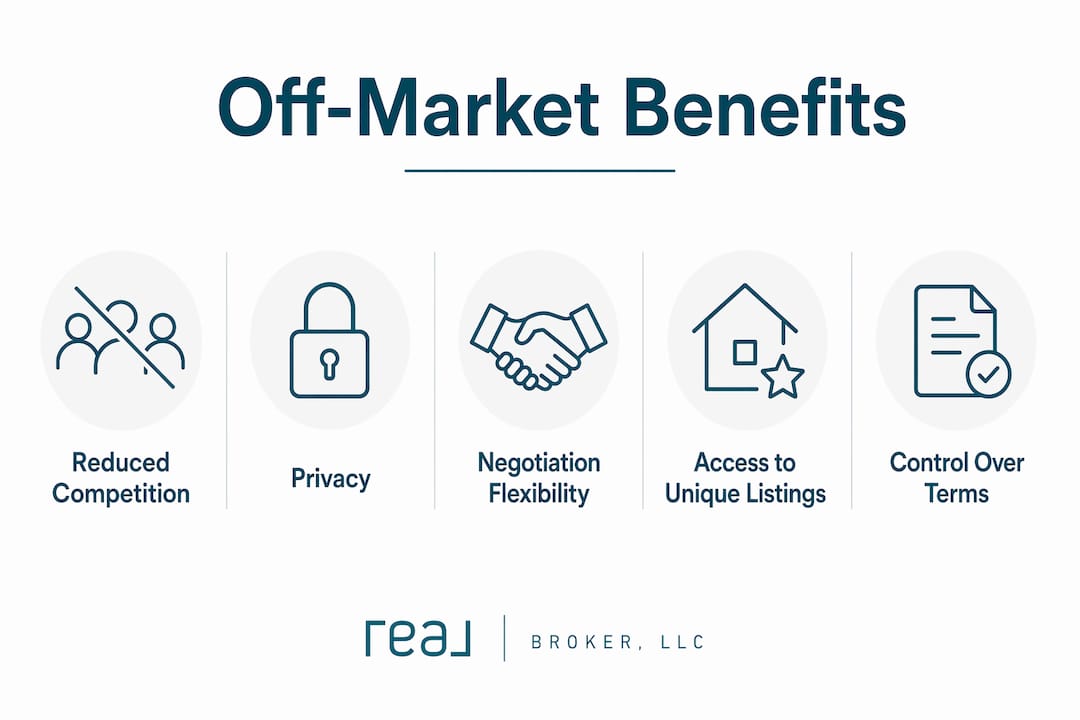
Extended settlement periods, rent-back options, and custom financing clauses are common negotiation points in off-market transactions. These terms matter enormously to buyers who need time to sell an existing property or who want flexibility on their move-in date. A seller who avoids public listing often does so because they want a specific outcome, not just the highest number. That alignment creates room for creative deal structures.
Pricing data supports the stability of off-market transactions. Off-market homes show about 20% less visible price reduction and achieve a 1.6% higher sale-to-list price ratio compared to publicly listed properties. That means sellers price with more confidence and buyers face fewer artificial price signals. The negotiation starts from a more honest baseline.
The key negotiation advantages buyers gain off-market:
- Settlement flexibility. Agree on a 60, 90, or 120-day close without competing buyer pressure.
- Rent-back agreements. Allow the seller to remain in the home briefly after closing, which often unlocks a lower price.
- Financing contingencies. Include mortgage and appraisal clauses that auction buyers routinely waive.
- Repair credits. Request concessions after inspection without fear of losing the deal to another bidder.
Pro Tip: Bring a licensed real estate attorney to review any off-market contract. Terms that deviate from standard forms need professional scrutiny before you sign.
What privacy and discretion benefits do off-market listings offer?
Privacy is a defining feature of off-market sales, and it benefits buyers more than most realize. When a property never appears publicly, your interest in it stays confidential. That matters for executives, investors, and anyone who prefers their financial moves stay out of public record until the deal closes.
Sellers in prestige markets choose off-market sales specifically to avoid public scrutiny. That preference creates a quieter negotiation atmosphere. There is no open house crowd, no public days-on-market counter ticking upward, and no public price history for other buyers to use against you.
The privacy dynamic also affects timelines. Sellers who value discretion tend to work with a small circle of trusted agents and buyers. That selectivity filters out low-intent parties and produces more productive conversations from the first meeting.
How privacy benefits buyers in practice:
- Confidential interest. Your offer and financial position stay between you and the seller.
- No public bidding record. Other buyers cannot see what you offered or use your history to outmaneuver you.
- Focused seller attention. Without dozens of inquiries to manage, sellers engage more seriously with each buyer.
- Reduced public scrutiny of the property. Fewer eyes on the home means fewer competing opinions driving up demand.
The Clear Cooperation Policy reduced the pricing premium of pocket listings in some markets but preserved their core function: filtering for high-intent buyers who value private transactions. Privacy remains a structural advantage regardless of policy shifts.
What risks should buyers know before purchasing off-market?
Off-market deals carry real risks, and buyers who ignore them pay for it later. The absence of public listing means less pricing data, shorter inspection windows, and no external market pressure keeping the seller honest on price.
The most common risk is valuation uncertainty. Without comparable public listings to anchor the price, buyers can overpay without realizing it. Off-market status places full due diligence responsibility on the buyer since public scrutiny is absent. That means independent appraisals, structural inspections, and title searches are non-negotiable, not optional extras.
A second risk is timeline pressure. Off-market negotiations often involve tighter timelines and faster inspection periods. Sellers who want discretion also tend to want speed. Buyers who are not pre-approved and not ready to move quickly lose deals or make rushed decisions.
Understanding the type of off-market listing also matters. Pre-market listings and true pocket listings are fundamentally different. Pre-market properties are "coming soon" announcements that can generate a buyer list and create artificial competitive pressure before the official launch. A true pocket listing stays fully private throughout the entire sale process.
| Listing type | Key characteristic | Buyer implication |
|---|---|---|
| Pre-market | Announced publicly before MLS launch | Can attract competing buyers early |
| Pocket listing | Never publicly advertised | Fully private, lowest competition |
| Off-MLS sale | Sold without MLS but may be marketed | Varies by agent and seller preference |
A common misconception is that off-market automatically means a lower price. Off-market deals do not guarantee price discounts. Their value lies in negotiation control, privacy, and reduced competition. Buyers who enter expecting a bargain without independent valuation often overpay.
Pro Tip: Always commission an independent appraisal before making an off-market offer. Never rely solely on the seller's agent valuation, which reflects the seller's interests, not yours.
How can buyers find and access off-market listings?
Access to off-market properties runs through relationships, not search portals. The buyers who consistently find these deals share one trait: they are connected to agents who specialize in private transactions and they are ready to act when a property surfaces.
A licensed buyer's agent is the most direct path to off-market inventory. These professionals maintain networks of seller agents, attorneys, and property managers who share listings before they go public. Beamsrealtygroup builds exactly these relationships for buyers in Virginia, giving clients access to properties that never reach the open market.
Preparation is equally critical. Buyers must have financing pre-approval and professional support ready before engaging off-market listings. A seller offering a private deal will not wait for a buyer to get their finances in order. Pre-approval, a clear budget, and a shortlist of preferred neighborhoods signal that you are a serious buyer worth the seller's time.
Practical steps to access off-market deals:
- Work with a buyer's agent who specializes in private sales. General agents rarely have access to true pocket listings.
- Get pre-approved before you start looking. Sellers and their agents screen buyers for readiness before sharing private listings.
- Build relationships with estate attorneys and property managers. These professionals often know about sales before any agent does.
- Be specific about what you want. Vague buyers get generic listings. Buyers who describe their ideal property in detail get matched to off-market opportunities that fit.
- Combine agent access with independent valuation. Never let relationship access replace your own due diligence on price and condition.
First-time buyers benefit most from a buyer's agent in this context. The off-market process moves faster and requires more preparation than a standard MLS search. Professional guidance closes that gap.
Key Takeaways
Off-market listings give buyers negotiation control, privacy, and reduced competition that public listings cannot match, but only when buyers enter with preparation and professional support.
| Point | Details |
|---|---|
| Reduced competition | Off-market buyers face fewer competing offers, creating calmer and more productive negotiations. |
| Negotiation flexibility | Buyers can negotiate settlement timelines, rent-back terms, and financing clauses unavailable in public sales. |
| Privacy advantage | Both parties benefit from confidential transactions, filtering out low-intent buyers and reducing public pressure. |
| Due diligence is non-negotiable | Absent public scrutiny, buyers must commission independent appraisals and inspections before every offer. |
| Pre-approval is required | Sellers in private deals expect buyers to be financially ready before the first conversation. |
What I have learned after watching buyers win and lose off-market deals
The buyers I see succeed off-market share one quality: they treat preparation as a competitive advantage, not a formality. They arrive pre-approved, they know their target neighborhoods in detail, and they have an attorney on standby. The buyers who struggle arrive with enthusiasm but no structure.
The biggest misconception I encounter is that off-market means discounted. It does not. What it means is that you have a real conversation with a seller instead of a bidding war with strangers. That conversation can produce better terms, a better timeline, and a deal structure that actually fits your life. Price is one variable in that conversation, not the only one.
I also think buyers underestimate the value of the privacy benefit for themselves. Most buyers focus on the seller's desire for discretion. But your financial position, your offer history, and your interest in a property are also private in an off-market deal. That confidentiality gives you room to negotiate without exposing your hand to competing buyers.
The risk side is real and should not be minimized. Shorter timelines and limited pricing data require discipline. Every off-market offer I have seen go wrong shared the same flaw: the buyer skipped the independent appraisal because the deal felt urgent. Urgency is not a reason to skip due diligence. It is a reason to have your team ready before you need them.
— Myra
How Beamsrealtygroup connects buyers to off-market opportunities
Beamsrealtygroup works with homebuyers and investors in Virginia who want access to properties that never reach the public market. The team maintains active relationships with seller agents, attorneys, and property managers across the region, giving clients a direct line to private listings before they surface anywhere else. Every client arrives pre-screened and pre-prepared, which is exactly what sellers in private transactions require. From the first conversation through closing, Beamsrealtygroup handles negotiation strategy, contract review coordination, and due diligence guidance so buyers move with confidence, not guesswork. If you are ready to access deals the open market never shows, contact Beamsrealtygroup to get started.
FAQ
What is an off-market listing?
An off-market listing is a property sold without public advertisement on the MLS or major portals. The sale happens through private networks, buyer's agents, or direct seller contact.
Do off-market homes sell for less than market value?
Off-market homes do not automatically sell below market value. Buyers must commission independent appraisals because fewer public price signals are available to anchor the negotiation.
How do I find off-market properties as a buyer?
Work with a licensed buyer's agent who specializes in private sales, get pre-approved for financing, and build relationships with real estate attorneys and property managers who hear about sales early.
What is the difference between a pre-market and a pocket listing?
A pre-market listing is announced publicly before its MLS launch and can attract competing buyers. A pocket listing stays fully private throughout the entire sale, offering the lowest competition for buyers.
Is off-market buying suitable for first-time buyers?
Off-market buying works for first-time buyers who work with an experienced buyer's agent. The faster timelines and limited public data require professional guidance that a specialist agent provides.