
Real estate agent efficiency is defined as how effectively an agent manages time and resources to produce successful property transactions. The role of real estate agent efficiency goes far beyond showing homes or listing properties. Top agents who use AI and automation reclaim 15–23 hours weekly, dedicating 60–70% of their time to revenue-generating activities. That gap in time allocation directly determines whether your transaction closes on schedule, at the right price, and without costly surprises. Beamsrealtygroup works from this principle every day, applying it to every client relationship in Virginia.
What tasks define the role of real estate agent efficiency?
Agent efficiency is measured by how an agent divides time between administrative work and high-value client activities. The distinction matters more than most buyers and sellers realize.
Median agents spend 9 hours weekly on non-client-facing tasks. That adds up to roughly 39 hours monthly on paperwork, inbox management, and scheduling follow-ups. Those are hours not spent negotiating on your behalf or preparing your pricing strategy.
High-value agent activities include:
- Lead qualification and client consultation. Structured early conversations identify serious buyers and sellers, preventing wasted appointments.
- Negotiation and offer management. This is where an agent's skill directly affects your financial outcome.
- Comparative market analysis (CMA) preparation. Accurate pricing protects sellers from undervaluing and buyers from overpaying.
- Risk identification. Spotting inspection red flags or appraisal gaps before they derail a deal.
Top agents gain operational leverage by offloading CMA prep, inbox triage, and routine follow-up to staff or AI tools. The result is a 5x deal volume advantage over median agents. That gap owes mostly to capacity, not raw skill.
Pro Tip: Ask any agent you interview how they handle routine administrative tasks. An agent who answers with a specific system or tool is far more likely to stay on top of your transaction than one who relies on memory alone.

How do technology and AI tools improve agent performance?
AI tools have changed what a productive agent looks like. The improvements are specific and measurable, not vague promises about working smarter.
Virtual staging and listing coordination
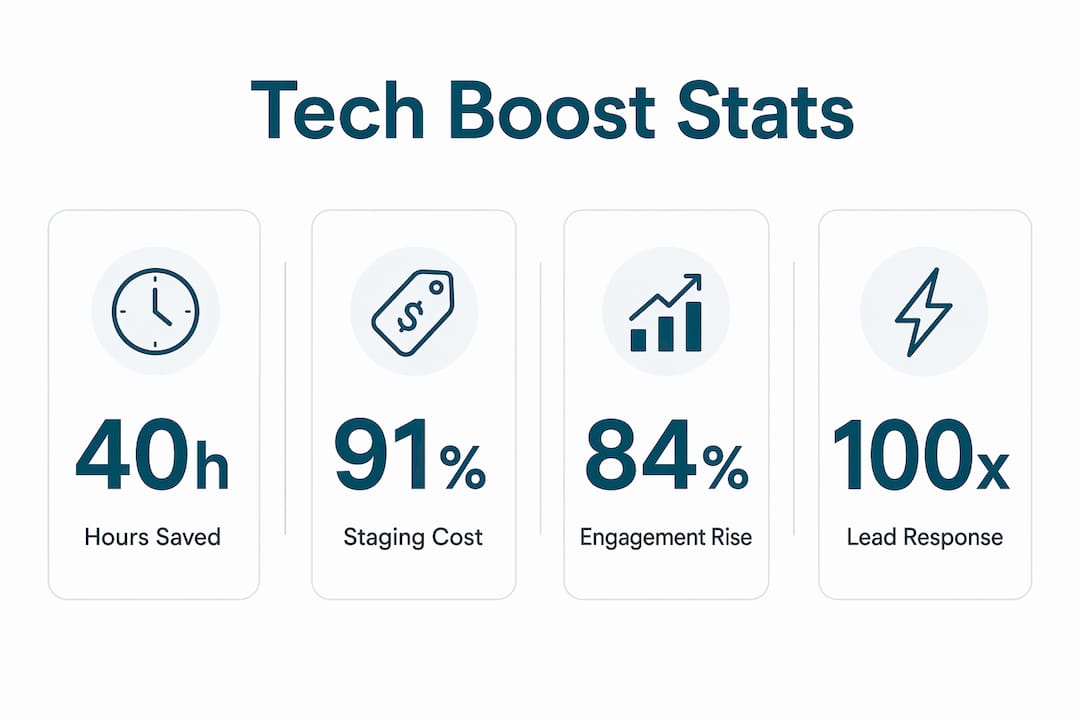
AI-driven listing coordination reduces staging costs by up to 91% and improves listing engagement by 84%. Time on market drops by 38% for listings managed with AI-assisted workflows. Each listing saves an average of 4.8 hours in coordination time. That time goes back into client communication and negotiation prep.
Automated lead response
Responding to a new inquiry within 5 minutes makes an agent 100 times more likely to qualify that lead than waiting over 30 minutes. Automated lead-response systems make that speed consistent, not dependent on whether the agent is in a showing or on another call. For you as a buyer or seller, this means your agent's attention is never divided at a critical moment.
AI-assisted CMA preparation
AI CMA tools save agents 8–15 hours monthly across 3–5 analyses. That is time reinvested into understanding your specific neighborhood, not spent pulling comps manually. Accurate CMAs directly affect your list price and your negotiating position.
The table below shows where AI tools create the most measurable time savings:
| Task | Time saved with AI | Direct client benefit |
|---|---|---|
| CMA preparation | 8–15 hours/month | More accurate pricing strategy |
| Listing coordination | 4.8 hours/listing | Faster market entry, lower staging cost |
| Lead response | Up to 40 hours/month | No missed inquiries, faster appointments |
| Inbox and follow-up triage | 9 hours/week | Agent stays focused on your transaction |
Pro Tip: When interviewing agents, ask specifically which tools they use for lead follow-up and CMA preparation. Vague answers like "I use technology" signal that the agent has not actually integrated these tools into their daily workflow.
Automation works best when it handles repetitive tasks, not client relationships. The best agents use AI to free up time for the conversations and decisions that require human judgment. Efficiency is about reinvesting reclaimed time into high-impact client activities, not just working faster.
What metrics help you evaluate real estate agent effectiveness?
Online reviews measure satisfaction and responsiveness. They do not reliably indicate financial performance. To evaluate an agent's true effectiveness, you need objective data.
List-to-sale price ratio
A consistent list-to-sale ratio of 98–102% signals an agent who prices accurately and negotiates well. A ratio below 95% for a seller's agent suggests chronic overpricing or weak negotiation. A ratio above 100% for a buyer's agent means clients routinely pay over asking, which is worth questioning.
Days on market
Days on market measures how long a listing sits before going under contract. A low average relative to the local market indicates strong pricing, good marketing, and effective buyer qualification. An agent with a high days-on-market average may be overpricing listings or underinvesting in marketing.
Transaction volume and neighborhood focus
Volume matters, but neighborhood focus matters more. An agent who closes 40 deals per year in your specific zip code knows the micro-market pricing patterns, the common inspection issues in local housing stock, and the active buyer pool. An agent with 80 deals spread across three counties may know less about your street than you do.
Effective agents combine neighborhood expertise with consistent performance metrics. Great communication skills alone do not protect you financially. You can request MLS-derived performance data directly from any agent you are seriously considering. A confident, effective agent will provide it without hesitation.
How does agent efficiency directly benefit buyers and sellers?
Agent efficiency translates into specific, tangible outcomes for you. The benefits show up at every stage of a transaction.
For sellers, an efficient agent:
- Prices accurately from day one. Overpriced listings go stale. Stale listings attract low offers. An agent with a strong CMA process prevents this cycle entirely.
- Reduces time on market. Faster sales mean fewer carrying costs, fewer price reductions, and less negotiating leverage lost to a "why has it been sitting?" question from buyers.
- Catches compliance issues early. Missed disclosures are one of the most common causes of deal cancellations. Automation can reduce missed disclosures to below 1%.
For buyers, an efficient agent:
- Qualifies your offer position quickly. In competitive markets, speed and preparation win. An agent who can submit a clean, complete offer within hours of a showing has a structural advantage.
- Manages inspection and appraisal risk. The role of agents has evolved from showing homes to managing process control, including mitigating inspection surprises and appraisal gaps that kill deals.
- Prevents administrative delays. A delayed document request or missed deadline can push a closing back by weeks or void a contract entirely.
Understanding how to negotiate investment property purchase price is one example of where an agent's preparation and process directly protect your financial position. Efficient agents do not wing these conversations. They arrive with data, a strategy, and a clear understanding of your priorities.
Process control is vital to guarding high-dollar risks and ensuring smooth closings. Every administrative delay is a potential deal failure. Every missed deadline is a financial risk.
Key Takeaways
Agent efficiency is the single most reliable predictor of transaction success, and buyers and sellers can measure it with objective data before signing any agreement.
| Point | Details |
|---|---|
| Time allocation reveals agent quality | Top agents spend 60–70% of time on client-facing, revenue-generating work. |
| AI tools create measurable advantages | AI saves up to 40 hours monthly, cutting staging costs and reducing time on market. |
| Reviews do not equal performance | Request MLS metrics like list-to-sale ratio and days on market to evaluate agents objectively. |
| Process control protects your money | Efficient agents catch inspection issues, appraisal gaps, and compliance problems before they cost you. |
| Neighborhood focus beats raw volume | An agent with deep local expertise outperforms a high-volume generalist in your specific market. |
What I've learned about choosing an efficient agent
Most buyers and sellers pick agents based on personality. That is understandable. You are about to spend months working closely with this person on one of the largest financial decisions of your life. But personality is not a proxy for performance.
I have seen charming, well-reviewed agents consistently leave money on the table because they had no system for pricing, no process for follow-up, and no tools to manage the complexity of a modern transaction. I have also seen quieter, less flashy agents close deals faster and at better prices simply because they ran a tight operation.
The question to ask every agent candidate is not "how long have you been in real estate?" It is "walk me through what happens from the moment I sign with you to the day we close." An efficient agent will give you a specific, step-by-step answer. An inefficient one will describe their personality.
Clients should ask agents to explain their pricing strategy, negotiation approach, risk mitigation process, and how they handle communication. These questions reveal operational reality, not just intent. You deserve an agent who can answer all four without hesitation.
The real estate market in Virginia, like most markets, rewards preparation. Knowing what drives a real estate cycle and how an agent responds to shifting conditions tells you far more than any five-star review.
— Myra
How Beamsrealtygroup puts efficiency to work for you

Beamsrealtygroup brings together deep Virginia market knowledge and technology-enabled workflows to deliver faster, cleaner transactions for buyers and sellers. The team uses AI-assisted CMA preparation, automated follow-up systems, and structured client communication to keep every deal on track from first showing to final closing. You get an agent who spends their time on your negotiation and your outcome, not on paperwork. Whether you are buying your first home or selling an investment property, Beamsrealtygroup's approach means fewer surprises, better pricing, and a process you can actually follow. Explore personalized real estate services and see what working with an efficient, dedicated team looks like.
FAQ
What is real estate agent efficiency?
Real estate agent efficiency is the measure of how effectively an agent allocates time and resources to produce successful transactions. Efficient agents spend 60–70% of their time on high-value activities like negotiation and client consultation rather than administrative tasks.
How can I measure a real estate agent's effectiveness?
Request objective MLS data including list-to-sale price ratio, days on market, and transaction volume in your target neighborhood. A list-to-sale ratio of 98–102% indicates accurate pricing and strong negotiation skills.
Do online reviews accurately reflect agent performance?
Online reviews measure client satisfaction and responsiveness, not financial outcomes. MLS-derived metrics give a more reliable picture of whether an agent actually protects your financial interests.
How does AI improve real estate agent performance?
AI tools save top agents up to 40 hours monthly by automating lead response, CMA preparation, and listing coordination. That time goes back into client-facing work, which directly improves your transaction outcome.
What questions should I ask an agent about their efficiency?
Ask agents to walk you through their full transaction process, explain their pricing strategy, and describe how they handle inspection or appraisal issues. Specific, detailed answers signal an agent who runs a structured, reliable operation.