
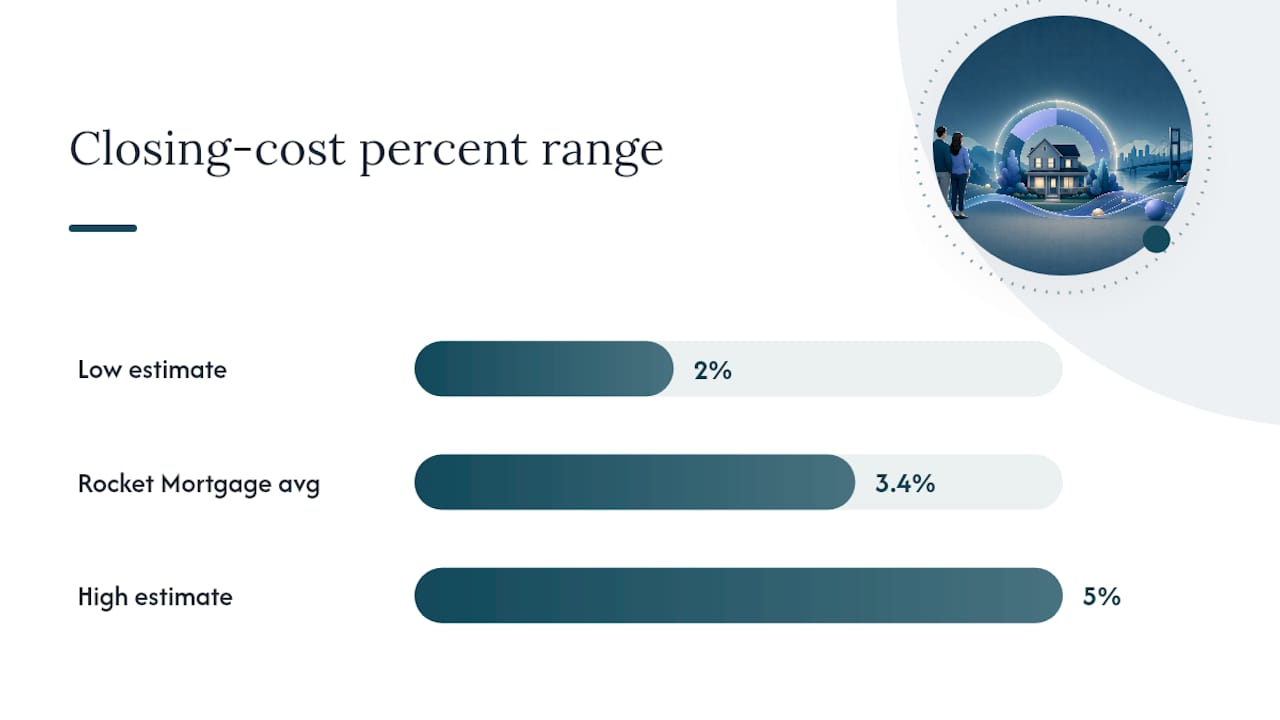
Virginia buyers pay an average of $16,054 in closing costs, roughly 3.4% of the purchase price. The safer planning number is 2% to 5% of your home's price, on top of your down payment, since your exact tab depends on loan type, locality, and who negotiates what into the contract. Buyers and sellers split the bill differently, and the details below show exactly where your money goes.
TL;DR:
- Borrowers should expect to pay between 2% and 5% of the purchase price in closing costs, varying by loan type, location, and negotiations.
- Virginia statutory taxes, like the deed recordation tax and grantor's tax, are fixed by law and typically paid by the buyer, leaving little room for negotiation.
- Shop multiple lenders and title companies early to compare fees and obtain written quotes, which can significantly reduce overall closing expenses.
- Negotiating seller concessions of 2% to 3% of the purchase price can help offset closing costs, especially in slower markets.
- Timing the closing near the start of the month and locking in rates after comparing lenders offers the best opportunities for cost savings.
Table of Contents
- Closing Costs Virginia Buyers and Sellers Should Budget For
- What Closing Costs Look Like at $300K, $500K, and $700K
- Who Pays What: Buyer and Seller Closing Cost Splits in Virginia
- Fee-by-Fee: What Every Line on Your Closing Disclosure Means
- How to Estimate Your Own Closing Costs Before You Sign
- Ways to Lower Your Closing Costs in Virginia
- Virginia's Statutory Taxes and Why an Attorney Often Gets Involved
- A Checklist and Sample Estimate to Bring to Closing
- The Real Lesson Buyers and Sellers Miss About Closing Costs
- Sources
Closing Costs Virginia Buyers and Sellers Should Budget For
Closing costs are the fees and prepaid expenses you pay to finalize a real estate transaction, separate from the purchase price itself. They cover the lender's underwriting work, the title company's research and insurance, government recording taxes, and the upfront funding of your escrow account for property taxes and insurance.
A cash purchase skips lender fees entirely. A jumbo loan in Northern Virginia triggers higher title premiums than a conventional loan in the Shenandoah Valley. Your two most important documents, the Loan Estimate and the Closing Disclosure, translate all of this into real numbers specific to your file. At Beamsrealtygroup, we walk clients through both documents line by line before they sign anything.
What actually moves the number:
- Loan type and size (conventional, FHA, VA, jumbo)
- Locality, since cities and counties add their own recordation fees
- Purchase price, because several taxes and premiums scale with it
- Whether you negotiate seller concessions into the offer
What Closing Costs Look Like at $300K, $500K, and $700K
Dollar ranges make the 2% to 5% rule concrete. Here's how it plays out at three common Virginia price points, using the low end, the industry mid-range, and the high end of typical estimates:
- $300,000 home: $6,000 (2%) to $15,000 (5%), with $10,000 to $10,200 as a realistic middle
- $500,000 home: Closing costs typically fall within a wide range depending on buyer qualifications and loan type.
- $700,000 home: Higher purchase prices generally lead to proportionally higher closing costs due to certain fees scaling with price.
The industry benchmark: Rocket Mortgage's average of $16,054, about 3.4% of price, lands squarely in the middle of these ranges for a typical Virginia purchase near the state's median home value.
Your actual number can drift from these estimates for a simple reason: title and settlement offices break out fees differently. Some bundle the settlement fee with title search costs, while others itemize every line separately. Ask for a written quote early so you're comparing apples to apples.
Who Pays What: Buyer and Seller Closing Cost Splits in Virginia
Virginia follows fairly consistent customary splits, though your purchase contract is the document that actually governs who pays for what.
- Buyers typically cover: state and local recordation taxes on the deed of trust, all lender fees (origination, appraisal, credit report), prepaid escrow funding, and often the lender's title insurance policy.
- Sellers typically cover: the grantor's tax, the real estate commission, and in some regions, additional transfer fees. Sellers in Northern Virginia and Hampton Roads face regional add-ons like the WMATA capital fee or congestion fee that push seller costs above the statewide baseline.
- Everything is negotiable within the contract. Seller concessions toward buyer closing costs are common, especially in slower markets or when a seller wants a faster close.
Check your ratified contract against this list. If a line item doesn't match the customary split, it was probably negotiated that way on purpose.
Fee-by-Fee: What Every Line on Your Closing Disclosure Means
Your Closing Disclosure groups charges into categories. Here's what each one actually pays for.
Lender fees cover the cost of underwriting your loan: origination fees, appraisal fees, credit report charges, and discount points if you're buying down your rate. Origination fees are often negotiable, especially if you have competing Loan Estimates in hand. Appraisal and credit report fees are closer to fixed, pass-through costs.
Title and settlement charges protect the lender and, if you buy an owner's policy, protect you. Virginia title and settlement offices separate professional fees, title premiums, and third-party charges, with settlement fees commonly running from a few hundred dollars into the low thousands depending on region and file complexity. Because title insurance rates vary by underwriter and there's no single statewide fee schedule, shopping two or three title companies can genuinely lower this line.

Government taxes and recording fees are set by statute, not negotiation. Virginia charges a state deed recordation tax of $0.25 per $100 of the loan amount, plus a local third typically around $0.0833 per $100. These apply to the buyer's deed of trust.
Prepaids and escrow funding include your first year of homeowner's insurance, prepaid daily interest from closing through the end of the month, and an initial deposit into your property tax escrow account. Closing date timing changes these amounts directly, since fewer days of accrued interest means less cash due at the table.
Third-party items round out the disclosure: HOA transfer fees, survey costs, courier and notary fees. Individually small, but they add up.
Pro Tip: Ask your settlement agent for a full fee breakdown before closing week, not after. Catching a duplicated charge or an inflated courier fee three days out gives you time to actually fix it.
How to Estimate Your Own Closing Costs Before You Sign
Your Loan Estimate arrives within three business days of applying for a mortgage. Your Closing Disclosure arrives at least three business days before closing, and by federal rule, the numbers shouldn't move much between the two without a valid reason.
Here's a repeatable process:
- Collect Loan Estimates from at least two or three lenders before locking a rate.
- Enter each lender's fees into a closing cost calculator or a simple spreadsheet, keeping loan fees separate from prepaids.
- Request a written quote from your title or settlement provider for the title search, premium, and settlement fee.
- Add any seller credits or lender credits as negative line items to find your true cash-to-close.
- Compare your final Closing Disclosure against this worksheet line by line before signing.
Pairing a lender's LE with an independent title quote is the single best way to catch a fee that's out of line with the local market.
Ways to Lower Your Closing Costs in Virginia
Since statutory taxes aren't up for debate, focus your energy on the fees that are. That means prioritizing lender competition and seller concessions over trying to negotiate the recordation tax.
- Ask for seller concessions in your offer, commonly 2% to 3% of the purchase price toward closing costs, especially in a buyer-favorable market.
- Shop at least three lenders and compare origination charges, points, and rate lock fees side by side.
- Get written quotes from two title companies before choosing a settlement agent, since owner's policy pricing varies more than most buyers expect.
- Time your closing date near the start of the month to shrink prepaid interest charges.
- Consider a slightly higher rate in exchange for lender credits if you're short on cash to close, then refinance later if rates drop.
If you're working with an agent who understands local concession norms, negotiating these costs into the offer itself, rather than fighting over them after inspection, tends to work best. Our guide to going FSBO versus hiring representation breaks down why professional negotiation often pays for itself here.
Virginia's Statutory Taxes and Why an Attorney Often Gets Involved
Two taxes in Virginia are fixed by law, not by lender or title company discretion.
| Tax | Rate | Who typically pays | Source |
|---|---|---|---|
| State deed recordation tax | $0.25 per $100 of loan amount | Buyer | Va. Code Title 58.1, Ch. 8 |
| Local recordation tax (the "local third") | ~$0.0833 per $100 | Buyer | Va. Code Title 58.1, Ch. 8 |
| Grantor's tax (statewide baseline) | Set per $100 of sale price/value | Seller | Prime Title Virginia |
| Regional grantor's tax add-ons (NoVA, Hampton Roads) | Varies by locality | Seller | Prime Title Virginia |
Virginia is also an attorney or licensed settlement agent state for real estate closings, which means a portion of your settlement fee pays for legally required professional oversight of the transaction, not just paperwork processing. Because these rates are calculated from consideration or assessed value, your purchase contract remains the operative document if you and the other party want to reassign who actually pays them. Request a written title and settlement quote as early as you can, ideally right after your offer is ratified.
A Checklist and Sample Estimate to Bring to Closing
Before you sign anything, request your Loan Estimate and Closing Disclosure side by side, and ask your lender and settlement agent these questions: Which fees are fixed by statute versus negotiable? Has anything changed since the LE without a documented reason? Are prepaids calculated to your actual closing date?
Here's a sample estimate for a $400,000 purchase to use as a scaling template:
Scale each row roughly with your purchase price, then flag anything on your actual CD that runs meaningfully higher than these ranges for a follow-up call.
The Real Lesson Buyers and Sellers Miss About Closing Costs
Most advice on this topic treats closing costs as a fixed toll you simply pay. That framing costs Virginia buyers real money. The statutory pieces, recordation tax and grantor's tax, are genuinely fixed. Everything else on the Closing Disclosure sits somewhere on a spectrum from "slightly negotiable" to "wide open," and treating the whole bill as non-negotiable means leaving cash on the table.
The gap between the cheapest and most expensive title company on the same file is often bigger than people expect, and nobody shops it because they assume title fees are as fixed as taxes. They aren't.
If you take one thing from this, prioritize timing over tricks. Closing near the start of the month, locking your rate once you've compared lenders, and negotiating concessions into the offer rather than after inspection will do more for your bottom line than any single fee dispute at the settlement table.
— Myra