
Most first-time buyers in Virginia should look at three programs before anything else: Virginia Housing's Down Payment Assistance Grant or its Plus second mortgage, the DHCD DPA pilot, and the VIDA match for buyers who need help building savings. The single next move is simple: enroll in a state-approved homebuyer education course, then contact an approved lender or a local DPA provider to see which combination fits your income and target purchase price.
TL;DR:
- Most Virginia first-time buyers should complete the homebuyer education course before applying for pre-approval to avoid delays and last-minute paperwork issues.
- Assistance options vary: grants are non-repayable, deferred second mortgages carry no payments until resale or refinance, and income limits are county-specific.
- Qualifying depends on household income relative to area median income, purchase price caps, and credit or debt-to-income ratios, which differ by loan type.
- Coordinating application steps in the correct order, especially education, pre-approval, and DPA application, is crucial to prevent program expiration or disqualification.
- Utilizing local and regional providers and getting a pre-application eligibility review can save weeks and help buyers focus on programs they are genuinely qualified for.
Table of Contents
- Which Virginia Programs Actually Help First-Time Buyers?
- Do You Qualify? Income, Price, and Credit Basics
- What Does the Application Process Actually Look Like?
- What Will This Actually Cost You Upfront?
- Where Do You Find Local Help and Approved Providers?
- How a Local Agent Helps You Navigate These Programs
- The Part Nobody Tells First-Time Buyers
- Get a Free Eligibility Review Before You Apply for Anything
- Sources
Which Virginia Programs Actually Help First-Time Buyers?
Virginia runs three main assistance tracks, and they solve different problems, as outlined on DWELR. Some buyers need help with the down payment. Others are fine on the down payment but short on cash for closing costs. A few need both, plus a boost in savings before they even qualify.
Virginia Housing's Down Payment Assistance Grant is money you never pay back. It pairs with an eligible Virginia Housing loan and applies toward your down payment or closing costs, provided you stay under the program's income and sales price limits. This is usually the first thing a lender checks for a qualifying first-time buyer.
Virginia Housing Plus Second Mortgage works differently. You don't make payments on it monthly. It comes due later, typically when you sell, refinance, or pay off the first mortgage.
The DHCD Homeownership DPA Pilot operates through regional providers rather than one central office, which is why finding the right provider for your county matters. Assistance is generally structured as a deferred loan tied to occupancy requirements, and eligibility depends on where your income falls relative to the area median income (AMI) for your area.
VIDA, the Virginia Individual Development Account program, matches savings for income-qualified participants who need to build a down payment fund from scratch rather than access one that already exists. It's a slower path, but for buyers a year or two out from purchase, the match structure can meaningfully shrink the gap.
- Grant: nonrepayable, paired with a Virginia Housing loan
- Plus Second Mortgage: deferred, 0% interest, due on sale or refinance
- DHCD DPA pilot: deferred loan through a regional provider, AMI-based
- VIDA: matched savings for buyers still accumulating funds
Do You Qualify? Income, Price, and Credit Basics
Virginia programs generally define a first-time buyer as someone who hasn't owned a primary residence in the past three years, and the home has to become your primary residence, not a rental or second property.
Income limits are set as a percentage of AMI and vary by county, so a household that qualifies in Petersburg might not qualify in Arlington. Purchase price caps follow the same county-by-county logic. Before you get attached to a listing, check your county's limits rather than assuming a statewide number applies everywhere.
By the numbers: Closing costs in Virginia typically run 2% to 4% of the purchase price, which is often the piece buyers underestimate most when budgeting for a first home.
Credit and debt-to-income guidance shifts depending on which loan you're pairing with assistance. FHA loans tend to be more forgiving on credit score, while conventional loans paired with Virginia Housing programs usually want a cleaner DTI ratio.
- First-time buyer: no primary-residence ownership in the last three years
- Income limits: set as a percent of AMI, varies by county
- Purchase price caps: also county-specific, check before house hunting
- Education requirement: a state-approved homebuyer education course, often mandatory before closing on a Virginia Housing loan
That last point deserves its own emphasis. State-approved homebuyer education isn't a formality. It's frequently the gatekeeper for grants and VHDA loan products, and classes run online and in multiple languages, so scheduling around it is rarely the hard part.
What Does the Application Process Actually Look Like?
The order of operations matters more than most buyers expect. Doing steps out of sequence is the single biggest reason applications stall.
- Get pre-approved with an approved lender before you start touring homes seriously.
- Complete your state-approved homebuyer education course and save the certificate.
- Apply for the DPA program or grant that matches your county and income bracket.
- Submit documentation: government ID, recent paystubs, two years of tax returns, and asset statements.
- Go under contract, then move through inspection, appraisal, and underwriting.
- Close, once your lender and DPA provider both sign off on final numbers.
Expect pre-approval to take a few days once documents are in, DPA approval to run longer since it involves a separate regional provider, and underwriting to add another few weeks depending on how quickly you respond to lender requests.
Pro Tip: Finish your homebuyer education course before you apply for pre-approval, not after. Lenders often ask for the certificate up front, and scrambling to schedule a class mid-underwriting is one of the most common causes of last-minute delay.
What Will This Actually Cost You Upfront?
Down payment requirements shift dramatically by loan type, and that's exactly where assistance programs earn their keep. FHA loans typically require 3.5% down, conventional loans can go as low as 3%, and VA loans, for eligible veterans and service members, often require nothing down at all. A grant or deferred second mortgage can push your out-of-pocket down payment closer to zero regardless of which loan you choose.
By the numbers: Beyond the down payment, closing costs typically add another 2% to 4% of the purchase price, and most guidance recommends keeping a cash reserve on top of that for moving costs and immediate repairs.
Seller concessions are the other lever worth knowing about. In a market where a seller is motivated, you can negotiate for them to cover a slice of your closing costs, commonly framed as a percentage of the purchase price during negotiation. Inspection results give you real leverage here: a repair estimate from a licensed inspector often becomes the justification for a concession request.
- Down payment: 0% to 3.5%, depending on loan type, before assistance
- Closing costs: typically 2% to 4% of purchase price
- Reserves: budget beyond closing costs for immediate post-move expenses
- Seller concessions: negotiate using inspection findings as leverage
Where Do You Find Local Help and Approved Providers?
Virginia Housing maintains a lender finder so you're working with someone approved to originate its loans and pair them with assistance. DHCD runs a similar list for local DPA providers, organized regionally rather than through one statewide office.
County programs add another layer worth checking. Fairfax County, for example, runs its own first-time homebuyer program with orientation sessions, eligibility screening, and access to below-market-price homes, which comes with its own paperwork separate from state programs.
- Use Virginia Housing's approved lender directory before applying for any VHDA product.
- Check DHCD's regional provider list for DPA availability in your specific county.
- Contact a HUD-approved housing counselor if you need help interpreting income limits or comparing loan options.
- Research county-specific programs like Fairfax's, since eligibility rules there run separately from state limits.
How a Local Agent Helps You Navigate These Programs
Programs on paper are one thing. Coordinating them against a real closing date is another. A Virginia agent who works with first-time buyers regularly can match you to the right combination of grant, second mortgage, or DPA pilot before you fall in love with a house that's priced above your county's cap.
Some real estate agents handle that coordination directly, working alongside your lender to keep documentation, education certificates, and DPA applications moving on the same timeline instead of arriving piecemeal. That sequencing is often what separates a smooth 45 day close from one that drags into month three.
- Matching buyers to the programs they actually qualify for, not just the ones they've heard of
- Coordinating lender submissions so DPA paperwork doesn't lag behind loan approval
- Flagging county-specific price caps before you write an offer that exceeds them
- Catching common pitfalls, like missing an education certificate deadline or misreading AMI limits
The Part Nobody Tells First-Time Buyers
Most guides treat these programs as a menu: pick a grant, pick a second mortgage, done. That's backwards. The programs aren't the hard part. Sequencing them is.
A buyer who completes homebuyer education, gets pre-approved, and lines up a DPA provider in the right order can close in a matter of weeks. A buyer who does those same three things out of order can watch a time-limited grant expire while paperwork sits in someone's inbox. The research on this is blunt: coordinating education, lender approval, and DPA documentation early prevents the kind of last-minute disqualification that derails otherwise qualified buyers.
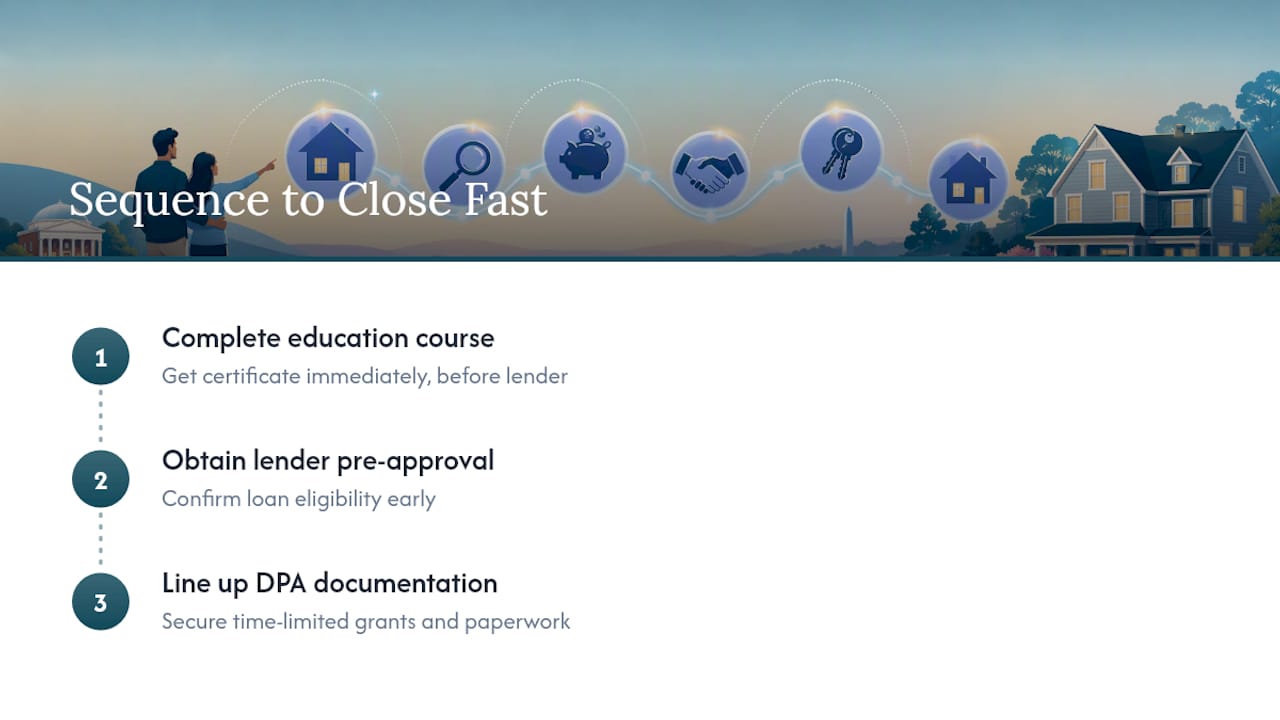
The conventional advice, "check your eligibility, then apply," skips the part that actually determines outcomes. Eligibility isn't static. County AMI limits shift, purchase price caps get updated, and grant funding pools aren't infinite. Waiting to sequence your steps until you feel "ready" is the single most avoidable mistake in this process.
If you take one thing from this, prioritize the education course immediately, even before you've picked a lender. Everything else moves faster once that certificate exists.
— Myra
Get a Free Eligibility Review Before You Apply for Anything
You don't need to guess which combination of grant, second mortgage, or DPA pilot fits your income and county. Some real estate agents review your situation against current AMI limits and purchase price caps first, so you're not applying for a program you don't qualify for or missing one you do.
That review happens before you sign with a lender, which means you walk into pre-approval already knowing your realistic price range and which assistance program to pair with it. For buyers juggling homebuyer education deadlines, DPA provider paperwork, and lender documentation at the same time, having one person coordinating all three saves weeks, not days.
Schedule a free consultation through Beamsrealtygroup and get a straight answer on which Virginia programs actually apply to your situation, before you make an offer on anything.
Sources
- Down Payment Assistance Grant for Homebuyers — Virginia Housing
- Homeownership Down Payment Assistance Program (DPA) — DHCD
- Homebuyer handbook — Virginia Housing
- First-Time Homebuyers Program — Fairfax County Housing and Community Development