
Yes, you can buy a house in Virginia right now. Get preapproved with a Virginia Housing-approved lender, check whether you qualify for state assistance through Virginia Housing or VIDA, and line up a licensed local agent before you start touring homes. VIDA can match your savings up to $10,000, and most buyers need a moderate down payment and additional funds for closing costs. The sections below cover loan programs, required inspections, and how to shop smart depending on which part of Virginia you're targeting.
TL;DR:
- Buyers should get preapproved with a Virginia Housing-approved lender early to meet quick-moving market demands and understand their financing limits.
- The VIDA matched savings program offers up to a ten-to-one match on deposits up to $10,000, requiring disciplined savings and proper documentation.
- High-competition markets need strong preapprovals, escalation clauses, and flexible closing dates, while slower markets allow more negotiation on inspections and repairs.
- Inspectors, especially for termites, should be scheduled promptly after the offer acceptance, as they are crucial for FHA or VA loans and can impact closing timelines.
- Understanding local zoning rules and deed types is essential before purchase, especially in rural versus suburban areas, to ensure properties meet intended use and building plans.
Table of Contents
- A 30 to 90 Day Checklist to Get Started
- Financing and Assistance: Virginia Housing, DPAs, and VIDA
- Adjusting Your Search by Region
- What to Expect From Inspection to Closing
- Choosing a Virginia Agent and What Comes Next
- Foreclosure and Short Sale Basics in Virginia
- Legal Details That Matter in a Virginia Purchase
- Property Taxes and Costs After You Close
- Zoning Rules That Affect What You Can Buy or Build
- What Buyers Get Wrong, and Two Shortcuts That Actually Help
- Work With a Virginia Team That Handles the Details
- Official Virginia Resources Worth Bookmarking
- Sources
A 30 to 90 Day Checklist to Get Started
Competitive Virginia markets punish buyers who wait to get organized. Start pulling documents now, even before you've picked a neighborhood.
- Gather pay stubs, W-2s, two years of tax returns, recent bank statements, and a government ID.
- Get preapproved through a Virginia Housing-approved lender and ask what debt-to-income ratio and credit score they need for your target program.
- Estimate cash needed: a down payment of a modest portion of the purchase price, plus an additional amount for closing costs.
- Enroll in a homebuyer education course if you're pursuing Virginia Housing assistance, and check your eligibility for VIDA's matched savings program.
- Call a licensed home inspector now to check their availability. In hot markets, good inspectors book out fast.
Pro Tip: If you're using an FHA or VA loan, ask your lender upfront whether a termite inspection is mandatory. Finding out on day 25 of a 30-day contract is a bad surprise.
Financing and Assistance: Virginia Housing, DPAs, and VIDA
Most Virginia buyers don't pay full freight out of pocket, and they shouldn't have to. Virginia Housing runs the state's primary assistance infrastructure: down payment assistance grants, closing cost assistance, and a Plus Second Mortgage that can eliminate the upfront down payment entirely for eligible buyers. These pair with conventional loans as well as FHA, VA, and USDA financing, which widens the door for buyers who don't have a large FHA down payment stashed away.
VIDA, Virginia's Individual Development Accounts program, works differently. It's a matched savings account: for every dollar you save toward a home purchase, the state matches it ten to one, up to $10,000 in matching funds for your down payment and closing costs. That means a disciplined saver putting away $1,000 could walk away with $10,000 in matching assistance. The catch is documentation. You'll need proof of consistent savings deposits and enrollment through a participating agency, so start that paperwork early rather than scrambling once you find a house.
| Program | What it offers | Who typically qualifies |
|---|---|---|
| Virginia Housing DPA Grant | Down payment assistance grant paired with a Virginia Housing loan | First-time and repeat buyers meeting income limits |
| Virginia Housing Plus Second Mortgage | Can eliminate upfront down payment | Buyers using an eligible first mortgage |
| VIDA Matched Savings | $10 match per $1 saved, up to $10,000 | Low- to moderate-income savers enrolled through a participating agency |
| FHA/VA/USDA + Virginia Housing | Federal loan combined with state DPA | Buyers meeting both federal and state program criteria |
Many Virginia Housing loans require a free homebuyer education class before closing. Treat that class as a checklist item, not an afterthought. It's often the piece buyers forget until their lender flags it two weeks before closing.
Your first move: call a Virginia Housing-approved lender, ask which programs you qualify for, and get the education requirement scheduled immediately if it applies to you.
Adjusting Your Search by Region
Virginia isn't one housing market. It's several, and the strategy that wins in Arlington will lose you a house in Rockingham County. Northern Virginia runs hotter, more expensive, and far more competitive than most of the rest of the state, which means offer strategy has to flex depending on where you're shopping.
In fast-moving submarkets, a soft preapproval letter won't cut it. You need a strong preapproval, and in many cases an escalation clause that automatically outbids competing offers up to a ceiling you set. Flexible closing dates can also sweeten an offer without raising your price. In slower, more affordable markets, buyers have more room to request inspection contingencies and repair credits without losing the house to a backup offer.
- In high-competition areas, lean on stronger preapproval, escalation clauses, and flexible closing timelines.
- In slower markets, use inspection contingencies and repair negotiations more freely.
- If affordability is tight, ask about manufactured housing options or ARS-supported programs built for first-time, moderate-income buyers.
- Rank your priorities (schools, commute, resale value) before you tour, so you're not making that decision under offer-deadline pressure.
Pro Tip: Ask your agent for actual days-on-market data in the specific neighborhood you're targeting, not the county average. A three-mile difference can mean a two-week difference in how fast homes sell.
If you're eyeing smaller metros like Charlottesville or Waynesboro, pricing and competition look nothing like Northern Virginia, and your offer strategy should reflect that.
What to Expect From Inspection to Closing
Most Virginia purchase contracts run 30 to 60 days from accepted offer to closing table. Your inspector shows up first, typically within the first week or two, followed by the appraisal your lender orders to confirm the home's value supports the loan.
Termite and wood-destroying organism inspections deserve special attention in Virginia. The state's climate makes termite pressure a real issue, and FHA and VA loans commonly require a WDO inspection before they'll close. Budget $75 to $300 for this inspection, and get it scheduled the moment your offer is accepted rather than waiting.
- Order the general home inspection within the first week of your contract.
- Schedule a termite/WDO inspection immediately if you're using FHA or VA financing.
- Expect the appraisal to follow shortly after inspection, usually within two to three weeks of contract acceptance.
- Budget 3% to 6% of your loan amount for total closing costs, covering title fees, appraisal fees, and lender charges.
Pro Tip: Inspection findings are your best negotiating tool, not a reason to panic. Use them to request repairs or a seller credit rather than walking away from a house you actually want.
Choosing a Virginia Agent and What Comes Next
A good agent earns their commission by knowing things Zillow can't tell you: which streets flood, which sellers negotiate, and which lender actually closes on time. Virginia REALTORS® survey data consistently shows buyers rely on agents for financing guidance and local market read, not just lockbox access.
Before you commit to an agent, ask these questions:
- What have you closed in this specific neighborhood in the last six months?
- Have you worked with Virginia Housing or VIDA-assisted buyers before?
- How do you typically negotiate repairs after inspection?
- What's your standard response time during an active contract?
Once you've picked someone, the sequence moves fast: finalize your target neighborhood list, set a showing cadence, and draft an offer checklist covering earnest money amount, inspection contingency window, and financing contingency deadline before you're under time pressure to decide.
A full-service agent who understands Virginia Housing paperwork and coordinates inspection timing can save you from the kind of missed deadline that costs buyers their earnest money.
Foreclosure and Short Sale Basics in Virginia
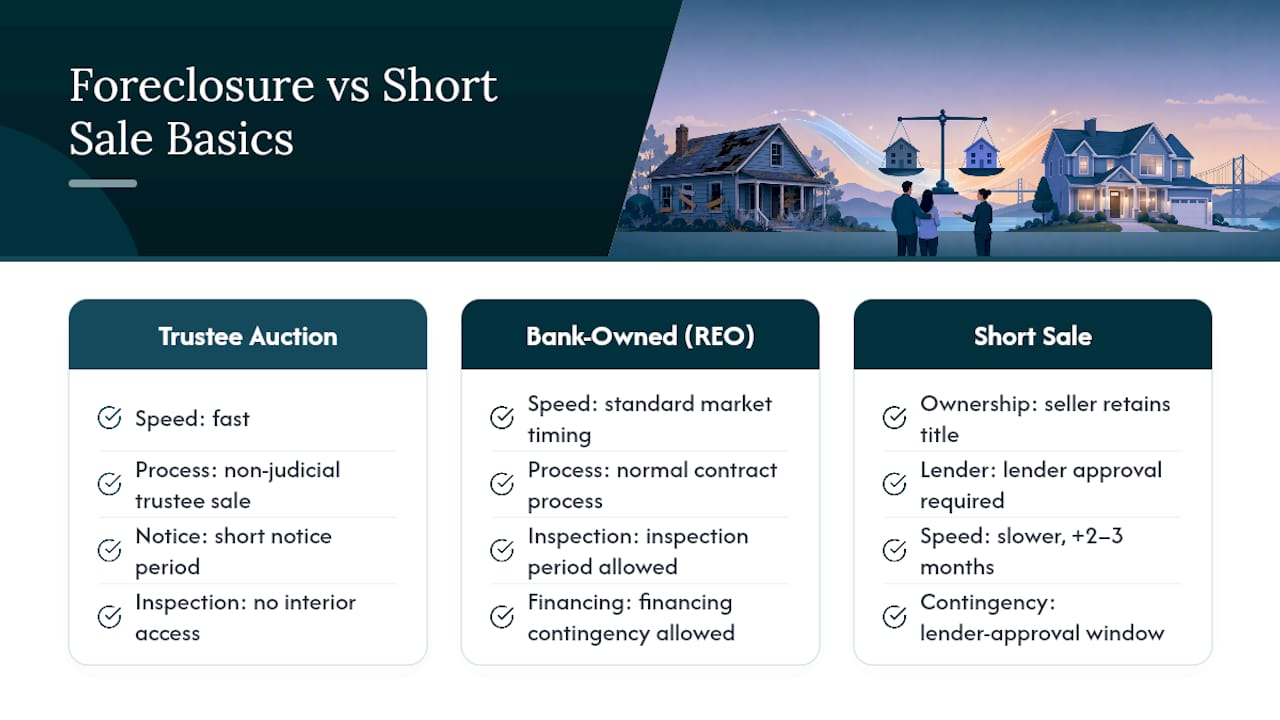
Virginia is a non-judicial foreclosure state, which means lenders can foreclose through a trustee sale without going through court, and the process moves faster than in judicial states. That speed matters if you're eyeing a foreclosed property. Once a homeowner defaults, the lender typically issues a notice, and the trustee can schedule a public auction after a relatively short notice period compared to states requiring court approval at every step.
Buying at a trustee auction differs sharply from a standard purchase. You're usually bidding with certified funds, often can't inspect the interior beforehand, and there's no financing contingency to protect you if your loan falls through. Most first-time buyers are better served waiting for a foreclosure to hit the open market as a bank-owned listing, where a normal contract process, inspection period, and financing contingency still apply.
Short sales work differently. The seller still owns the home but owes more than it's worth, and the sale requires their lender's approval before closing. Expect a longer timeline here, sometimes two to three months longer than a standard sale, because the seller's lender has to sign off on accepting less than the full loan balance. Your offer will typically include a contingency giving the lender's approval window, and your agent's experience negotiating these deals matters more than usual since delays are common and patience gets tested.
If you're considering either route, loop in an agent who has actually closed one. The paperwork and timeline expectations differ enough from a standard purchase that general experience doesn't automatically transfer.
Legal Details That Matter in a Virginia Purchase
Virginia uses a few different deed types, and which one you receive affects your protection if a title problem surfaces later. A general warranty deed offers the strongest protection, guaranteeing clear title back through the property's full history. A special warranty deed, common in Virginia resale transactions, only guarantees the title was clear during the seller's own ownership period. Ask your agent or closing attorney which deed type your contract specifies, and don't assume it's automatically the stronger version.
Virginia also offers a homestead exemption that can protect a portion of your home's equity from certain creditors in the event of bankruptcy or judgment. The exemption amount is modest compared to some states, and it requires you to file the appropriate paperwork rather than applying automatically, so it's worth a conversation with a real estate attorney if protecting equity is a priority for your situation.
Virginia is also an attorney-optional closing state, unlike some neighboring states that require an attorney to oversee every residential closing. Many Virginia closings happen through a title company alone. That said, a real estate attorney can be worth the fee for anything unusual: an estate sale, a property with a title cloud, or a purchase involving significant negotiation over easements or shared driveways.
Property Taxes and Costs After You Close
Virginia property taxes are assessed and collected at the county or city level, not the state level, which is exactly why your tax bill in Fairfax County looks nothing like your cousin's bill in a rural county three hours south. Rates are typically expressed per $100 of assessed value, and local governments reassess property values on their own schedules, often annually in fast-growing areas and less frequently elsewhere.
Beyond the tax bill itself, budget for the costs that show up after closing day rather than at the closing table. Homeowners insurance is mandatory if you have a mortgage, and premiums vary based on your home's age, location, and flood risk. If your down payment is under 20%, expect private mortgage insurance or, on FHA loans, a mortgage insurance premium added to your monthly payment. HOA dues apply if you're buying in a planned community, and those fees can range from a modest annual assessment to several hundred dollars a month depending on the amenities.
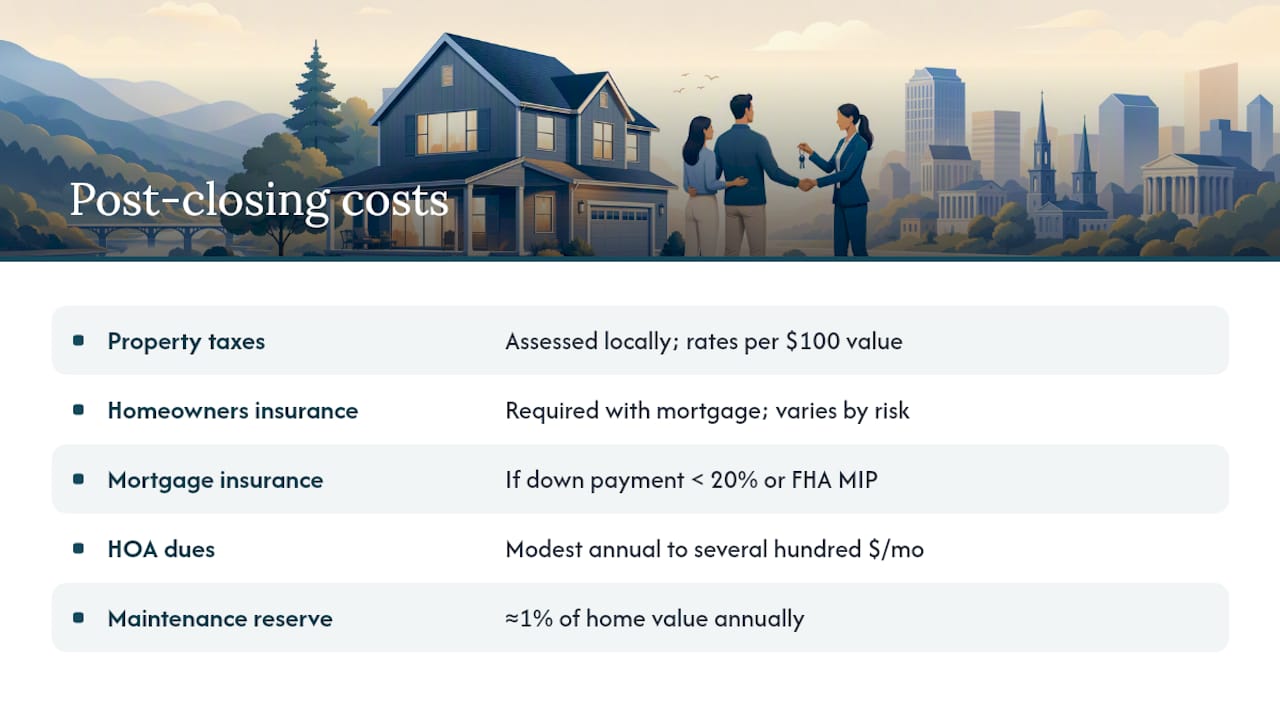
Set aside a maintenance reserve too. A common rule of thumb is budgeting 1% of your home's value annually for repairs and upkeep, though older homes and homes with aging systems, like a 20-year-old HVAC unit, tend to need more. None of this should scare you off buying. It just means your monthly budget needs to account for more than principal and interest from day one.
Zoning Rules That Affect What You Can Buy or Build
Zoning in Virginia is set locally, by county or city, which means the rules governing what you can build, rent, or operate on a property change the moment you cross a jurisdiction line. Before you fall for a property with big plans for an addition, a detached accessory dwelling, or a home-based business, check the local zoning ordinance rather than assuming it's allowed.
Rural Virginia counties often have more permissive zoning for agricultural use, outbuildings, and larger accessory structures, which is part of why buyers looking for acreage or a hobby farm gravitate toward those markets. If that's your goal, a farm-focused search with an agent who understands agricultural zoning and easements will save you from bidding on a property that can't actually support what you want to do with it.
Suburban and urban jurisdictions tend to have stricter setback requirements, height limits, and short-term rental restrictions. If you're planning to rent out a room on Airbnb or add a second unit for a family member, confirm it's permitted under the specific zoning classification before you write an offer, not after you close. A quick call to the county planning office or a request through your agent for the zoning designation can save months of frustration later.
What Buyers Get Wrong, and Two Shortcuts That Actually Help
The biggest mistake I see is buyers getting preapproved for the maximum they qualify for, then discovering that number leaves no room for closing costs or a competitive escalation clause. The second is skipping the termite inspection on a "just to save time" basis, only to have their FHA loan stall two weeks before closing. The third is underestimating closing costs entirely, treating the 3% to 6% range as a worst-case scenario instead of the realistic one.
Two shortcuts genuinely help. First, build your offer around neighborhood-specific comps rather than county averages. Second, use smart contingencies. An inspection contingency with a short response window protects you without scaring off a motivated seller. If you want help applying these to your specific search, reach out to an agent who works your target area regularly.
— Myra
Work With a Virginia Team That Handles the Details
Beams Realty Group is the direct alternative to piecing this process together on your own. Instead of juggling a lender, an inspector, a title company, and a Virginia Housing application separately, you get one team that coordinates financing programs, inspection timing, and negotiation strategy under a single point of contact.
Our agents work Virginia's submarkets daily, from Northern Virginia's fast-moving contracts to the Shenandoah Valley's more relaxed timelines, and we help clients apply for Virginia Housing and VIDA assistance without missing a documentation deadline. We also coordinate licensed inspectors, including termite specialists, so your contract stays on schedule instead of stalling in week three.
If you're ready to start, reach out through our contact page to schedule a consultation, or browse our down payment assistance guide to see which programs fit your situation before you talk to a lender.
Official Virginia Resources Worth Bookmarking
For program applications, check the VIDA and DHCD homebuyer resources page directly rather than relying on secondhand summaries. Virginia Housing's own loan options page lists current lenders and program requirements, and Virginia REALTORS® publishes regional sales data worth reviewing before you set price expectations in any specific county.
Sources
- VIDA — Virginia Department of Housing and Community Development
- Home loan options — Virginia Housing
- Virginia REALTORS® — home sales reports