
An offer escalation clause makes sense when you're chasing a home you know will draw multiple bids and you want to stay competitive without submitting round after round of counteroffers. It only works safely, though, if you require the seller to prove a competing bid is genuine before your price moves a dollar. Skip that protection and you risk two things at once: revealing your top number for nothing, and getting stuck paying more than an appraiser thinks the house is worth.
TL;DR:
- Escalation clauses only work safely if the seller must verify a genuine competing bid before increasing your offer price.
- Setting appropriate initial price, increment, and cap values depends on local market conditions and your financing limits, to avoid overpaying.
- Always require written proof of bona fide competing offers, including financial terms, to prevent inflated or sham bids from triggering the escalation.
- In slow or buyer-favorable markets, using an escalation clause can weaken your negotiating position by revealing your maximum price.
- Carefully consider the risk of appraisal gaps, as higher contract prices may not align with appraised value, potentially requiring cash out of pocket.
Table of Contents
- What Is an Escalation Clause, and How Does It Actually Work?
- When Does an Offer Escalation Clause Actually Help?
- How Do You Draft a Safe Escalation Clause?
- What Are the Biggest Risks, and How Do You Protect Yourself?
- Step-by-Step: Adding an Escalation Clause to Your Offer
- How Beams Realty Group Approaches Escalation Clauses
- A Practical Take on When Escalation Clauses Earn Their Place
- How Beams Realty Group Can Help You Bid With Confidence
- Sources
- FAQ
What Is an Escalation Clause, and How Does It Actually Work?
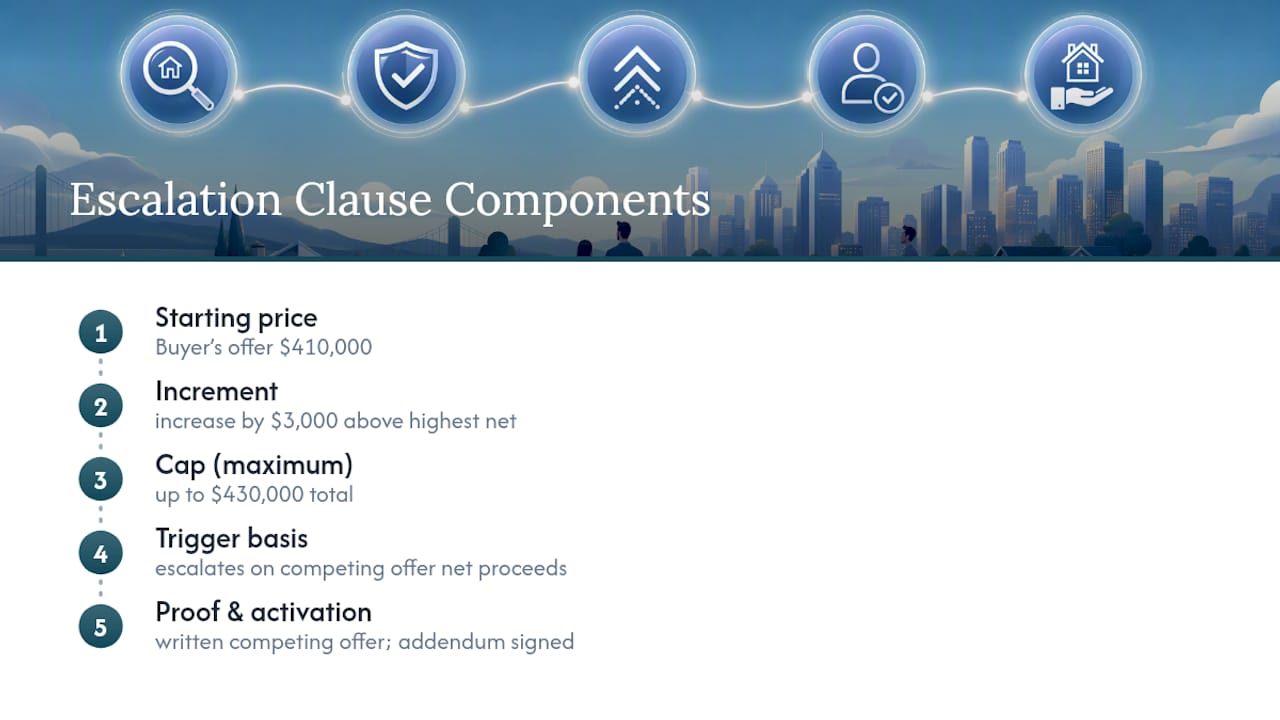
An escalation clause, sometimes called an escalation addendum, is a contract provision that automatically raises your offer price if the seller receives a higher, verified competing bid. Four elements make it function:
- Initial offer price — your starting bid, the one the seller sees first.
- Escalation increment — the fixed amount your offer rises above any competing bid.
- Maximum cap — the ceiling your price will never cross, no matter how high bidding goes.
- Proof requirement — the seller's obligation to show evidence of a real competing offer before the clause triggers.
Here's how it plays out in practice. Say you offer $410,000 with a $3,000 increment and a $430,000 cap. A verified competing offer comes in at $415,000. Your price automatically rises to $418,000, which is $3,000 above that bid. If a later offer hits $432,000, your clause stops at your $430,000 cap and you're out of the race unless you choose to raise it manually. Escalation addenda usually attach as a separate signed document to the purchase agreement, not buried inside the main contract.
When Does an Offer Escalation Clause Actually Help?
Escalation clauses solve one specific problem: staying competitive in a bidding war without the back and forth of multiple counteroffers. Freddie Mac advises using one only when you and your agent genuinely expect multiple offers — not as a default add-on to every bid you write.
Before you include one, run a few checks with your agent:
- Pull recent comps and sale-to-list ratios for the neighborhood to gauge how competitive the market really is.
- Ask the listing agent directly whether the seller is even open to escalation clauses, since some request sealed "highest and best" offers instead and will disregard escalators entirely.
- Check the property's days on market and listing history. A relisted or price-reduced home often signals a softer market where escalation adds no advantage.
- Confirm your agent's read on how many other buyers are actually touring the property, not just how many showings are scheduled.
Skip the clause in a slow or buyer-favorable market. Revealing your maximum price with no competition to justify it only weakens your negotiating position.
How Do You Draft a Safe Escalation Clause?
Good drafting comes down to precision on four fronts: starting price, increment, cap, and proof. Increment size functions as both a signal and a cost — too small and you look timid in a hot market, too large and you're paying more than necessary to win.
Agents often suggest escalation increments based on price bands, such as smaller amounts for lower-priced homes and larger increments for higher-priced properties, but these vary widely by local market and are not fixed rules.
One detail buyers routinely miss: whether the escalation triggers on gross price or net proceeds. Net-based triggers account for seller concessions, so if a competing offer includes $10,000 in closing-cost credits, your clause escalates based on what the seller actually nets, not the sticker price on the other contract. Without that language, you could end up escalating against a bid that looks higher but nets the seller less than yours.
Sample addendum language might read:
"Buyer's offer is $410,000. If Seller receives a bona fide competing offer at a higher net price, Buyer's price shall automatically increase by $3,000 above the highest verified competing net offer, up to a maximum price of $430,000. Seller shall provide written documentation of any competing offer's material financial terms, with buyer-identifying information redacted, prior to activation of this clause."
The addendum attaches to and amends the purchase agreement, and both parties sign it alongside the rest of the offer package.
Pro Tip: Always require a written copy of the competing bona fide offer with the financial terms intact and only the buyer's identifying information redacted. A verbal assurance from a listing agent that "there's another offer" is not proof, and it's exactly the gap sham-offer schemes exploit.
What Are the Biggest Risks, and How Do You Protect Yourself?
Three failure modes account for most escalation clause regret, and each has a fix.
- Appraisal gaps. Lenders base your loan amount on the appraised value, not your escalated contract price. If your price climbs to $425,000 but the home appraises at $410,000, you're on the hook for the $15,000 difference in cash, or you have to renegotiate. This gap is one of the most cited risks in escalation guidance, and pairing your escalator with a capped appraisal-gap commitment, or keeping cash reserves ready, closes it.
- Sham or inflated offers. A seller or agent under pressure to drive up price has an incentive to claim offers that don't exist. Freddie Mac's guidance defines a bona fide offer as a written, signed, enforceable contract from an independent third party, and your clause should require documentation meeting that exact standard before it activates.
- Revealing your ceiling for nothing. Your cap tells the seller your absolute maximum. If bidding stalls below it, you've handed over information with no offsetting benefit. Strengthening non-price terms, like a shorter inspection period, a flexible closing timeline, or larger earnest money, can make your offer competitive without pushing your price cap as high.
Before setting any cap, confirm with your lender exactly how much financing flexibility you have and what documentation they'll need if a gap appears. State regulators have also flagged disclosure concerns around escalation clauses, and North Carolina's real estate commission specifically warns agents and buyers to check local rules before relying on one.
Step-by-Step: Adding an Escalation Clause to Your Offer
- Confirm market conditions with your agent. Review comps, showing traffic, and the listing agent's stance on escalators before drafting anything.
- Lock in financing details. Get lender preapproval and verify your cash reserves in case of an appraisal gap.
- Set your three numbers. Decide the initial price, increment, and absolute cap, then add gross-versus-net and proof-of-offer language to the addendum.
- Sign and submit. Attach the addendum to your purchase agreement and submit both together.
- Confirm the final price in writing. Once the clause triggers, require a signed amendment reflecting the new purchase price within a set number of business days, typically two to three, so there's no ambiguity about what price actually applies.
How Beams Realty Group Approaches Escalation Clauses
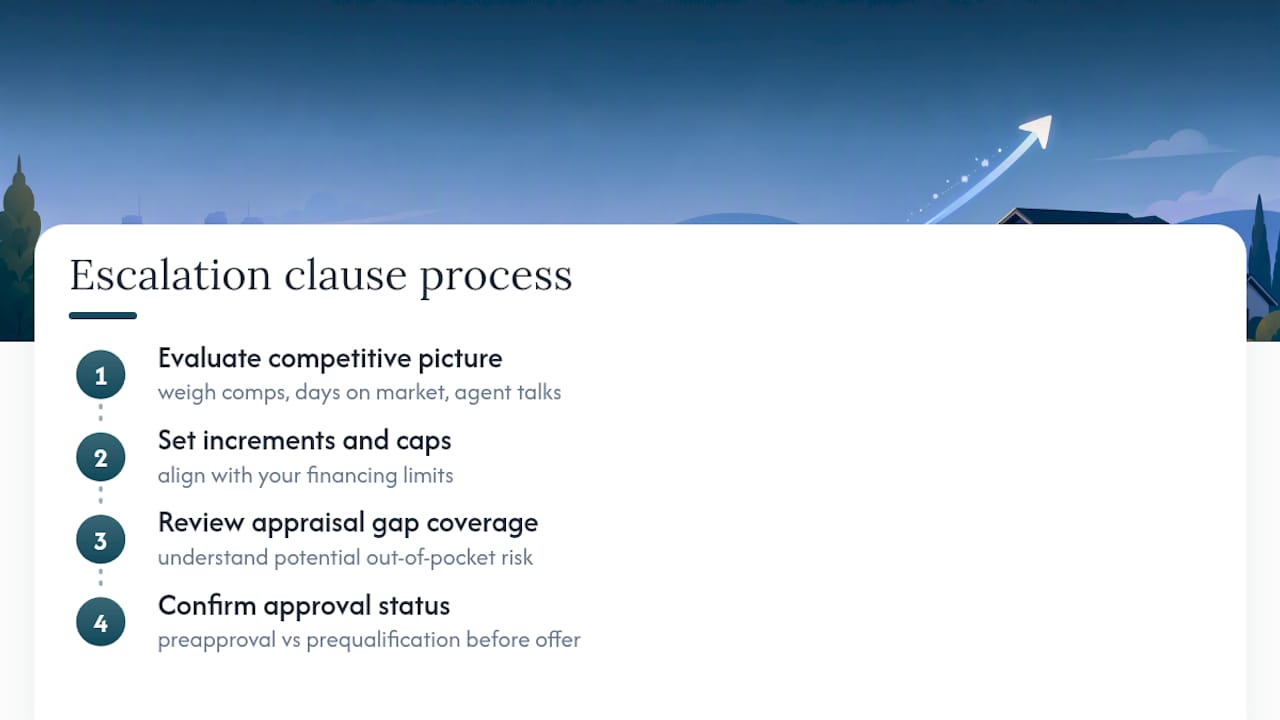
Each listing's competitive picture should be evaluated before recommending an escalator, weighing comps, days on market, and direct conversations with the listing agent. Increments and caps get set around your financing limits, not just what feels aggressive in the moment. For related planning, our clients often read up on appraisal gap coverage and the difference between preapproval and prequalification before finalizing an offer strategy.
A Practical Take on When Escalation Clauses Earn Their Place
I recommend an escalation clause only when the comps and the agent conversation both point to real competition, never as a reflexive add-on to every offer. The moment it stops being a targeted tool and becomes a habit, you're giving away information for no return. State-specific wording varies enough that a quick check with your agent or a real estate attorney before you sign is worth the extra day it takes.
— Myra
How Beams Realty Group Can Help You Bid With Confidence
Drafting an escalation clause that actually protects you takes more than a template. It takes someone who knows what your specific market is doing right now. Local market analysis paired with hands-on offer drafting, negotiation, and appraisal-gap planning helps ensure your increment, cap, and proof language are set based on relevant comps and lender limits, not guesswork borrowed from a national average.
Before you write your next offer, it's worth a conversation about whether an escalator even fits the listing you're chasing, and if it does, what cap actually makes sense for your financing. If you want a second set of eyes on the wording or the strategy behind it, you can also review questions worth asking any agent before you sign as a starting point. Schedule a consultation on the Beams Realty Group site and get a market-specific read before you submit anything.
Sources
- Should my offer include an escalation clause? | Freddie Mac
- How to write an escalation clause in real estate | LegalClarity
- The Pitfalls of Using Escalation Clauses | NCREC Bulletins
FAQ
Should I Remove the Escalation Clause When Offering?
Only if the market data or your agent's conversation with the listing agent suggests low competition. In a genuine multi-offer situation, removing it means competing on price alone through repeated counteroffers instead.
What Is a Typical Escalation Clause?
A typical clause names a starting offer price, a fixed increment that varies by local market and home's price band, a maximum cap, and a requirement that the seller prove any competing offer is bona fide before the price adjusts.
Can an Escalation Clause Backfire?
Yes. It can reveal your maximum price to the seller with no competing offer to justify it, and it can push your contract price above the eventual appraised value, leaving you to cover the gap in cash.
Is an Escalation Clause a Good Idea?
It's a good idea specifically in confirmed multiple-offer situations where you want to avoid repeated counteroffers, and only when paired with seller verification of a bona fide competing bid and a clear plan for a possible appraisal gap.