
Yes, dual agency is legal in Virginia, but only under strict conditions. State law lets one agent or one brokerage represent both the buyer and the seller in the same deal, provided the client gets written disclosure and gives informed consent before that arrangement takes effect. The tradeoff: your agent becomes neutral, which limits how hard they can advocate for you on price or strategy. If you want the exact statutory language, § 54.1-2139 covers residential deals.
TL;DR:
- Dual agency in Virginia requires written disclosure and informed consent before the arrangement begins, with no verbal or implied agreements accepted.
- Once in dual agency, agents cannot provide confidential negotiation advice or strategic guidance, limiting advocacy for either side.
- Designated agency offers a middle ground by allowing separate agents within the same firm to represent each party with full advocacy, provided proper paperwork.
- Clients should ask specific questions about who is representing them, what information will be shared, and whether designated agency is available before signing disclosures.
- If already in a dual agency, clients can withdraw consent, request different representation, or file complaints if proper procedures were not followed.
Table of Contents
- Dual Agency Virginia Law: What the Statutes Actually Require
- What Dual Agency Actually Changes for You
- Designated Agency: The Alternative That Keeps Full Representation
- Questions to Ask Before You Sign a Dual Agency Disclosure
- Already Signed and Something Feels Off? Here's What to Do
- The Beams Realty Group View on Dual Agency
- Get Full Representation Without the Guesswork
- Sources
Dual Agency Virginia Law: What the Statutes Actually Require
Virginia's rules on this aren't vague suggestions. They're specific statutes with specific paperwork requirements, and skipping them creates real liability for the agent involved.
§ 54.1-2139 governs residential transactions and says a licensee can only act as a dual agent or dual representative after getting written consent from every party, following a written disclosure that spells out the consequences. No verbal agreement counts. No implied consent counts. It has to be on paper, and the client has to understand what they're giving up before they sign.
Commercial deals fall under a separate law, § 54.1-2139.01, which adds detail on how the disclosure has to look. It requires conspicuous formatting, meaning bold text, capital letters, or a clearly separated box, not fine print buried in a stack of other forms.
The statutes also draw a line between two terms that sound interchangeable but aren't:
- Dual agent: one licensee personally represents both parties in the same transaction.
- Dual representative: two different licensees at the same firm each represent a different party, under one supervising broker.
On timing, 18VAC135-20-220 requires disclosure at the earliest practical point in the relationship, and in most cases before any offer gets presented. Consent obtained after the fact doesn't retroactively fix a late disclosure.
What Dual Agency Actually Changes for You
Signing a dual agency form doesn't just add paperwork. It changes what your agent can and can't do for you, and a lot of clients don't grasp the practical impact until they're mid negotiation.
Once an agent becomes a dual agent, they lose the ability to give either side private strategic advice. That means no coaching on how high you can push an offer, no sharing what the other side's real bottom line might be, and no confidential discussion of financing weaknesses that could be used as leverage against you.
Here's what typically survives, and what typically doesn't:
- Still required: disclosure of material facts about the property (a leaking roof, a failed septic inspection, known structural issues).
- Still required: reasonable care and honesty in handling the transaction.
- Curtailed: negotiation advocacy, meaning your agent won't tell you to counter higher because they believe the seller will bend.
- Curtailed: confidential guidance on concessions, repair credits, or how urgently the other party needs to close.
Picture an inspection turning up a cracked foundation. A dual agent still has to disclose that fact to both sides. What they won't do is privately tell the buyer, "push for a $15,000 credit, they're desperate to sell." That kind of counsel disappears the moment neutrality kicks in.
Pro Tip: If you're the one making an offer, ask your dual agent directly whether they're permitted to share comparable sales strategy with you. If the answer is a hesitant "sort of," that's your sign the advocacy you're used to isn't fully there anymore.
Designated Agency: The Alternative That Keeps Full Representation
If losing that advocacy doesn't sit right with you, Virginia law offers a middle path that most clients never hear about until they ask.
Designated agency lets a single brokerage represent both the buyer and the seller while assigning each of them a separate agent inside the firm. Each designated agent keeps full fiduciary duty to their own client, including negotiation advocacy and confidential advice, while the brokerage as a whole still technically has both sides.
The supervising broker manages the internal wall between the two agents, and that firewall has to be documented, not assumed. Virginia REALTORS notes that a properly assigned designated agency requires explicit paperwork naming who represents whom, so the arrangement doesn't quietly slide back into de facto dual agency.
If designated agency isn't offered, you have other options:
- Ask for a different brokerage entirely for one side of the deal.
- Bring in independent legal counsel to review terms before signing anything.
- Request a separate buyer's or seller's agent instead of accepting dual representation by default.
Questions to Ask Before You Sign a Dual Agency Disclosure
Before you put your name on any agency form, walk through these questions with the agent or broker directly:
- Will you be my sole point of contact, or will someone else at your firm represent the other party as a designated agent?
- What specific information about my finances or motivations will you be able to share with the other side?
- Who reviews offers and counteroffers, and will I see every version before it's sent?
- How is your commission split, and does dual representation change what you're paid?
- Can I request a designated agent instead of straight dual agency, and what would that cost me, if anything?
Certain answers should make you pause before signing:
- The agent pressures you to sign quickly without reading the disclosure.
- The form is vague about which version of agency (dual agent vs. dual representative) actually applies.
- The broker refuses to offer designated agents even though the firm represents both parties.
Pro Tip: Ask for 24 hours to review the disclosure with independent counsel, and keep a dated copy of everything you're given. Catalyst Legal's consumer guidance on dual agency notes that clients uncomfortable with the arrangement can request separate representation instead of proceeding.
Already Signed and Something Feels Off? Here's What to Do
If you've already consented and now suspect your interests are being shortchanged, you have real options, not just regret.
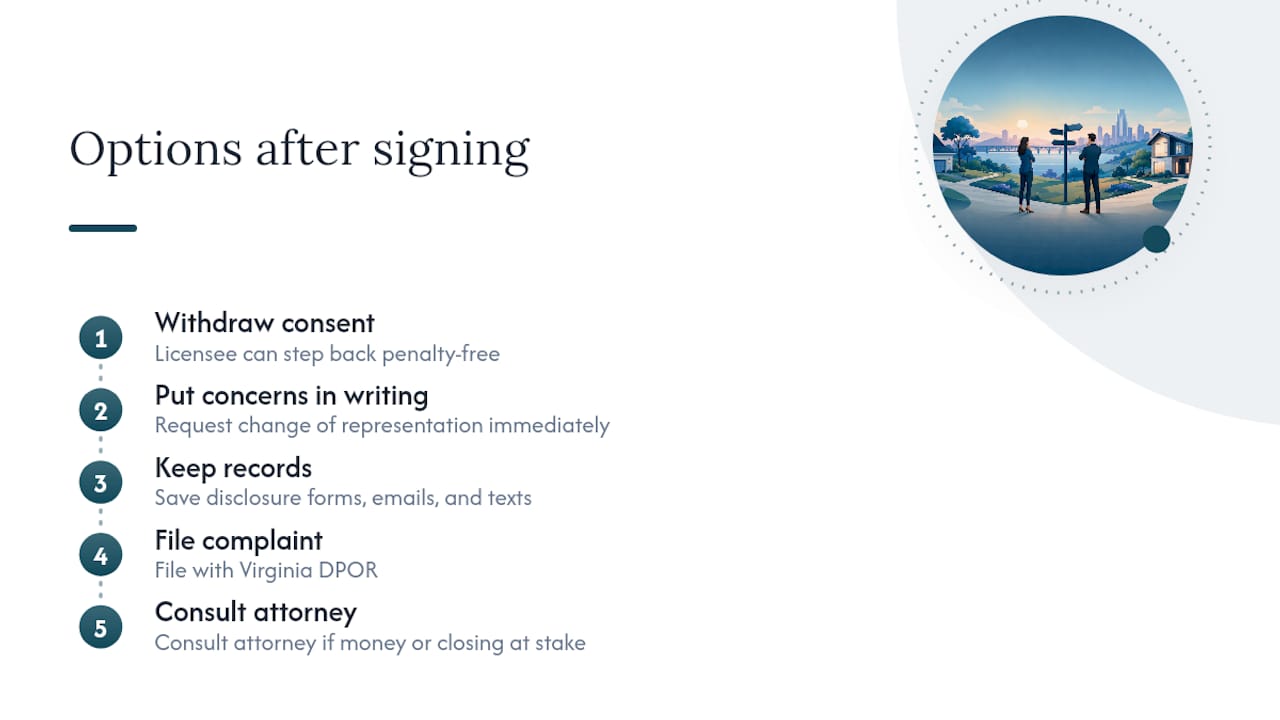
You can withdraw consent, and the law protects the licensee's right to step back from representing you without penalty if you refuse to continue under dual agency. Put your concerns in writing and request a change in representation immediately rather than waiting. Keep copies of every disclosure form, email, and text tied to the transaction. If the issue involves a suspected violation of disclosure timing or consent procedure, you can file a complaint with the Virginia Department of Professional and Occupational Regulation, and consult a real estate attorney if money or a closing is on the line.
The Beams Realty Group View on Dual Agency
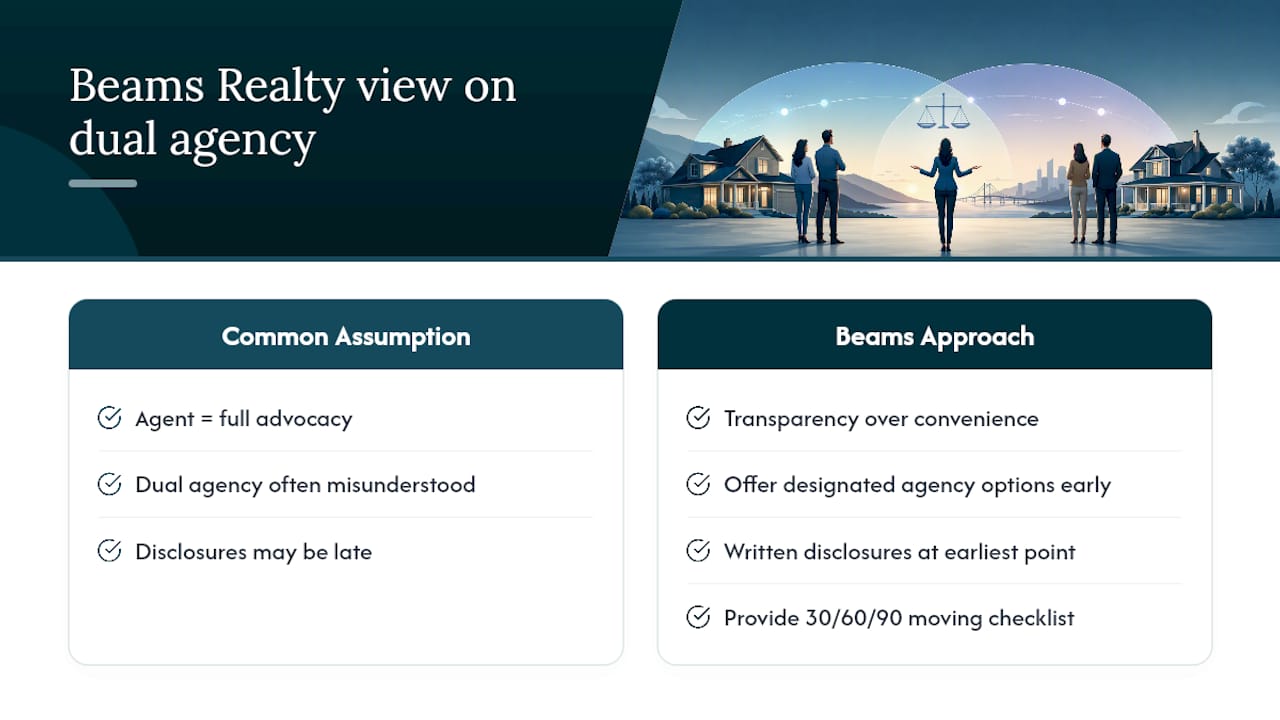
Dual agency isn't inherently unethical, but it's frequently misunderstood, and that gap is where clients get hurt. Most people assume "my agent" means full advocacy no matter what, and Virginia's disclosure rules exist precisely because that assumption breaks down under dual representation.
Some real estate groups default to transparency over convenience. That means walking clients through designated agency options before dual agency ever comes up, and putting every disclosure in writing at the earliest possible point, not the day before closing. Practical tools, like a 30/60/90 moving checklist and clear inspection guidance, can help keep clients informed at every stage.
— Myra
Get Full Representation Without the Guesswork
A lot of Virginia agencies default to dual representation because it's simpler for them, not because it's better for you. Some brokers take the opposite approach: assigning a designated agent who advocates only for your side rather than putting you in a neutral arrangement you didn't fully choose.

That means clear written agreements before you ever make an offer, direct answers about who sees your financial details, and a team that explains commission structure without you having to ask twice. If you're buying or selling in Virginia and want to know exactly what kind of representation you're getting before you sign anything, schedule a consultation with Beams Realty Group and get straight answers on your options.
Sources
- § 54.1-2139. Disclosed dual agency and dual representation authorized in a residential real estate transaction
- Virginia dual agency rules, disclosures, and protections – Catalyst Legal
- What agency forms do I need when my firm represents both parties? - Virginia REALTORS®