
Preapproval is the stronger document, verified by a lender and often backed by a hard credit check, while prequalification is a quick, self-reported estimate. Get prequalified when you're just starting to figure out your budget. Get preapproved once you're touring homes and ready to write offers. Either way, ask the lender exactly what they verified before you assume the letter means more than it does.
TL;DR:
- Prequalification offers a quick, informal estimate based on self-reported data, usually with a soft credit pull that doesn't impact your score.
- Preapproval involves verified income, assets, and debts through a hard credit check, making it more credible and preferred by sellers.
- Timely preapproval, aligned with your actual home search, is essential because expiration dates and the verification process can weaken an otherwise strong letter.
- Buyers should gather and verify their documentation early, avoid new debt, and ensure consistency in income reporting to improve their chances of preapproval.
- Both prequalification and preapproval are estimates, not guarantees, and final loan approval depends on property appraisal, underwriting, and stable financial conditions.
Table of Contents
- Preapproval vs Prequalification: What Prequalification Actually Means
- Preapproval vs Prequalification: What Preapproval Requires
- Prequalification vs Preapproval Compared Side by Side
- When to Get Prequalified vs Preapproved (Plus a Prep Checklist)
- How Sellers and Agents Actually Read These Letters
- What Beams Realty Group Sees Go Wrong With Buyer Paperwork
- Why Neither Letter Is a Guaranteed Loan
- How Preapproval Changes Your Negotiating Power
- What Preapproval Actually Costs You
- Why Preapproval and Prequalification Applications Get Denied
- How Preapproval and Prequalification Affect Your Credit Score
- How to Improve Your Odds of Getting Preapproved
- The Real Lesson Buyers Miss About These Two Letters
- How Beams Realty Group Helps You Turn Preapproval Into a Winning Offer
- Sources
Preapproval vs Prequalification: What Prequalification Actually Means
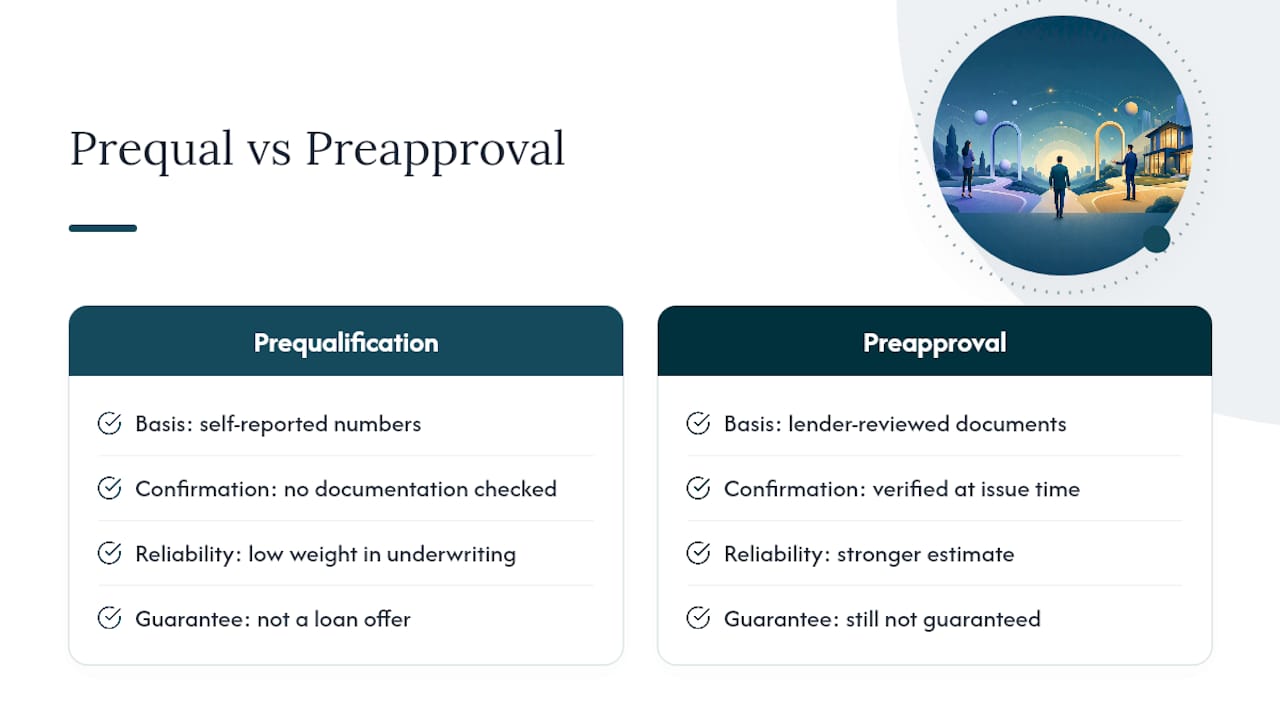
Prequalification is a lender's early, informal read on how much you might be able to borrow, based mostly on information you provide yourself. You tell the lender your income, debts, and savings, either over the phone, online, or in a short conversation, and they run a rough calculation. Nobody is checking your pay stubs at this stage.
Most lenders use a soft credit pull for prequalification, or sometimes skip the credit check entirely. A soft pull does not affect your credit score, which makes prequalification a low-risk way to get a ballpark number early on.
Here's what prequalification is actually good for:
- A fast estimate of your price range before you start touring homes
- Zero commitment and usually zero cost
- A useful budgeting tool if you're months away from making an offer
- A way to catch obvious red flags (like a debt-to-income ratio that's too high) before you invest more time
The catch: lenders vary widely in how they handle this step. Some run a soft credit check, others none at all, and some call it "prequalification" while doing something closer to preapproval. Always ask what was checked.
Preapproval vs Prequalification: What Preapproval Requires
Preapproval is a conditional, verified estimate of what a lender will actually lend you, and it carries real weight because someone has checked your paperwork. Rocket Mortgage notes that preapproval involves a lender-run credit check and verification of your income, assets, and debts, which is exactly why sellers take it more seriously than a prequalification letter.
To get there, expect to submit:
- Recent pay stubs covering the last 30 days
- W-2 forms or 1099s, plus two years of tax returns for most borrowers
- Bank statements from the last two to three months, showing your savings and checking accounts
- A government-issued photo ID and your Social Security number
- Documentation of any additional income, gifts, or debts the lender flags during review
Because preapproval involves a hard credit inquiry, it can knock a few points off your score temporarily. Most scoring models forgive multiple mortgage inquiries within a short shopping window, treating them as one event rather than several.
Timelines vary by lender. Wells Fargo cites conditional approvals returned in roughly 7 to 10 business days after you submit documentation. Once issued, the letter isn't permanent. Bank of America points out that preapproval letters typically expire within 30 to 90 days, depending on the lender and loan program.
Prequalification vs Preapproval Compared Side by Side
The gap between these two documents comes down to five practical factors, and they matter more than the labels lenders slap on them.
| Factor | Prequalification | Preapproval |
|---|---|---|
| Verification level | Self-reported numbers | Lender-verified income, assets, debts |
| Credit check | Usually soft pull, sometimes none | Typically a hard pull |
| Documentation required | Minimal, often just a conversation | Pay stubs, tax returns, bank statements, ID |
| Speed to decision | Minutes to a day | Often 7 to 10 business days |
| Seller/agent weight | Low, seen as informal | High, seen as offer-ready proof |
One detail buyers overlook: the letter itself carries specific information a seller's agent will actually scan. That includes the approved loan amount, the lender's name, the issue date, and an expiration date. A preapproval letter dated three months ago, sitting past its window, reads almost as weak as no letter at all.
Pro Tip: Lender terminology isn't standardized, so a document called "prequalification" from one bank might involve more verification than a "preapproval" from another. Ask directly: which documents did you check before issuing this?
When to Get Prequalified vs Preapproved (Plus a Prep Checklist)
The decision rule is straightforward. If you're still browsing listings and figuring out your budget, get prequalified. Once you're actively touring homes or planning to submit an offer within the next few weeks, move to preapproval.
Here's how to prepare for the preapproval application without losing time:
- Pull your own credit report first and fix any errors before the lender runs a hard check
- Gather two years of tax returns, your two most recent pay stubs, and two to three months of bank statements
- Have your Social Security number and government ID ready to upload
- List any additional income sources, gifts, or outstanding debts up front, rather than letting the lender discover them mid-process
- Ask the lender for their typical decision timeline and letter expiration window before you submit anything
Once you're preapproved, resist the urge to open a new credit card, finance a car, or switch jobs. Underwriters recheck your file before closing, and any of those moves can jeopardize the loan you thought was locked in.
Pro Tip: Time your preapproval to match your actual home search window. If you expect to shop for two months, don't get preapproved four months out, since your letter may expire before you find the right house.
How Sellers and Agents Actually Read These Letters
Listing agents treat preapproval as proof a buyer can close, not just a nice gesture. A verified letter tells them financing is unlikely to fall apart late in the process, which matters enormously in competitive markets where multiple offers land the same week.
A prequalification letter, by contrast, often gets a shrug. It signals interest, not readiness.
- Sellers weigh preapproval letters far more heavily in multiple-offer situations
- Agents check the loan amount, lender name, and expiration date before advising their client
- Neither letter is a final commitment. Bank of America notes that preapproval is still subject to underwriting, appraisal, and property eligibility checks before the loan actually funds
What Beams Realty Group Sees Go Wrong With Buyer Paperwork
The most common holdup isn't a low credit score. It's incomplete paperwork: a missing year of tax returns, a bank statement with an unexplained large deposit, or pay stubs that don't match the income the buyer quoted verbally.
Real estate agents often walk buyers through their documentation before submission to lenders, catching gaps that would otherwise stall a preapproval by days. That prep work pairs naturally with appraisal readiness, since a clean financial file and a clean property file both move underwriting forward faster. Buyers who understand their expected closing costs ahead of time also avoid the awkward scramble when a lender asks for proof of reserves.
Why Neither Letter Is a Guaranteed Loan
Both documents are estimates, not commitments. The Consumer Financial Protection Bureau states plainly that prequalification and preapproval letters both indicate how much a lender is willing to lend, but neither is a guaranteed loan offer.
That distinction trips up plenty of buyers who assume preapproval means the deal is done. It doesn't. Preapproval tells you what a lender expects to approve based on the documents reviewed at that moment. Final approval still depends on the specific property passing appraisal, the title coming back clean, and your financial picture staying the same through closing.
Say you get preapproved for $450,000 in January. If you find a house in March, the lender will still order an appraisal on that exact property, verify the title, and often re-pull your credit before funding the loan. If the appraisal comes in low, or if your income changed, or if you took on new debt, the preapproved amount can shift.
This is also why prequalification carries even less weight. It's a snapshot based on numbers you reported yourself, without anyone confirming them. Think of prequalification as a weather forecast and preapproval as a more detailed radar reading. Both are estimates. Neither guarantees tomorrow's weather, but one is built on a lot more real data.
Buyers who treat either letter as a done deal often get blindsided at the underwriting stage. The safer mindset: preapproval gets you close to the finish line, but the lender still has the final say.
How Preapproval Changes Your Negotiating Power
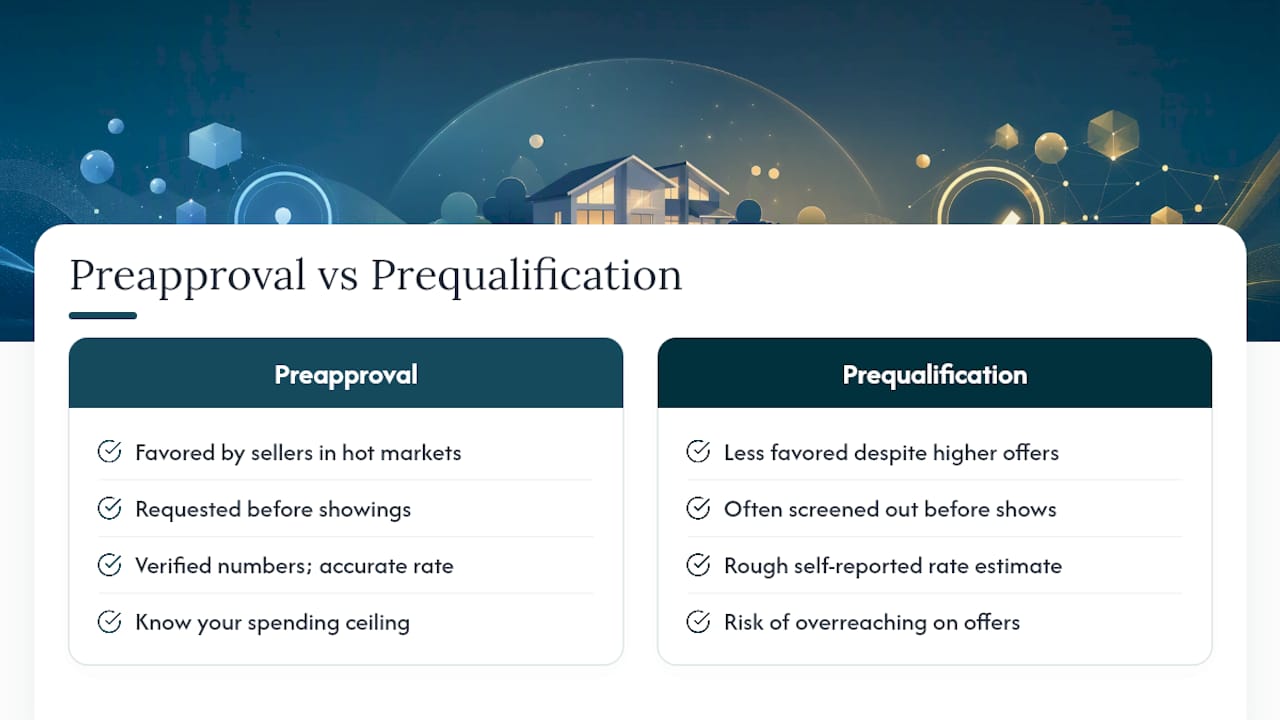
A verified preapproval letter gives you leverage a prequalification letter simply can't match. Sellers in competitive markets routinely favor offers backed by preapproval, because it signals the financing risk is lower and the closing timeline is more predictable.
That leverage shows up in a few concrete ways. A seller comparing two similar offers will often choose the one with a stronger, more current preapproval letter, even if the prequalified offer is slightly higher. Agents representing sellers frequently ask for proof of preapproval before even scheduling a showing in hot markets, screening out buyers who aren't truly ready.
Interest rates themselves don't move because you have a preapproval letter instead of a prequalification letter. Your rate is set by your credit profile, loan program, market conditions, and lock timing, not by which document you're carrying. But preapproval does give you a more accurate rate estimate, since the lender is working from verified numbers rather than a rough self-reported guess. That accuracy matters when you're comparing monthly payments across different homes or deciding how much to offer.
There's a subtler advantage too: preapproval lets you negotiate with confidence on price and terms, because you already know your ceiling. Buyers relying only on prequalification sometimes overreach on an offer, then discover during underwriting that their actual approved amount is lower than they assumed.
What Preapproval Actually Costs You
Prequalification is almost always free, and it should be treated as a red flag if a lender tries to charge for it. Preapproval is typically free as well at most major lenders, though the process can carry indirect costs worth knowing about.
The most common cost is the temporary credit score dip from the hard inquiry, typically a small, short-lived drop rather than a lasting mark. Some lenders charge a fee to pull your credit report, though many roll this into the broader loan process rather than billing it separately. If you apply for preapproval with several lenders in a short window, most credit scoring models treat those inquiries as a single event rather than penalizing you repeatedly, since they recognize rate shopping.
Where costs really show up is later, once you move from preapproval into an actual mortgage application: appraisal fees, credit report fees, and other charges that get itemized in your loan estimate. Preapproval itself is generally not where buyers pay real money. It's the checkpoint before the expenses start.
Why Preapproval and Prequalification Applications Get Denied
Prequalification denials are rare, mostly because so little is verified. If a lender does decline to prequalify you, it's usually because the self-reported numbers show a debt-to-income ratio far outside acceptable ranges, or income that clearly can't support the loan amount you're asking about.
Preapproval denials happen more often, precisely because someone is actually checking the paperwork. Common reasons include:
- A credit score that falls below the lender's minimum threshold for the loan program
- A debt-to-income ratio that exceeds guidelines once verified debts are factored in
- Inconsistent income, especially for self-employed buyers whose tax returns show fluctuating earnings
- Insufficient funds for the down payment or reserves once bank statements are reviewed
- Recent large, unexplained deposits that raise questions during underwriting
- A change in employment status discovered during document verification
If you're denied, the lender is required to send an adverse action notice explaining why, which gives you a starting point for fixing the issue before you try again with a different lender or program.
How Preapproval and Prequalification Affect Your Credit Score
The credit impact depends entirely on which type of check the lender runs, and this is one of the most misunderstood parts of the process. Prequalification typically involves a soft credit pull, which has no effect on your score. You can get prequalified by five different lenders in one afternoon without any credit consequence.
Preapproval is different because it typically requires a hard credit inquiry. A hard pull can lower your score by a small amount, and that dip usually recovers within a couple of months as long as you keep managing your credit responsibly. Multiple hard pulls for the same type of loan within a short shopping window (typically 14 to 45 days depending on the scoring model) usually count as a single inquiry rather than several separate hits.
Where buyers get into trouble is applying for preapproval too early, then letting months pass before making an offer, then having to reapply or get re-verified closer to closing. Each fresh hard pull adds up if they're spread far enough apart to count separately. That's one more reason to time your preapproval to your actual search window rather than getting it "just to see" long before you're ready to buy.
How to Improve Your Odds of Getting Preapproved
Getting preapproved successfully starts well before you contact a lender. Pull your own credit report first and dispute any errors, since inaccurate late payments or incorrect balances can tank your score for no legitimate reason.
Pay down revolving debt where you can, even modestly, since your debt-to-income ratio is one of the first things underwriters scrutinize. Avoid opening new credit accounts or financing big purchases in the months leading up to your application. That new car loan might feel unrelated, but it directly raises your debt-to-income ratio at the worst possible time.
Keep your bank statements clean and explainable. Large, unexplained deposits are one of the most common reasons preapprovals stall, so if a family member is gifting you down payment money, document it with a gift letter before you apply. Getting preapproved early enough in your process can actually work in your favor here, since it surfaces credit or documentation issues you can fix while you still have time, rather than discovering them once you're under contract with a closing date looming.
Finally, be consistent. If you tell a lender your income verbally, make sure your pay stubs and tax returns back up that exact number. Discrepancies, even small ones, slow down underwriting and invite more scrutiny than a clean, matching file ever will.
The Real Lesson Buyers Miss About These Two Letters
Most advice on this topic treats prequalification and preapproval like two steps on the same ladder, one slightly better than the other. That framing undersells how differently they function. Prequalification is a self-reported guess. Preapproval is a lender's verified judgment, and treating them as interchangeable is where buyers get hurt, usually by overestimating their budget early and building emotional attachment to homes they can't actually afford once the real numbers come in.
The bigger blind spot is timing. Buyers obsess over which letter to get, but rarely think about when to get it. A preapproval sitting unused for four months is nearly as weak as no preapproval at all, since it's likely expired by the time an offer matters. I'd argue the smartest move isn't rushing to get preapproved the moment you start browsing listings. It's getting prequalified early to set realistic expectations, then timing preapproval to land right as your search gets serious.
The paperwork itself deserves more respect than it gets, too. Buyers treat document gathering as an annoyance instead of the actual leverage point it is. A clean, complete file doesn't just speed up approval. It's what turns a preapproval letter into something a seller's agent actually trusts.
— Myra
How Beams Realty Group Helps You Turn Preapproval Into a Winning Offer
Having professional real estate guidance can be the difference between a preapproval letter that sits unused and one that helps you secure a house. Expert advice can provide a personalized document checklist, guidance on common paperwork issues, and coordination with your lender to keep the timeline moving.

An initial consult covers where you stand today, whether that's early budgeting or offer-ready, and maps out exactly what your preapproval package needs before you submit it. Beams Realty Group also helps you sequence your timing so your letter stays valid through your actual search window, and connects the financing piece to everything else that matters once you're under contract, from appraisal prep to understanding appraisal gap coverage if the market gets competitive.
If you're ready to move from browsing to bidding, reach out through the Beams Realty Group contact page and get a clear plan for your preapproval before your next home tour.
Sources
- What’s the difference between a prequalification letter and a preapproval letter? | Consumer Financial Protection Bureau
- Preapproval vs. prequalification: What’s the difference? | Rocket Mortgage
- Mortgage prequalification vs. preapproval | Bank of America
- Mortgage prequalification versus preapproval | Wells Fargo