
Preforeclosure in Virginia starts the day your mortgage payment goes unpaid and runs until a trustee sells your home at auction. Two deadlines define the window: the federal rule barring foreclosure filing before 120 days past due, and Virginia's requirement of at least 60 days' written notice to an owner-occupant before a trustee sale under Va. Code § 55.1-321. Call your servicer and a HUD-approved housing counselor today. That single call preserves options that disappear once the trustee schedules a sale date.
TL;DR:
- Federal rules can add multiple months to the preforeclosure timeline if homeowners submit a complete loss-mitigation application, which triggers a freeze on foreclosure proceedings.
- Virginia law mandates at least 60 days' written notice to owner-occupants before sale and specifies publication periods that can extend the process beyond five months.
- Responding promptly to servicer outreach and maintaining documentation can preserve options like reinstatement or loan modification within tight deadlines.
- Missing the sale deadline results in immediate property loss with no post-sale redemption period, and the lender can pursue deficiency judgments for any shortfall after auction.
- Engaging a HUD counselor or legal professional early provides critical guidance, as the entire foreclosure process in Virginia is fast-paced and legally complex.
Table of Contents
- What Is the Preforeclosure Process in Virginia, Step by Step?
- How Do Trustee Sale Notices and Advertising Work in Virginia?
- What Federal Rules Slow Down a Virginia Foreclosure?
- What Are Your Options for Stopping a Virginia Foreclosure?
- When Should You Call an Agent Instead of a Lawyer?
- How Does Preforeclosure Affect Your Credit?
- Who Does What During a Virginia Preforeclosure?
- Why Do Virginia Homeowners End Up in Preforeclosure?
- Where Can You Find Legal Help and Housing Counseling in Virginia?
- What Happens If You Don't Cure a Virginia Foreclosure?
- How Does Eviction Work After a Virginia Foreclosure Sale?
- A Straight-Talk Perspective on Acting Fast
- How Beams Realty Group Helps When the Clock Is Running Out
- Sources
- FAQ
What Is the Preforeclosure Process in Virginia, Step by Step?
Missing a mortgage payment does not immediately trigger the pre foreclosure process in Virginia. Most loan agreements build in a short grace period, typically 10 to 15 days, before a late fee posts. What follows is a fairly predictable sequence, though the exact pace depends on your servicer and whether you respond to outreach.
- Days 1 to 15: Payment is due, then the grace period lapses and a late fee is assessed.
- By day 36: Federal servicing rules require your servicer to attempt live contact, by phone or in person, to discuss loss-mitigation options under 12 C.F.R. § 1024.39.
- By day 45: The servicer must send a written notice listing the specific options available to you, such as forbearance, modification, or short sale.
- Around day 90 to 105: If you haven't responded or arranged a workout, a breach letter or notice of default typically arrives, spelling out the amount owed and the deadline to cure.
- After day 120: Only now can the servicer legally refer the loan to foreclosure, per the federal 120-day rule.
- Notice and advertisement phase: The trustee sends the required owner notice and begins publishing sale advertisements under Virginia law.
- Sale date: The trustee sale occurs, often 60 to 120 days after the initial notice, depending on advertisement timing and whether federal protections extend the clock.
For an owner-occupied home, that whole arc, from missed payment to auction, usually spans five to eight months. It can stretch further if you submit a complete loss-mitigation application, which triggers additional federal freezes on the timeline.
How Do Trustee Sale Notices and Advertising Work in Virginia?
Virginia handles foreclosure through a nonjudicial power-of-sale process, meaning no judge signs off before your home goes to auction. Your deed of trust names a trustee, usually a substitute trustee appointed by the lender, who holds legal authority to sell the property once you default. When the trustee's deed records, title transfers immediately to the buyer. Virginia offers no post-sale right of redemption, so once the gavel falls, the house is gone.
That makes the pre-sale notice period the last real leverage point you have. Virginia law requires it in two layers:
- Owner notice: Va. Code § 55.1-321 requires written notice to an owner-occupant no less than 60 days before the sale, and that notice must include contact information for HUD-approved housing counseling and legal aid.
- Public advertisement: Va. Code § 55.1-322 requires the trustee to advertise the sale in a newspaper, with the sale occurring no earlier than 8 days after the first ad and no later than 30 days after the last one.
Your deed of trust also contains reinstatement language, usually buried in a section titled "Borrower's Right to Reinstate." That clause tells you exactly what it costs to bring the loan current and how late in the process you can still do it. Virginia law sets a minimum notice period for owner notice. Read your notice the day it arrives.
What Federal Rules Slow Down a Virginia Foreclosure?
Virginia's trustee-sale process moves fast by design, but federal mortgage servicing rules act as a brake, and homeowners who know how to use them buy real time.
- The 36/45 day rule: Under 12 C.F.R. § 1024.39, your servicer must attempt live contact by day 36 of delinquency and send written notice of available options by day 45.
- The 120-day bar: 12 C.F.R. § 1024.41 prohibits a servicer from making the first foreclosure filing until the loan is more than 120 days past due.
- The dual-tracking freeze: Under § 1024.41(g), if you submit a complete loss-mitigation application more than 37 days before a scheduled sale, the servicer generally cannot move the foreclosure forward until it evaluates your application and responds.
That word "complete" carries enormous weight. A complete package typically means the servicer's application form, two pay stubs or proof of income, your two most recent bank statements, and a signed hardship letter. Submit a partial file and the freeze may never apply. Call your servicer's loss-mitigation line and ask, in writing, what specific documents make your file complete for their system.
What Are Your Options for Stopping a Virginia Foreclosure?
You have more room to maneuver than most people assume, but every option in Virginia runs on a tighter clock than in judicial-foreclosure states. Here's how the main paths stack up.
- Reinstatement. Pay the full past-due amount, fees included, by the deadline your deed of trust allows under Va. Code § 55.1-339. This is the cleanest fix if you have access to a lump sum, and in Virginia reinstatement generally remains available right up to the moment of sale, so long as your loan documents permit it.
- Loan modification or repayment plan. Servicers typically take 30 to 45 days to review a complete application. Required documents include income verification, a hardship letter, and a budget worksheet. Modifications lower your payment permanently; repayment plans spread the missed amount across future installments.
- Short sale. You sell the home for less than you owe, with lender approval, and in Virginia you should negotiate a deficiency waiver as part of that approval since the state permits deficiency suits after a shortfall. The short sale process requires a hardship package and a lender valuation review, and can take two to four months to close.
- Deed in lieu of foreclosure. You sign the deed over to the lender voluntarily. It's faster than a short sale but doesn't automatically erase the deficiency risk unless the lender agrees to release you from it in writing.
- Bankruptcy. Filing Chapter 7 or Chapter 13 triggers an automatic stay that halts a scheduled trustee sale immediately, though it's a temporary pause, not a permanent fix, and the lender can petition to lift the stay.
- Selling before the auction. A traditional listing can close in 30 to 45 days in an active Virginia market, which is often faster than waiting out a short-sale approval.
Pro Tip: If you're leaning toward a short sale, submit your complete package at least 37 days before any scheduled sale date. That timing triggers the federal dual-tracking freeze and can be the difference between closing on your terms and losing the house at auction.
When Should You Call an Agent Instead of a Lawyer?
A real estate agent and a foreclosure attorney solve different problems, and knowing which one to call first saves precious weeks. An attorney or HUD counselor helps you understand your legal rights, negotiate with the servicer, or evaluate bankruptcy. An agent gets the property sold before the trustee does it for you.
A Virginia agent working a preforeclosure listing typically handles pricing the home to sell within your remaining timeline, arranging staging or minor repairs that don't blow your schedule, and coordinating inspections and closing dates that align with your sale-date deadline. Published guidance is available on maximizing sale proceeds and on low-cost curb appeal fixes that add value without adding weeks to a listing timeline.
- Call an attorney or HUD counselor first if you're unsure of your legal options or need to evaluate bankruptcy.
- Call an agent as soon as you know selling is on the table, since pricing and staging decisions need lead time.
- Use both together if a short sale is likely. The agent lists and markets; the attorney or counselor negotiates the deficiency terms.
How Does Preforeclosure Affect Your Credit?
A missed mortgage payment shows up on your credit report as soon as it's 30 days late, and each additional 30-day mark, 60, 90, 120, gets reported separately, compounding the damage. By the time a home reaches foreclosure sale, most borrowers have already absorbed several rounds of derogatory marks, and a completed foreclosure itself is one of the most severe entries a credit file can carry, often on par with bankruptcy.
The good news, if there is any, is that the path you choose to resolve preforeclosure changes the outcome. A loan modification that brings your account current typically stops new derogatory marks from accruing. A short sale or deed in lieu still hurts your score, but many lenders and future underwriters view it somewhat less harshly than a completed foreclosure sale, particularly when applying for a new mortgage down the road. A completed trustee sale is the worst outcome for your credit file and can limit your ability to qualify for another home loan for several years.
None of this is instantaneous. Recovery is gradual, built through on-time payments on remaining obligations and, where possible, keeping credit utilization low. The credit hit is real, but it is not permanent, and it should never be the reason you delay calling your servicer. Waiting to "protect your score" while ignoring the delinquency guarantees the worst version of that outcome.
Who Does What During a Virginia Preforeclosure?
Three parties drive this process, and confusing their roles costs homeowners time they don't have.
Your mortgage servicer is the company you send payments to, and it's usually not the same entity that owns your loan. The servicer manages collections, processes loss-mitigation applications, and decides whether to approve a modification or short sale. Under federal rules, the servicer also owns the compliance obligations, the 36-day contact, the 45-day notice, and the 120-day filing bar.
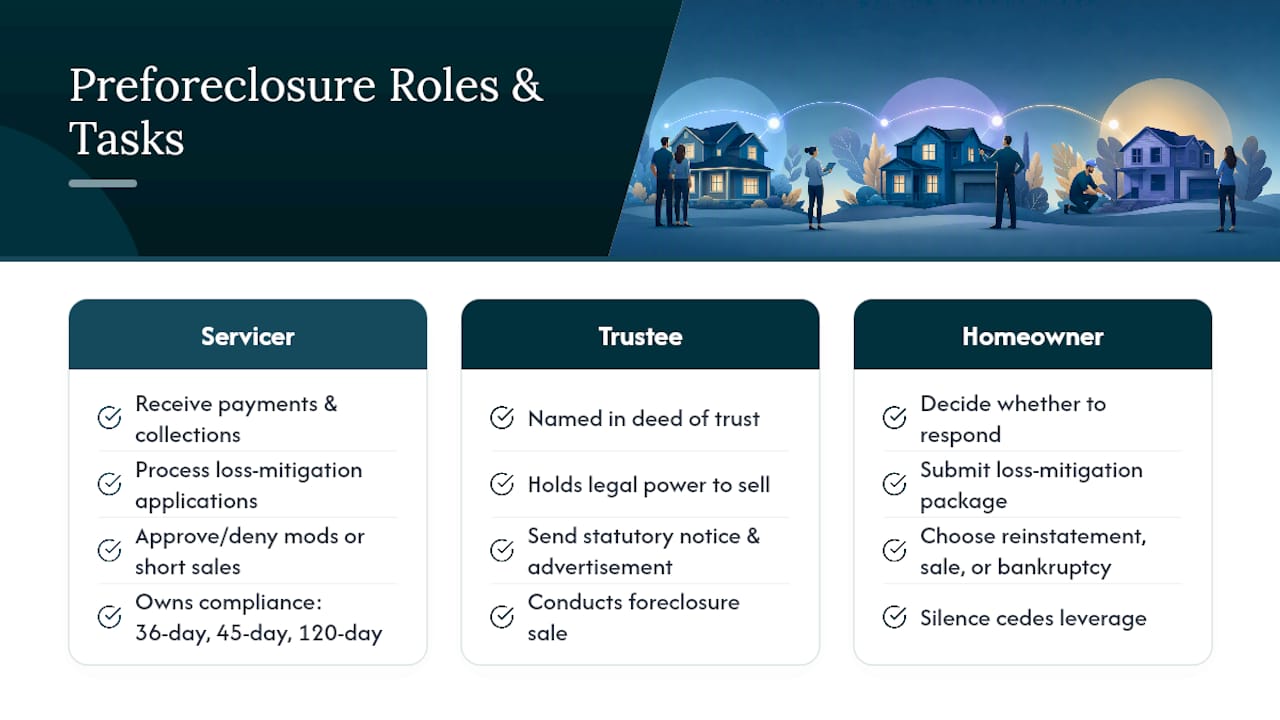
The trustee, or substitute trustee, is named in your deed of trust and holds the legal power to sell your property once default is established. The trustee doesn't negotiate your loan terms; that's the servicer's job. The trustee's role is procedural: send the statutory notice, publish the advertisement, and conduct the sale if it isn't stopped beforehand.
You, the homeowner, hold more control than the process suggests at first glance. You decide whether to respond to servicer outreach, whether to submit a loss-mitigation package, and whether to pursue reinstatement, sale, or bankruptcy. Every deadline in this article exists because you're entitled to notice and time to act. Silence is the only move that guarantees you lose that leverage.
Why Do Virginia Homeowners End Up in Preforeclosure?
The triggers are rarely exotic. Job loss and reduced income top the list nationally, and Virginia's economy, with its heavy reliance on federal employment, government contracting, and military-adjacent industries around Hampton Roads and Northern Virginia, means furloughs, contract cuts, or a permanent change of station can hit household income hard and fast.
Medical debt and unexpected health expenses are another common driver, particularly for homeowners without robust employer coverage. Divorce or separation frequently forces a single income to cover a mortgage sized for two. Rising property taxes and insurance premiums, especially in fast-appreciating markets like parts of Northern Virginia, can quietly push a previously affordable payment out of reach, particularly for homeowners on fixed retirement incomes.
Adjustable-rate mortgages that reset to higher payments, a pattern that resurfaced as rates climbed in recent years, catch some borrowers off guard when they haven't budgeted for the increase. And for military families and government contractors concentrated in Virginia, a permanent change of station or a lapse in a security clearance can create a sudden gap between income and mortgage obligation that outpaces savings.
None of these causes make the deadlines above move slower. Whatever put you here, the clock started the day you missed a payment, and the response has to match that pace.
Where Can You Find Legal Help and Housing Counseling in Virginia?
You do not have to navigate this alone, and in most cases, you shouldn't try to. HUD-approved housing counseling agencies offer free or low-cost guidance on your specific loan situation, and Virginia's foreclosure notice statute requires your servicer to include this contact information directly in your 60-day notice. You can also search HUD's Virginia foreclosure resources directly rather than waiting for the notice to arrive.
Legal aid organizations serving Virginia homeowners provide free representation for qualifying households facing foreclosure, deficiency claims, or eviction. These groups can review your loan documents, verify the servicer followed proper notice procedures, and represent you if a deficiency lawsuit follows a short sale or foreclosure sale. A private foreclosure attorney is worth the cost if your equity position, income, or legal complexity, such as a contested divorce or estate issue, justifies dedicated representation.
Start with a HUD-approved counselor even if you're fairly confident about your next move. Counselors have seen servicer loss-mitigation departments up close and often know which documentation gets an application processed faster versus which submissions sit in a queue for weeks.
What Happens If You Don't Cure a Virginia Foreclosure?
Failing to reinstate, modify, or sell before the trustee sale date means you lose the home, permanently and immediately, once the trustee's deed records. Virginia provides no post-sale redemption period, so there's no grace window afterward to buy the property back.
The financial exposure often doesn't end at the sale, either. If the auction price doesn't cover your full loan balance plus fees and costs, the lender can pursue a deficiency judgment against you for the shortfall. That's a real legal claim, and Virginia law permits it, unlike states with anti-deficiency statutes that bar this kind of suit after a foreclosure sale. A deficiency judgment can lead to wage garnishment or a lien against future assets, extending the financial consequences of foreclosure well past the loss of the house itself.
This is precisely why negotiating a deficiency waiver matters so much if you go the short-sale or deed-in-lieu route. A short sale or deed in lieu that closes with a clear, written deficiency waiver protects you from that follow-on liability. A completed trustee sale offers no such negotiation. The lender decides after the fact whether to pursue the balance, and you have far less leverage to stop it once the property is gone.
How Does Eviction Work After a Virginia Foreclosure Sale?
Once the trustee's deed records, the new owner, often the lender itself if no third-party bidder wins the auction, becomes the legal owner of the property immediately. If you're still living in the home, that owner typically starts by serving a notice to vacate, giving you a defined window, commonly a matter of days to a few weeks, to leave voluntarily.
If you don't vacate, the new owner files an unlawful detainer action in the general district court for the county or city where the property sits. That's a formal court process, not a self-help eviction, meaning the new owner cannot simply change the locks or remove your belongings without a court order. A hearing is scheduled, and if the court rules for the new owner, which is the near-universal outcome once title has already transferred, it issues a writ of possession that authorizes the sheriff to remove you if you still haven't left.
The entire post-sale eviction process typically runs several weeks to a couple of months, depending on court scheduling in your jurisdiction. If you're renting the property rather than the owner, federal protections may require the new owner to honor your existing lease term or provide additional notice, so renters facing this situation should confirm their specific rights rather than assuming the homeowner's timeline applies to them.
A Straight-Talk Perspective on Acting Fast
The single biggest mistake I see homeowners make isn't financial, it's silence. People avoid the servicer's calls because they feel ashamed, and that silence burns the exact days that federal law sets aside to protect them. Document every call, every letter, every submission date. Use a HUD-approved counselor if the process feels like too much to manage alone. Dignity here means acting, not hiding.
— Myra
How Beams Realty Group Helps When the Clock Is Running Out
If you're weighing reinstatement, a short sale, or a fast traditional sale against a looming trustee-sale date, the math usually comes down to speed and certainty. A traditional agent might take weeks just to get comfortable with a compressed timeline. Some real estate agents work Virginia's preforeclosure timeline directly, pricing your home to move fast, coordinating short-sale paperwork with your lender, and connecting you with HUD-approved counselors and foreclosure attorneys when your situation calls for it.

Here's what that looks like in practice: a fast market valuation so you know your realistic price and timeline within days, not weeks, staging and listing guidance built around your remaining calendar, and coordination between your closing date and the reinstatement or sale deadline your notice specifies. If you're already facing a scheduled sale date, that coordination matters more than almost anything else in this process. Homeowners weighing a fast, traditional sale over a short sale can also review practical guidance on maximizing your proceeds before deciding which path fits their timeline.
Reach out through Beams Realty Group today to get a straight answer on your timeline and your realistic options before the trustee sets a sale date.

This article is general information, not a substitute for advice from a qualified lawyer. Consult a qualified legal professional about your own circumstances before acting on anything here.
Sources
- 12 C.F.R. § 1024.41 (Loss-mitigation procedures)
- Consumer Financial Protection Bureau: 12 C.F.R. § 1024.39
- Va. Code § 55.1-321 (Notice of sale; owner-occupied longer notice provisions)
- Va. Code § 55.1-322 (Advertisement of sale; publication rules)
FAQ
How Long Does a Foreclosure Process Take in Virginia?
From a missed payment to a completed trustee sale, the process for an owner-occupied home typically runs five to eight months, driven by the federal 120-day filing bar plus Virginia's 60-day notice and advertisement requirements.
How Long Can a House Stay in Preforeclosure?
A house generally sits in preforeclosure for a minimum of 120 days under federal servicing rules, and it can extend several additional months if you submit a complete loss-mitigation application that triggers the dual-tracking freeze.
What Are the Disadvantages of Preforeclosure?
Preforeclosure damages your credit with cumulative delinquency marks, creates the risk of a deficiency judgment if the home sells for less than you owe, and puts you on a compressed legal timeline with limited room for error.
What Are the Requirements for a Foreclosure in Virginia?
Virginia requires the servicer to wait until the loan is more than 120 days past due, then the trustee must send owner-occupants at least 60 days' written notice and publish advertisements under a specific timing window before the sale can proceed.