
Yes, you can close a Virginia real estate transaction remotely. The state allows mail-away closings, hybrid closings, and full remote online notarization (RON). The catch isn't legality. It's your lender: some loan documents still demand ink signatures, so confirm your lender and settlement agent will accept your chosen method before you schedule anything.
TL;DR:
- Virginia offers mail-away, hybrid, and remote online notarization options, but approval depends on your lender's acceptance of the method.
- Remote online notarization requires Virginia-based notaries with a special endorsement, a platform meeting state standards, and session recordings retained for five years.
- Some lenders still mandate ink signatures on certain documents, making hybrid or mail-away closings necessary if RON is not approved.
- Clarify and confirm signing method and document requirements with your lender and settlement agent in writing before scheduling any session.
- Technical issues like poor internet or ID scanning problems are common but preventable with prior testing and preparation.
Table of Contents
- How Remote Closings Work in Virginia: Mail-Away, Hybrid, and RON
- Virginia's Legal and Technical RON Requirements You Must Know
- What Lenders, Title Companies, and Recorders Commonly Require or Decline
- Step-by-Step Checklist to Prepare for Your Virginia Remote Closing
- Remote-Closing Jobs in Virginia: What Roles Look Like and Where to Look
- Privacy and Data Security Considerations Specific to Virginia Remote Closings
- Steps for Notarizing Documents That Can't Be Done Remotely
- Common Technical Issues and Troubleshooting Tips During Remote Closings
- Legal Enforceability and Challenges of Remote Closings in Virginia
- Publisher Perspective: How Beams Realty Group Approaches Remote Closings
- How Beams Realty Group Coordinates Your Virginia Remote Closing
- Official Statutes and High-Authority Resources
- Sources
- FAQ
How Remote Closings Work in Virginia: Mail-Away, Hybrid, and RON
Virginia offers three legitimate paths to a remote closing, and which one you end up using usually comes down to your lender, your location, and how fast you need to move.
Mail-away closings send your documents to you by courier. You sign in front of a local notary, then ship the package back. It's the slowest of the three because courier timing has to be built into the schedule, but it's also the most universally accepted, since a wet-ink signature satisfies nearly every lender's requirements.
Hybrid closings split the difference. Some documents get signed electronically, while the documents your lender still wants notarized in person get handled with a traditional wet-ink signature. This works well when a lender has approved e-signatures for most of the package but hasn't cleared RON for the note or deed of trust.
Remote online notarization is the fastest option. You sign everything during a live audio-video session with a notary, with no courier and no in-person appointment. Virginia was the first state in the country to authorize RON, back in 2012, which means the notary pool and platform options here are more mature than in most states.
People tend to reach for these methods in specific situations:
- Out-of-state buyers who can't travel for closing day
- Military members deployed or stationed elsewhere
- Sellers or buyers on a tight timeline who can't wait for an in-person slot
- Anyone whose lender has already greenlit RON for their loan type
The tradeoff is straightforward: RON is fast but depends on lender acceptance, mail-away is slow but nearly bulletproof, and hybrid sits in the middle.
Virginia's Legal and Technical RON Requirements You Must Know
Virginia's remote notary rules live in Title 47.1 of the Code of Virginia, and they're more specific than most people expect.
The notary must be Virginia-based. A notary performing RON must be physically located in Virginia during the session, and the notarial certificate has to state which city or county they were in. A notary sitting in another state can't legally notarize your Virginia closing documents remotely, even with the right commission.
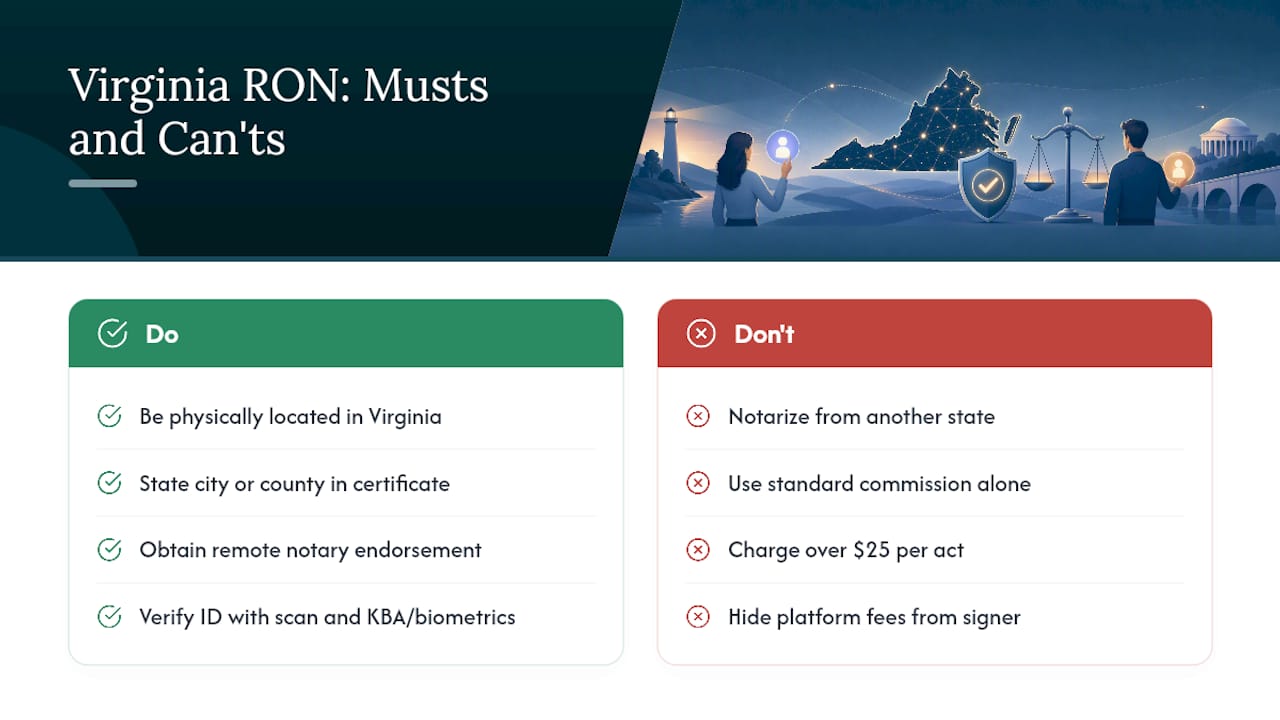
A separate endorsement is required. Notaries can't just add RON to a standard commission. They need a remote notary endorsement issued by the Secretary of the Commonwealth, and they have to use a platform that meets the state's technical standards. That endorsement ties to the notary's commission cycle, so it's renewed periodically rather than granted once and forgotten.
Identity verification is layered. Signers go through credential analysis (scanning a government ID) combined with knowledge-based authentication, a set of quiz-style questions pulled from public and private records, or a biometric alternative depending on the platform.
Fee cap: $25 per act. Virginia law caps what a notary can charge for an electronic or remote notarial act at $25. Platform technology fees are billed separately and must be disclosed before the session, so a $25 notarization can still come with additional software costs on your closing statement.
Session recordings matter too: RON sessions require real-time, two-way audiovisual recording, and the notary has to retain that recording for a minimum of five years.
What Lenders, Title Companies, and Recorders Commonly Require or Decline
The single biggest reason remote closings fall apart isn't the law. It's a lender rejecting the method after everyone thought it was settled.
Some lenders still require original ink signatures on the promissory note or deed of trust, even when they've approved e-signing for disclosures and lower-stakes forms. Title underwriters and county recorders across Virginia generally accept e-notarized documents without issue, but unusual instruments (certain trust documents, powers of attorney, or non-standard deeds) can trip up a specific recording office's system.
If a lender refuses RON for your loan, you're not stuck. The fallback options are:
- Switching to a mail-away closing with wet-ink signatures
- Scheduling a traditional in-person signing
- Using a power of attorney, but only with advance written approval from the lender and title company
Pro Tip: Get your lender and settlement agent to confirm the accepted signing method and any required original documents in writing, by email, before you book a courier or a RON session. Verbal confirmation from a loan officer isn't worth much if underwriting rejects the package a week later.
Step-by-Step Checklist to Prepare for Your Virginia Remote Closing
Getting the sequence right matters more than most people realize. Here's the order that keeps a remote closing on schedule.
- Confirm the accepted method. Get written confirmation from your lender and settlement agent on whether mail-away, hybrid, or RON is approved for your specific loan.
- Verify the notary's credentials, if using RON. Ask whether the notary holds the Virginia remote-notary endorsement and whether the platform meets state technical standards.
- Run a tech check. Test your camera, microphone, and internet connection at least a day before the session, not five minutes before.
- Schedule courier service, if using mail-away. Book secure, trackable delivery for both legs of the trip and line up a local notary appointment for the ink-signing.
- Prepare your documents and space. Have a valid photo ID ready, along with a quiet, well-lit room and printed closing instructions.
- Save contact information. Keep the title company's and notary's phone numbers handy in case something goes wrong mid-session.
- Consider a power of attorney carefully. Only use one with lender and title pre-approval, and have it drafted and executed correctly under Virginia rules.
Pro Tip: Signers underestimate how much identity verification slows things down. Having a valid photo ID ready and testing your device beforehand cuts real time off the session, since most delays happen in the first five minutes when someone's camera won't connect or their ID won't scan.
Remote-Closing Jobs in Virginia: What Roles Look Like and Where to Look
Remote closings created a real job market alongside the transactions themselves. Common titles include remote closer, settlement coordinator, remote notary, and mortgage funding specialist, and pay structures range from hourly contract work to salaried positions depending on the employer.
- Vet listings for employer reputation before applying, especially with newer title or signing services.
- Confirm required licensing (a Virginia notary commission, and the remote endorsement if the role involves RON) matches what the posting claims.
- Favor established title companies and lenders over unfamiliar third-party platforms.
- Skip any listing asking for upfront fees or personal financial information outside normal HR onboarding.
General job boards and the career pages of Virginia title and lending companies remain the most reliable sources for these openings.
Privacy and Data Security Considerations Specific to Virginia Remote Closings
A remote closing puts your Social Security number, bank details, and government ID on camera and in a recorded session, which raises the stakes on data security in a way an in-person closing simply doesn't.
Virginia's RON framework requires two-way audiovisual recording of the entire session, and that recording sits with the notary for at least five years. Ask who has access to that recording and how it's stored, since a breach at the platform level could expose years of closing sessions at once, not just yours.
Knowledge-based authentication pulls from public and private data sources to generate its verification questions, which means your credit history and public records are queried as part of the identification process. That's routine, but it's worth knowing before you're surprised by a question about a car loan from a decade ago.
Use only platforms that a licensed title company or lender has already vetted. A platform with genuine Virginia notary endorsement coverage has already cleared a compliance review that an unfamiliar app hasn't. Avoid signing documents over public Wi-Fi, and confirm the platform encrypts document transfer and storage rather than just the video call itself. If a notary or platform asks you to email a scan of your driver's license as a workaround, that's a signal to slow down and verify their legitimacy before continuing.
Steps for Notarizing Documents That Can't Be Done Remotely
Even in a mostly remote closing, some documents in Virginia still need a traditional wet-ink notarization, and knowing which ones ahead of time saves a last-minute scramble.
Certain trust instruments, some powers of attorney, and select loan documents fall into this category depending on your lender's internal policy and the county recorder's acceptance rules for that specific instrument. The fix isn't complicated, but it does require planning: identify these documents during the pre-closing document review, not on closing day.
Once flagged, you have two workable paths. Fold that single document into a short in-person signing with a local notary while handling everything else remotely, or shift the entire closing to a hybrid structure where the exception documents get wet-ink treatment alongside your electronically signed disclosures. Either way, the settlement agent should tell you exactly which pages need traditional signatures before the session starts, ideally marked in the closing package itself.
Confirm with the county recorder how they handle unusual instruments or eNotes before you assume a fully remote workflow will cover everything. Some recording offices need extra metadata for electronically recorded documents, and finding that out after the closing has already happened is the kind of delay that pushes back your funding date by days.
Common Technical Issues and Troubleshooting Tips During Remote Closings
Most remote closing failures aren't legal problems. They're technical ones, and they're almost always preventable.
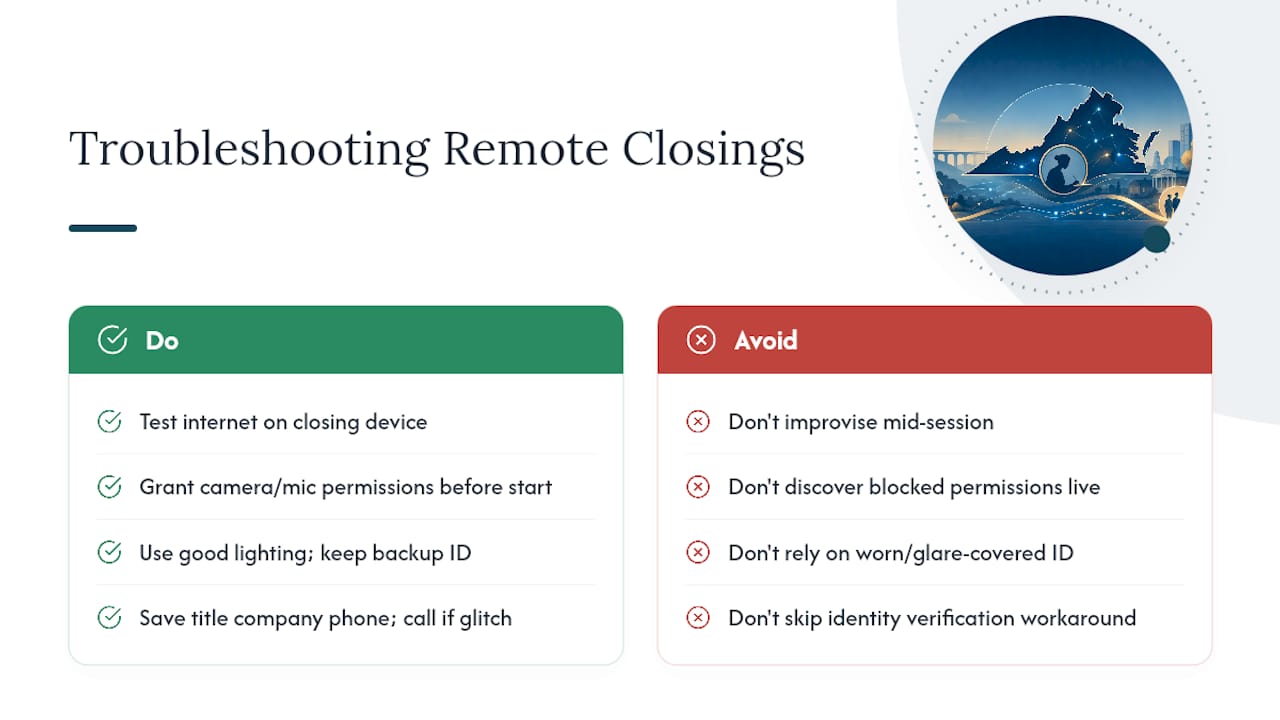
A shaky internet connection is the most common culprit, and it tends to show up mid-session as frozen video or dropped audio right when you're trying to confirm a signature. Test your connection on the actual device you'll use for the closing, not just your phone, since a laptop's Wi-Fi card can behave differently than a phone's cellular connection.
Camera and microphone permissions cause the second-most delays. Browsers and operating systems routinely block camera access by default for unfamiliar sites, so grant permissions before the session starts rather than discovering the block live with your notary watching.
ID scanning failures happen when lighting is poor or the ID is worn or glare-covered. Sit near a window or a bright lamp, and have a backup form of ID on hand in case the primary one won't scan cleanly.
If the platform itself glitches, mid-session, don't improvise. Contact the title company or notary directly using the phone number you saved ahead of time, since most platforms have a documented process for restarting a session without invalidating the signatures already collected. Sessions that fail entirely can usually be rescheduled without penalty, but a rushed workaround that skips proper identity verification can create real problems for the loan closing later.
Legal Enforceability and Challenges of Remote Closings in Virginia
A properly executed RON, mail-away, or hybrid closing carries the same legal weight in Virginia as an in-person signing. The statute doesn't create a lesser category of document. Recorded deeds, notarized loans, and remotely executed powers of attorney hold up in Virginia courts the same way traditionally signed versions do, as long as the notary followed the state's procedural requirements.
Where disputes tend to surface is procedure, not principle. A challenge to a remotely notarized document usually centers on whether the notary held a valid remote endorsement, whether the notary was actually located in Virginia during the session as the certificate claims, or whether identity verification met the required standard. The five-year recording retention requirement exists precisely for this reason: if a signature or the signer's identity is ever questioned, the session recording is the evidence that settles it.
That's also why sloppy vendor selection is riskier than people assume. A platform that doesn't fully document its Virginia compliance, or a notary operating without proper Secretary of the Commonwealth review, creates the exact gap that turns a routine closing into a legal headache years later. Using a platform already vetted for Virginia coverage isn't just convenient. It's a real hedge against a dispute nobody's expecting.
Publisher Perspective: How Beams Realty Group Approaches Remote Closings
Most of the delays we see aren't legal, they're sequencing errors: someone books a RON session before the lender has actually confirmed which documents need wet ink. Our process starts by getting that acceptance in writing first, then building the courier or notary schedule around it. Clients get a pre-sign checklist and courier tracking so nothing about closing day is a surprise.
— Myra
How Beams Realty Group Coordinates Your Virginia Remote Closing
This service is an alternative to guessing your way through a remote closing on your own. Instead of discovering on closing day that your lender wants ink signatures on the deed of trust, acceptance is confirmed with your lender and settlement agent up front, so the method chosen is the one that actually funds the loan.

This means scheduling and confirming a notary or courier, reviewing documents for anything that can't be signed remotely, coordinating the RON session or mail-away package, and following up after signing to make sure recording and disbursement go through cleanly. This legwork can turn a stressful remote closing into a routine one. If you're buying a home in Virginia and want someone managing that timeline for you, start with our Home Buying services and tell us your target closing date.
Official Statutes and High-Authority Resources
For the statutory language behind Virginia's notary and RON rules, review Title 47.1 of the Code of Virginia directly. For process comparisons across signing methods, see this overview of the remote home buying process. Buyers estimating total transaction costs alongside a remote closing can also check Virginia closing cost averages.
Sources
- Virginia Code, Title 47.1 — Notaries (Code of Virginia)
- Notary requirements — Virginia (ProStamps blog)
- Is Remote Online Notarization Legal in Virginia? (RemoteNotaryExperts)
FAQ
Can a Real Estate Closing Be Done Completely Remotely in Virginia?
Yes. Virginia allows fully remote closings through remote online notarization, along with mail-away and hybrid options for transactions where a lender hasn't cleared RON for every document. The right method depends entirely on what your specific lender and title company will accept.
What Documents Are Required When You're Getting Close to Closing?
You'll typically need a valid government-issued photo ID, your loan documents for review, and proof of funds or insurance depending on your lender's checklist. For a RON session, you'll also need a working camera and microphone since identity verification happens live on video.
How Long Does It Take to Close on a Home in Virginia?
Timelines vary by lender and closing method, but mail-away closings generally take longer than RON because of courier transit time in both directions. Building extra days into your schedule for courier delivery, as opposed to a same-day RON session, is the safest way to avoid pushing back your funding date.
What Is the Most Remote Location in Virginia, and Does It Affect Closing Options?
Remote online notarization exists specifically to solve for geography, so a buyer or seller in a rural or hard-to-reach part of Virginia can close without traveling, as long as their lender accepts RON. Location itself isn't a barrier under Virginia law since the notary is required to be Virginia-based, not necessarily nearby.
Does Beams Realty Group Handle Remote Closing Coordination?
Yes. Beams Realty Group coordinates lender and title acceptance, schedules notary or courier logistics, and follows up on recording and disbursement for Virginia clients. Reach out through our Home Buying page to discuss your closing timeline.