
Virginia law requires a standardized resale certificate for most home sales inside a common interest community, and the association has 14 days to hand it over once someone requests it in writing. The seller or the seller's agent makes that request, not the buyer. Miss the deadline, and the law treats the certificate as unavailable, which triggers real consequences for the association and real protections for the purchaser.
TL;DR:
- The association must deliver the resale certificate within 14 days of a complete written request; missing this deadline makes the certificate legally "unavailable."
- Exempt transactions include initial developer sales, gift transfers, court-ordered transfers, foreclosures, and trust transfers, which do not require a resale certificate.
- The resale package must include key documents such as governing rules, financial statements, violation notices, pending litigation, and recent board minutes, in a specific order.
- A buyer can cancel the contract within a few days of receipt if the certificate is late or incomplete, but that right disappears once settlement occurs.
- The seller usually bears the cost of producing the original certificate, with subsequent updates paid for by the requesting party or escrowed costs at settlement.
Table of Contents
- What Triggers a Virginia HOA Resale Package Requirement
- What's Actually Inside a Virginia HOA Resale Certificate
- The 14-Day Rule, Updates, and Financial Updates
- Who Pays for the HOA Resale Package in Virginia
- Buyer and Seller Rights When the Timeline Breaks
- How to Request a Resale Certificate Without Losing Time
- How Beams Realty Group Keeps Resale Timelines on Track
- Get Hands-On Help With Your Virginia HOA Resale Documents
- Sources
- FAQ
What Triggers a Virginia HOA Resale Package Requirement
Any sale of a unit inside a "common interest community" falls under this rule. That term covers condominiums, properties governed by a property owners' association, and real estate cooperatives. Before 2023, each of those structures had its own patchwork of disclosure rules. The Virginia Resale Disclosure Act folded them into one law and put the Common Interest Community Board in charge of a single standardized form, effective July 1, 2023.
Not every transfer needs a resale certificate, though. Several transactions are exempt:
- The developer's original sale of a newly built unit
- Gifts and transfers between family members with no sale involved
- Court-ordered transfers, including many divorce settlements
- Foreclosure sales and certain trustee auctions
- Some transfers into or out of a trust for estate planning purposes
Timing matters here more than most sellers expect. The clock on the 14-day delivery window starts only after the association receives a proper written request, so a seller who waits until a week before settlement to ask for the certificate has already put the closing date at risk.
What's Actually Inside a Virginia HOA Resale Certificate
The standardized resale certificate that DPOR requires opens with a short "road map," a set of summary pages built so a buyer doesn't have to dig through fifty pages of appendices to find the one fact that matters. The appendices follow in a specific statutory order, and Code of Virginia §55.1-2310 spells out exactly what has to be attached.
Here's what you should expect to find inside a complete package:
- Association contact information and management company details
- Copies of the governing documents (declaration, bylaws, rules)
- A current balance sheet and income and expense statement
- A reserve study summary or reserve fund disclosure
- Notices of any violations affecting the specific unit
- Disclosure of pending litigation involving the association
- Insurance and fidelity bond coverage information
- Recent board meeting minutes
- Occupancy, leasing, and rental restriction rules
Pro Tip: Check the appendix numbers against the road map pages first. If Appendix 6 is supposed to be the reserve study and it's missing or blank, that's your cue to call the association before you assume everything else in the package is complete.
The road map format exists because DPOR built the form for non-experts, not just attorneys and property managers. A buyer with zero HOA experience should be able to locate the litigation disclosure and the reserve summary within a couple of minutes, not a couple of hours.
The 14-Day Rule, Updates, and Financial Updates
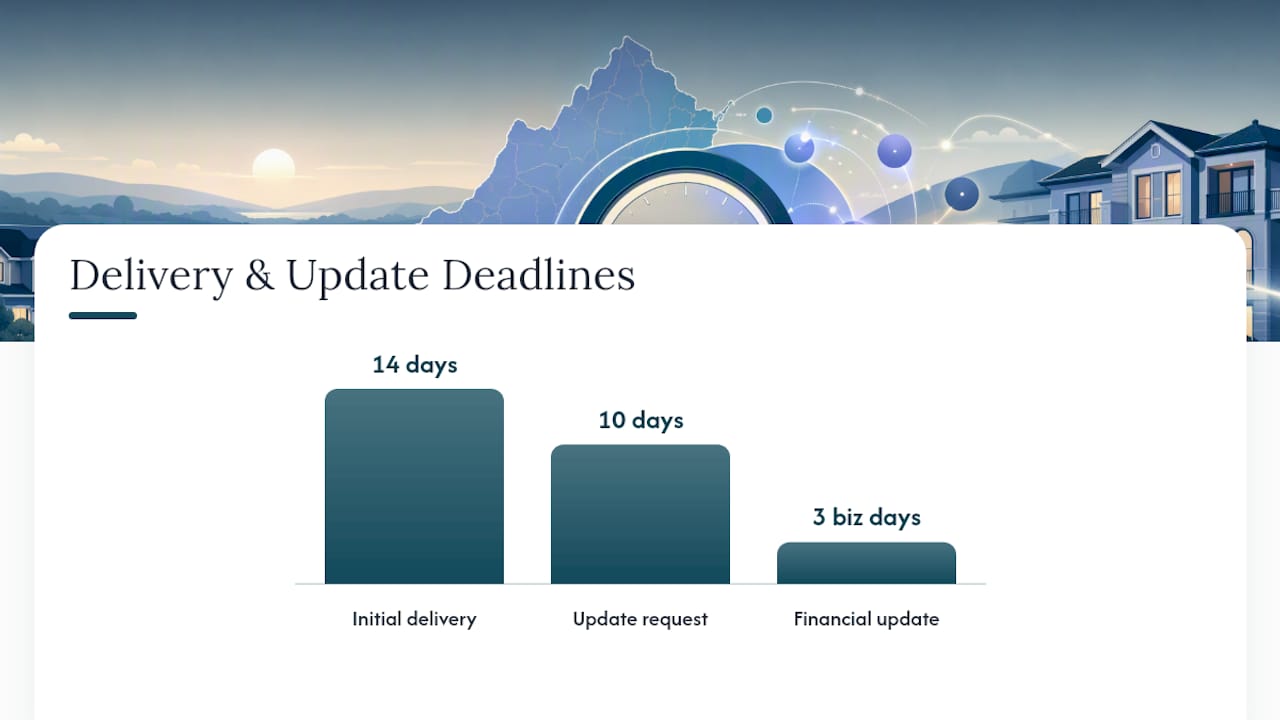
The initial delivery window is 14 days from a valid written request, and it's not a soft guideline. Under Chapter 23.1 of the Code of Virginia, an association that blows past that deadline has its certificate legally "deemed unavailable," which shifts leverage toward the buyer and exposes the association to penalties.
Beyond the initial request, there are two shorter windows worth knowing:
- Update request: If a certificate was issued more than 30 days but less than 12 months before settlement, either party can request an updated certificate. The association has 10 days to deliver it.
- Financial update: A settlement agent can request a narrower financial update closer to closing day. That one has a tighter turnaround: 3 business days.
Delivery can happen on paper or through a generally accepted electronic format, and the requester should specify exactly who gets the package, whether that's the seller, the buyer's agent, or the settlement agent directly. Vague delivery instructions are one of the most common, and most avoidable, causes of closing-day confusion.
Who Pays for the HOA Resale Package in Virginia
The seller is generally responsible for the cost of preparing and delivering the original resale certificate, since it's the seller's obligation to disclose. Anyone requesting an update or a financial update after that typically pays for that specific update. In practice, the settlement agent often fronts these costs and builds them into the closing statement so nobody's holding an unpaid invoice at the table, a detail worth understanding before you review your Virginia closing costs.
Fee categories commonly include:
- A base preparation and delivery fee
- An expedite fee for rush turnaround
- An update fee for the 10-day update
- A post-closing or transfer fee processed after settlement
An association can't just invent these charges. Before it collects any resale-related fee, it has to be properly registered with the Common Interest Community Board and current on its own filings, according to Virginia State Bar guidance. If an association can't show current registration, that's a red flag worth raising immediately.
Buyer and Seller Rights When the Timeline Breaks
Buyers get a real exit ramp if things go wrong. Under §55.1-2312, a purchaser can cancel the contract within a statutory window tied to when the certificate actually arrives relative to contract ratification and settlement. Depending on timing, that window generally runs a few days after delivery, but it closes for good at settlement. Sign the closing papers, and that cancellation right disappears whether or not you ever read the certificate.
The bigger protection kicks in when the association simply fails to deliver:
- If no certificate arrives and it's deemed unavailable, the purchaser is not required to pay delinquent assessments outstanding as of the request date
- The purchaser isn't required to remedy violations that existed but weren't disclosed by that date
- The association can face DPOR penalties and be liable for damages, capped by statute
Pro Tip: Missing a resale certificate doesn't mean you get to ignore the community's rules going forward. It just means the association has a much harder time enforcing anything against you that it should have disclosed and didn't.
None of this replaces legal advice. If a dispute over fees, timing, or a disclosed violation turns into a real disagreement, talk to an attorney who handles Virginia HOA resale disclosures before you assume you know how a court would read the statute.
How to Request a Resale Certificate Without Losing Time
- Put the request in writing and identify the exact unit, the seller's name, and the contract date if one exists.
- Name the recipient clearly. Tell the association whether the certificate should go to the seller, the listing agent, or the settlement agent directly.
- Ask for electronic delivery if the association supports it. It's faster and leaves a timestamp for your records.
- Confirm the association's registration status and fee schedule on DPOR's site before you pay anything.
- Track the 14-day clock from the date of a complete request, not from a phone call or a voicemail.
- Request an update or financial update only when the timing calls for it, and escrow the estimated fee so it doesn't stall settlement.
- File a DPOR complaint if the association misses its deadline or demands payment without proper registration.
Pro Tip: Ask for the buyer's name to stay off the initial request if the association tries to require it before preparing anything. The statute doesn't condition delivery on the association knowing who's buying the unit, and that request is a common stalling tactic.
How Beams Realty Group Keeps Resale Timelines on Track
Chasing down a resale certificate sounds simple until a closing date is on the line and an association hasn't responded in a week. In practice, this is coordination work: submitting the written request, confirming it was received, ordering the update if the certificate is aging past 30 days, and making sure funds are escrowed so an unpaid fee never becomes the reason a closing slips.
This process is handled by experienced local agents who check an association's DPOR registration before any payment toward a resale fee is made. That single step catches most of the improper fee demands sellers run into. It also matters for sellers weighing whether to skip representation entirely: the resale certificate process is exactly the kind of statutory deadline that punishes a seller working alone without a system for tracking it.
— Myra
Get Hands-On Help With Your Virginia HOA Resale Documents
The resale certificate request is managed from the first written notice through delivery confirmation, so clients are not left waiting with a property management office as the closing date approaches.

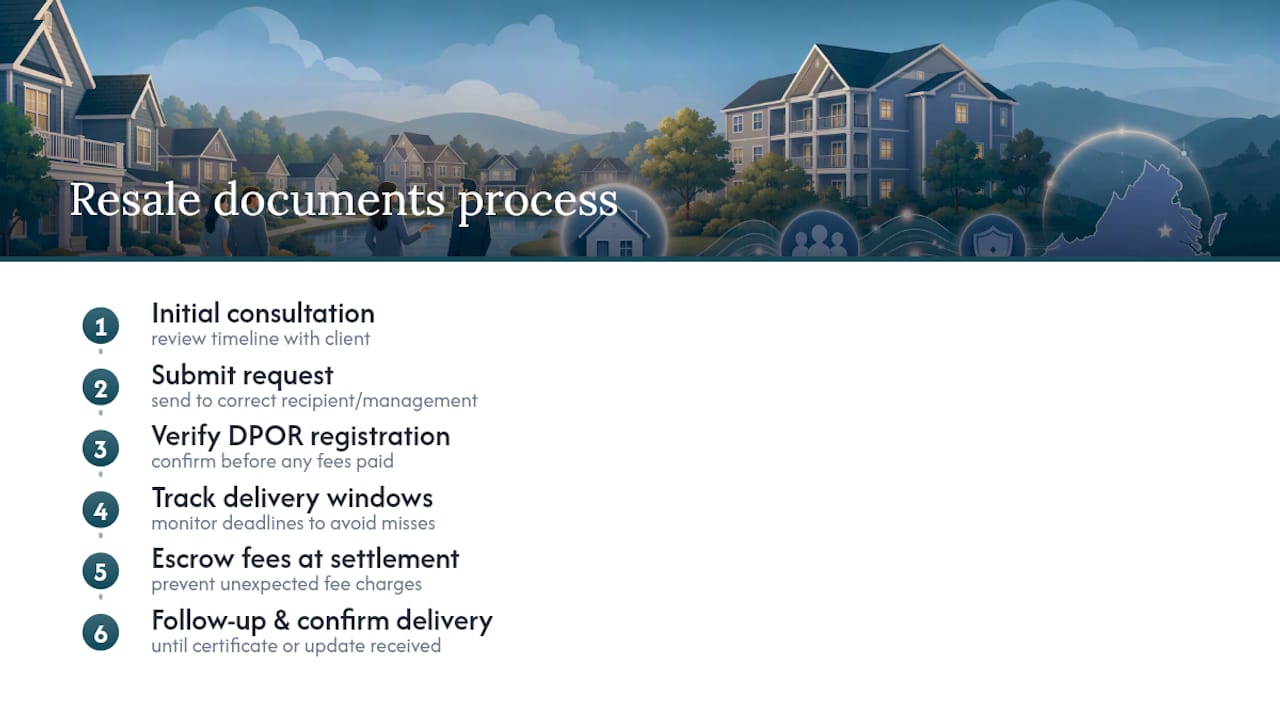
This process includes submitting the request to the correct recipient, verifying the association's DPOR registration before any fees are paid, tracking the required delivery windows to avoid missed deadlines, and ensuring that fees are escrowed properly at settlement rather than appearing unexpectedly. Clients can expect an initial consultation regarding their timeline, coordination with the association or management company, and follow-up until the certificate or update is received.
If you're buying or selling inside a Virginia common interest community, start with Beams Realty Group and get the resale-document process handled before it becomes a closing-day problem.
This article is general information, not a substitute for advice from a qualified lawyer. Consult a qualified legal professional about your own circumstances before acting on anything here.
Sources
- Common Interest Community Association Disclosures - DPOR
- § 55.1-2310. Resale certificate; form and contents
FAQ
Who Pays for the HOA Resale Package in Virginia?
The seller typically covers the cost of preparing and delivering the original resale certificate, while whoever requests a later update or financial update usually pays for that specific request.
What Is a Resale Certificate for a Virginia HOA?
It's the standardized document, required under the Virginia Resale Disclosure Act, that discloses an association's finances, rules, violations, and pending litigation before a resale closes.
Does Virginia Require a Resale Certificate for Every HOA Sale?
Most resales inside a common interest community require one, but exemptions exist for developer sales, gifts, foreclosures, and certain court-ordered transfers.
What Is Included in a Virginia HOA Resale Package?
It includes association contact details, governing documents, financial statements, a reserve summary, violation notices, pending litigation disclosures, insurance information, and recent board minutes, all attached in the order §55.1-2310 requires.
What Happens if a Virginia Association Doesn't Deliver the Certificate in 14 Days?
The certificate is deemed unavailable by law, the purchaser is relieved of paying certain delinquent assessments and undisclosed violations, and the association can face DPOR penalties.