
A Section 1031 like-kind exchange lets investors defer federal capital gains tax when they swap investment or business real property for other like-kind real property, provided they use a qualified intermediary, identify replacement property within 45 days, and complete the exchange within 180 calendar days. Miss any of these, and the IRS treats the transaction as a taxable sale.
The nonnegotiables:
- A qualified intermediary (QI) must hold your sale proceeds. You can never touch the cash.
- You have a maximum period of 45 calendar days from closing on the relinquished property to identify replacement property in writing.
- You have up to 180 calendar days total to close on the replacement, capped by your tax return due date (including extensions).
- Since 2018, only real property used in a trade or business or held for investment qualifies. Personal property is out.
Every exchange gets reported on Form 8824, filed with your return for the year of the transfer. That form is where the IRS checks your math on deferred gain, boot, and basis.
TL;DR:
- Investors must identify replacement property in writing within 45 calendar days after closing the relinquished property, using one of three rules.
- The entire exchange must close within 180 calendar days, capped by the tax return due date, including extensions, with weekends and holidays counting against the deadlines.
- Only real property used in trade or business or held for investment qualifies since 2018, excluding personal property, stocks, digital assets, and property held mainly for resale.
- The qualified intermediary must hold the sale proceeds in a segregated escrow account, and prior relationships with the seller disqualify some potential QI providers.
- Receipt of cash or debt relief that isn't reinvested, called boot, triggers immediate taxable gain in the exchange year.
Table of Contents
- What Counts as Like-Kind Real Property Under Current 1031 Exchange Rules
- How Do the 45-Day and 180-Day Rules Actually Work?
- Why Does the Qualified Intermediary Matter So Much?
- What Is Boot, and How Does It Trigger a Tax Bill?
- Reverse Exchanges, Multi-Asset Deals, and Related-Party Traps
- Filing Form 8824 and Watching for State-Level Surprises
- Your 1031 Exchange Checklist From Start to Finish
- Is a 1031 Exchange Actually the Right Move?
- Local Guidance for Executing a 1031 Exchange in Virginia
- Key Takeaways
- Where to Verify These Rules Yourself
- Sources
What Counts as Like-Kind Real Property Under Current 1031 Exchange Rules
Before 2018, "like-kind" covered a surprisingly wide range of assets, including business equipment, franchise licenses, and even aircraft. The Tax Cuts and Jobs Act eliminated all of that. Today, Section 1031 treatment applies only to real property held for use in a trade or business or for investment. That single change reshaped how investors plan exchanges, since anything that isn't real estate now falls outside the rule entirely.
Eligible property is broader than most people assume. It includes raw land, commercial buildings, rental houses, certain leasehold interests running 30 years or longer, air rights, and even boat slips when local law treats them as real property interests. Two properties don't need to be similar in grade or quality; for example, a parking lot can exchange for an apartment building, or farmland for a retail strip. Real is real.
What's excluded matters just as much:
- Primary residences (though Section 121's exclusion may apply separately if you've lived there long enough)
- Property held primarily for resale, like flips or inventory
- Stocks, bonds, and most partnership interests
- Cryptocurrency and other digital assets
One wrinkle worth knowing: the "incidental personal property" rule lets small amounts of non-real property (like appliances included in a rental sale) ride along without disqualifying the exchange, as long as their value stays under 15% of the total.
How Do the 45-Day and 180-Day Rules Actually Work?
Both clocks start on the same day: the date you close on the relinquished property. That's day zero, and both deadlines run on calendar days, not business days. Weekends, Thanksgiving, and your kid's birthday all count against you. The 180-day window is capped by your tax return due date, including extensions, which creates a nasty trap for anyone who sells in November or December without filing for an extension.
Identifying replacement property isn't as simple as jotting down an address. The IRS gives you three tests, and you only need to satisfy one:
- Three-property rule. Identify up to three properties of any value. Most exchanges use this one because it's simple and flexible.
- 200% rule. Identify any number of properties, as long as their combined fair market value doesn't exceed 200% of what you sold.
- 95% rule. Identify unlimited properties of any value, but you must actually acquire 95% of the total value identified. This one is rarely used because it leaves almost no margin for error.
Your identification must be in writing, signed, and delivered to your qualified intermediary or another party to the exchange before midnight on day 45. Vague descriptions ("a duplex in Fairfax County") don't hold up. Use the legal description or the street address, and deliver it a few days early rather than racing the clock.
Pro Tip: If you're selling late in the year, file a tax return extension even if you don't think you'll need it. It's the only way to guarantee you get the full 180 days instead of losing weeks to an early filing deadline.
Why Does the Qualified Intermediary Matter So Much?
A qualified intermediary is the entity that holds your sale proceeds, prepares your exchange documents, and eventually uses that cash to acquire your replacement property on your behalf. The QI exists for one reason: to keep you from ever having "constructive receipt" of the money. The moment those funds land in your personal account, even briefly, the IRS treats the entire exchange as a taxable sale.

This is why wiring instructions and escrow language matter more than most sellers realize. Funds need to move directly from the closing table to the QI's separate, dedicated account, never through you.
Not just anyone can serve as your QI. The IRS disqualifies anyone who's acted as your agent within the two years before the exchange, including your attorney, accountant, real estate broker, or employee. That conflict-of-interest rule exists because a QI with too much history with you creates too much temptation for informal control over the funds.
Before hiring one, confirm:
- They carry fidelity bond coverage and errors-and-omissions insurance
- Client funds sit in segregated, qualified escrow accounts, not commingled operating funds
- They have a documented track record with exchanges similar to yours
Pro Tip: Ask your QI candidate how they handle funds if their company is acquired or goes bankrupt mid-exchange. A qualified intermediary using segregated escrow accounts, not their own operating accounts, is the safer bet.
What Is Boot, and How Does It Trigger a Tax Bill?
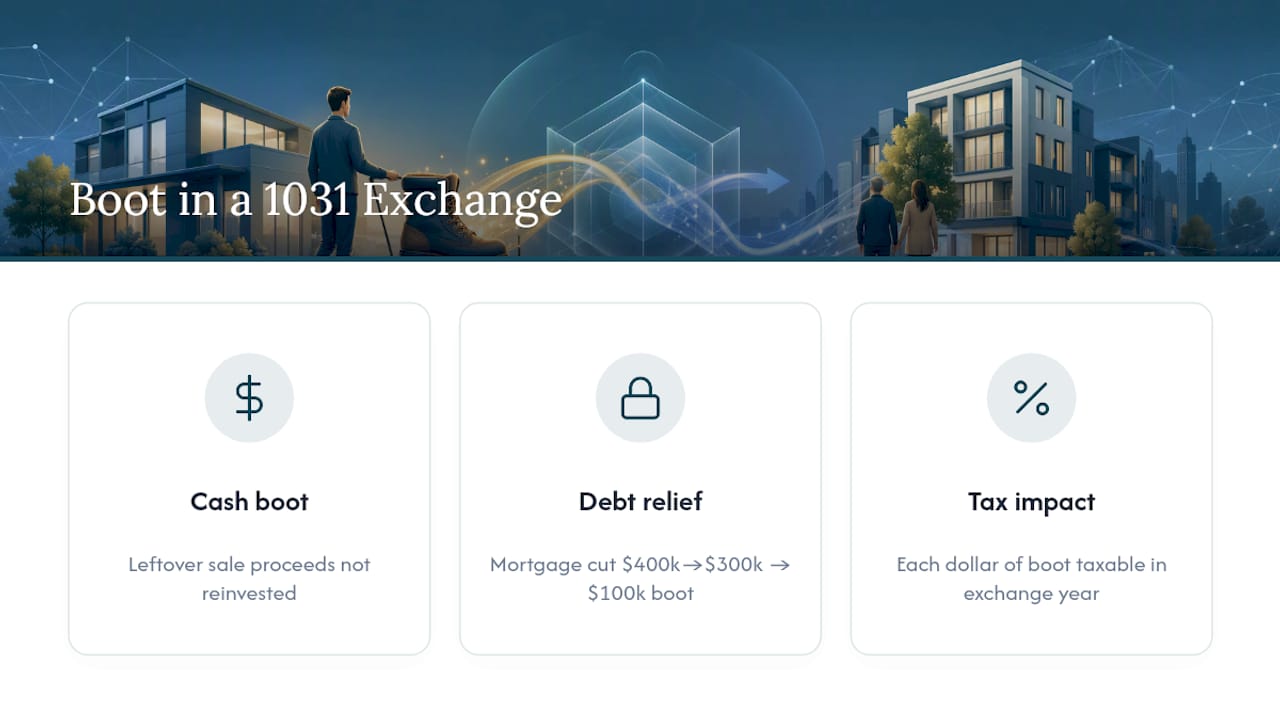
Boot is anything of value you receive in an exchange that isn't like-kind real property, and it's taxable in the year you receive it, even inside an otherwise valid exchange. The most common form is cash boot: leftover sale proceeds you didn't reinvest because your replacement property cost less than what you sold. Debt relief creates boot too. If you pay off a $400,000 mortgage on the relinquished property but only take on $300,000 of new debt on the replacement, that $100,000 difference is treated as boot unless you offset it with additional cash into the deal.
Your basis in the new property carries over from the old one, adjusted for any boot received or additional cash invested. This carryover basis is what eventually determines your taxable gain if you sell without exchanging again.
Depreciation recapture doesn't disappear either. It defers along with the rest of the gain, but it resurfaces the moment you sell for cash. Every dollar of boot you receive is fully taxable in the exchange year, up to your total realized gain, so partial exchanges rarely produce full deferral.
Reverse Exchanges, Multi-Asset Deals, and Related-Party Traps
Standard exchanges sell first and buy second. A reverse 1031 exchange flips that sequence: you acquire the replacement property before selling the relinquished one, using an exchange accommodation titleholder (EAT) to "park" title until the sale closes. Reverse exchanges make sense in competitive markets where waiting to sell first risks losing the property you actually want, but they cost more and demand tighter coordination with your QI and lender.
Multi-asset exchanges (selling several properties and buying several others, or vice versa) require grouping each exchange group separately for boot and gain calculations. Non-like-kind items mixed into a multi-asset deal get valued and taxed individually rather than blended across the whole transaction.
Related-party exchanges carry their own landmine: the two-year disposition rule. If you exchange with a related party (a sibling, parent, or an entity you control) and either of you disposes of the swapped property within two years, the IRS can retroactively disqualify the deferral. Exceptions exist for deaths, involuntary conversions, and transactions where tax avoidance clearly wasn't the motive, but count on the IRS scrutinizing these deals closely.
Filing Form 8824 and Watching for State-Level Surprises
Form 8824 gets filed with your federal return for the year the exchange closed, not the year you find a replacement. The form walks through the relinquished and replacement property descriptions, both closing dates, any boot received, and the resulting basis calculation.
Because the 180-day deadline is capped by your return due date, a late-year sale without a filed extension can quietly cut your window short by months.
State tax rules add another layer. Most states follow federal treatment, but a handful impose clawback provisions that recapture deferred gain when you eventually sell without exchanging again, particularly across state lines. Practitioner guidance consistently flags state conformity as an overlooked risk, especially for investors moving proceeds from a high-tax state into Virginia or vice versa. Transfer taxes and recordation fees also apply at the state and local level regardless of federal deferral, so budget for them separately.
Your 1031 Exchange Checklist From Start to Finish
Getting the mechanics right matters more than getting a great deal on the replacement property, because a blown deadline erases the tax benefit entirely. Here's the sequence that keeps investors out of trouble.
Before you sell:
- Shortlist two or three realistic replacement properties and get prequalified for financing.
- Select an independent qualified intermediary and have the exchange agreement ready before closing.
- Draft your identification language in advance so day 45 isn't a scramble.
During the exchange: 4. Deliver written identification to your QI well before the deadline, not on it. 5. Confirm your proceeds are sitting in a segregated escrow account. 6. Track both deadlines against your closing calendar and your lender's timeline.
After closing: 7. File Form 8824 with your return and document your new basis calculation. 8. Confirm any state filing or transfer tax obligations tied to the transaction.
Beams Realty Group has guided Virginia clients through exchanges involving everything from single rental conversions to multi-property portfolio swaps, coordinating closing timelines with QIs so identification deadlines never come down to the wire.
Pro Tip: Build your replacement property shortlist while your current property is still on the market. Investors who wait until after closing to start looking almost always feel the 45-day squeeze.
Is a 1031 Exchange Actually the Right Move?
Exchanges make sense for long-term investors who want to keep capital working in real estate rather than cashing out and paying the IRS. If you're planning to sell eventually and walk away from real estate entirely, an exchange only postpones a tax bill you'll pay later anyway, likely with added complexity along the way.
The costs (QI fees, tighter timelines, and the pressure of a 45-day clock) are real. Beams Realty Group generally counsels clients to exchange when they have a clear next property in mind and to sell outright when they're exiting the asset class for good, including in divorce sale situations where liquidity often outweighs deferral.
— Myra
Local Guidance for Executing a 1031 Exchange in Virginia
Coordinating a 1031 exchange means keeping several moving parts on the same calendar: your QI, your lender, your closing attorney, and the seller on the other end of your replacement purchase. Beams Realty Group manages that coordination for Virginia clients directly, working alongside your qualified intermediary to keep identification deadlines, financing approvals, and closing dates aligned instead of competing against each other.

That local closing support matters most in the final two weeks of a 180-day window, when a financing delay or a title issue can threaten the whole exchange. If you're weighing whether to exchange or sell outright on a property in Virginia, schedule a consultation with Beams Realty Group to map out your timeline before you list.
Key Takeaways
A 1031 exchange defers federal capital gains tax only when investors meet the 45-day identification deadline, the 180-day closing deadline, and full qualified intermediary custody of proceeds.
| Point | Details |
|---|---|
| Only real property qualifies | Post-2018 rules limit like-kind treatment to business or investment real estate, not personal property. |
| Deadlines run on calendar days | Both the 45-day identification and 180-day closing windows include weekends and holidays with no grace period. |
| Boot triggers immediate tax | Cash left over or reduced debt on the replacement property is taxable in the exchange year. |
| File an extension if selling late | The 180-day window is capped by your tax return due date unless you file for an extension. |
| Beams Realty Group coordinates locally | Beams Realty Group manages QI coordination, closing timelines, and financing milestones for Virginia exchanges. |
Where to Verify These Rules Yourself
- IRS like-kind exchange guidance: the federal agency's own explanation of eligible property.
- Form 8824 instructions: the reporting form and its line-by-line requirements.
- 26 U.S.C. § 1031: the statutory text governing exchange treatment.
- Baker 1031's exchange timeline breakdown: practitioner detail on deadline mechanics and common errors.
This article is general information, not a substitute for advice from a qualified financial advisor. Consult a qualified financial professional about your own circumstances before acting on anything here.
Sources
- Instructions for Form 8824 (2025) | Internal Revenue Service
- Like-kind exchanges - Real estate tax tips | IRS
- 26 USC 1031: Exchange of real property held for productive use or investment
- 1031 Exchange Timeline: The 45-Day and 180-Day Deadlines | Baker 1031
- 1031 exchange rules: Overview and FAQ | Thomson Reuters