
Buying mortgage points usually pays off if you plan to keep the loan for years and have cash to spare after closing. A no-points loan usually wins if you expect to move or refinance within a few years, or if closing cash is tight. The dividing line is your break-even point: months to break even equals the cost of the points divided by your monthly payment savings.
TL;DR:
- Buying points makes sense only if you plan to keep the loan for at least five years and can afford the upfront payment without draining your reserves.
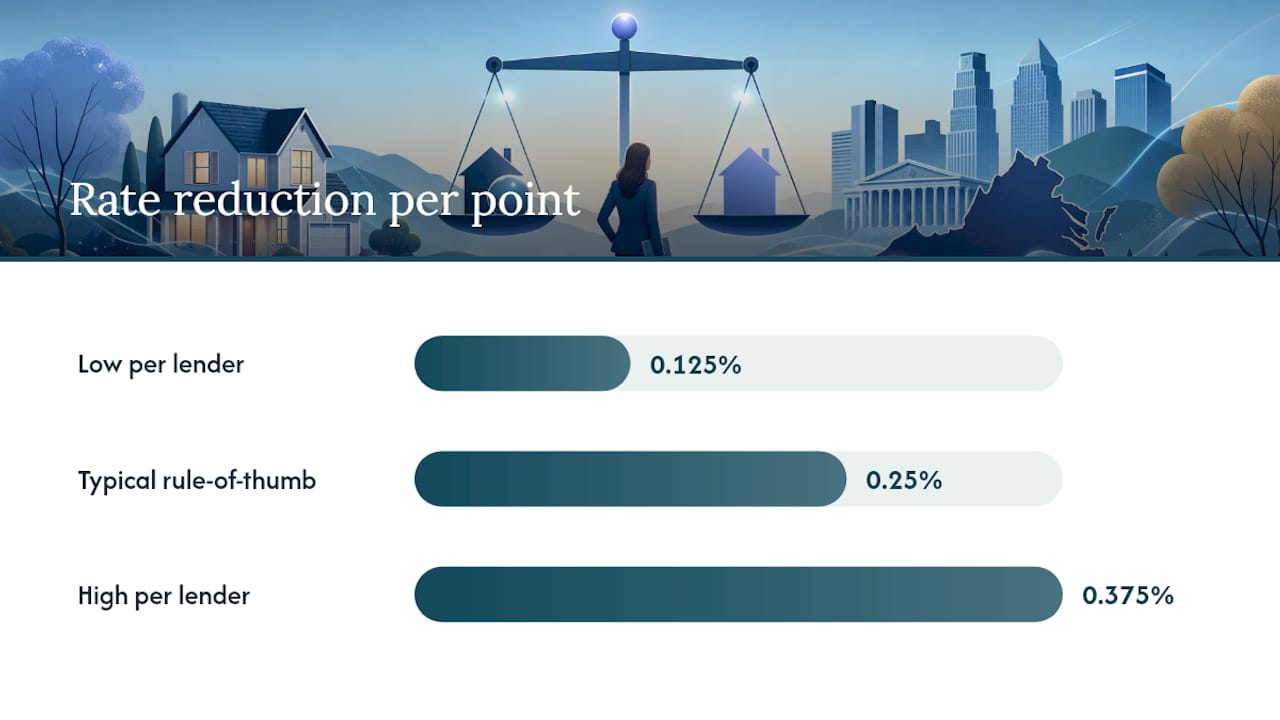
- The rate reduction per point varies significantly between lenders, with one point typically reducing the rate by about 0.25%, but this can range from 0.125% to 0.375%.
- The break-even point on paying for points usually occurs around five years, meaning you recover your costs if you stay in the home longer than that.
- If you expect to sell or refinance within a few years, or have limited cash, accepting lender credits or making a larger down payment might be more advantageous.
- Always compare multiple lender estimates side by side and prioritize the actual cost and savings over relying solely on APR or advertised rates.
Table of Contents
- What Are Mortgage Points, and How Do They Work?
- How Do Points Affect Your Rate, Payment, and APR?
- How Do You Calculate the Break-Even Point on Mortgage Points?
- When Does Buying Points Make Sense? Pros, Cons, and a Decision Checklist
- What Are the Alternatives to Buying Mortgage Points?
- How Do You Shop Lenders and Compare Loan Estimates?
- How Do Agents and Beams Realty Group Handle Points in Real Deals?
- The Overlooked Part of the Points Decision
- Get Local Help Comparing Your Mortgage Options
- Where to Verify the Numbers Yourself
- Sources
- FAQ
What Are Mortgage Points, and How Do They Work?
Mortgage points, also called discount points, are prepaid interest you hand over at closing to lock in a lower rate. One point costs 1% of your loan amount, so on a loan, one point costs 1% of that amount. That's different from an origination point, which is a lender fee for processing your loan and does nothing to your rate.
Lenders don't require you to buy points in whole numbers. A 0.5 point, or half point, costs half as much and buys roughly half the rate cut. Some builders and sellers also offer temporary buydowns, structures like a 2-1 buydown that lowers your payment for the first year or two before it steps back up to the note rate. These are a separate tool from permanent points, and worth asking about when a seller offers concessions.
At closing, points show up as a specific line item on your Loan Estimate, and the Consumer Financial Protection Bureau recommends checking these details before signing:
- The "Points" line under Loan Costs, showing dollar amount and percentage
- The interest rate tied to that specific points option
- Whether the points are lender credits (working in your favor) or a cost you're paying
- Your total cash needed to close, which points increase
How Do Points Affect Your Rate, Payment, and APR?
One point typically shaves about 0.25% off your rate, but that number moves around a lot. Depending on the lender and your credit profile, a single point might buy anywhere from 0.125% to 0.375% off the rate. There's no fixed exchange rate here, which is exactly why comparing offers matters more than trusting a rule of thumb.
Rate reductions per point can vary by a factor of three between lenders, even for buyers with identical credit scores and loan amounts.
A quarter-point rate drop sounds small until you run the payment math. For example, on a 30-year fixed loan, moving from 7% to 6.75% can cut your principal-and-interest payment by a moderate monthly amount, but it requires paying 1% of your loan amount upfront.
APR is where things get tricky. Because APR folds prepaid points into an annualized cost figure, a points loan can show a lower APR than a no-points loan even when it costs you more if you sell or refinance in two years. Bankrate notes that APR assumes you hold the loan to term, so it's a poor comparison tool for anyone planning a shorter stay. Skip the APR shortcut and calculate total cost over your actual expected holding period instead.
How Do You Calculate the Break-Even Point on Mortgage Points?
The formula is simple: months to break even = cost of points ÷ monthly payment savings. Once your cumulative monthly savings exceed what you paid for the points, you're ahead. Before that point, you're behind.
Here's a worked example using a $400,000 loan at 30 years fixed:
- Loan amount: $400,000
- Rate without points: 7.00%, monthly P&I payment: $2,661
- Cost of 1 point: $4,000 (1% of loan amount)
- Rate with 1 point: 6.75%, monthly P&I payment: $2,596
- Monthly savings: $65
- Break-even: $4,000 ÷ $65 = about 61.5 months, or roughly 5 years
That lines up with the illustrative examples NerdWallet uses, which typically land break-even periods around five years for a one- or two-point purchase on a 30-year loan. Stay in the home and keep the loan past that point, and every month after is pure savings. Sell or refinance before then, and you've lost money on the points.
| Scenario | Cost | Rate Change | Monthly Savings | Break-Even |
|---|---|---|---|---|
| 1 point, 30-year loan | About 1% of loan amount | Typical rate reduction around 0.25% | Moderate monthly savings depending on loan size | Break-even typically around five years in example cases |
| 2 points, 30-year loan | About 2% of loan amount | Larger rate reduction | Proportional monthly savings | Similar break-even period due to scaling |
| 0.5 point, 30-year loan | About 0.5% of loan amount | Smaller rate reduction | Smaller monthly savings | Break-even scales accordingly |
Notice the break-even stays roughly constant across point amounts on the same loan, because cost and savings scale together. That changes with a 15-year loan, where higher monthly payments mean each point buys proportionally smaller savings relative to cost, often stretching break-even out. Seller-paid points change the math entirely in your favor since you get the rate cut without spending your own cash. And if you refinance before break-even, whether by choice or because rates drop, you've paid for a benefit you never fully collected.
When Does Buying Points Make Sense? Pros, Cons, and a Decision Checklist
Buying points earns its cost back only under specific conditions. Run through this checklist before deciding.
Points tend to make sense when:
- You plan to stay in the home well past your calculated break-even point
- You have emergency savings left over after covering points and closing costs
- Lowering your monthly principal-and-interest payment matters for qualifying or budgeting
- You're not counting on refinancing in the next few years
Points are usually a bad idea when:
- You expect to sell or refinance before break-even, which the CFPB flags as the single biggest reason points backfire
- Buying points would drain your cash reserves down to the bone
- That same cash could eliminate PMI, pay off higher-interest debt, or cover a larger down payment
- Your job or life situation makes a move within a few years plausible
Pro Tip: Before you pull money out of savings to buy points, ask the seller or builder to cover them as part of your negotiation. Seller-paid points and seller-funded temporary buydowns give you the payment relief without touching your own cash, and they're increasingly common in negotiated deals where the seller has room to offer concessions.
What Are the Alternatives to Buying Mortgage Points?
Points aren't the only way to use extra cash at closing, and they're often not the best one.
Lender credits work in the opposite direction: instead of paying for a lower rate, you accept a slightly higher rate in exchange for cash toward your closing costs. That's the better move if preserving cash at closing matters more to you than a marginally lower payment.
Putting the same money toward a larger down payment can shrink your loan size directly or help you cross the 20% threshold that eliminates private mortgage insurance, which often saves more monthly than a point would. Financial planners generally advise against buying points if it would leave you without a cushion, recommending you weigh points against other uses of that cash such as paying down high-interest debt first.
- Lender credits: preserve cash, accept a higher rate
- Larger down payment: shrinks loan size, may eliminate PMI
- Extra principal payments: flexible, no upfront lock-in
- Refinancing later: often cheaper than points if rates drop meaningfully
If you suspect rates will fall within a year or two, refinancing later can beat paying for points now since you avoid locking in a purchase you might replace anyway.
How Do You Shop Lenders and Compare Loan Estimates?
Getting real numbers instead of advertised teaser rates takes a specific process, not just a phone call to your bank.
- Request a zero-points quote and a points quote from each lender, pulled on the same day so rate movements don't skew the comparison.
- Line up each Loan Estimate side by side and compare the points line, the interest rate, any lender credits, and total cash due at closing.
- Calculate your own break-even from those exact numbers rather than trusting a lender's verbal pitch.
- Collect at least two or three quotes, since pricing on points isn't standardized and varies meaningfully between lenders.
- Confirm in writing whether an advertised rate already assumes you're paying points. Experts interviewed by CBS News consistently recommend asking for the "rate at zero points" specifically, since some advertised rates bury point costs in the fine print.
A rent versus buy calculator can also help you sanity-check how long you're actually likely to hold the property, which feeds directly into whether points make sense in the first place.
How Do Agents and Beams Realty Group Handle Points in Real Deals?
During offer negotiations, agents can ask sellers to cover part or all of a points purchase as a concession, especially in markets where sellers have room to negotiate. That turns a personal cash outlay into a negotiated term of the deal.
When you're weighing points, ask your agent and lender the same set of questions at once: how will this affect your cash needed to close, are the points tax deductible in your situation under current IRS guidance, and do you lose the benefit of points if you refinance in the first year or two.
The Overlooked Part of the Points Decision
Most advice on points treats it as a pure math problem: calculate break-even, compare it to how long you'll stay, done. That math matters, but it skips the part that actually trips people up, which is that lender pricing on points is inconsistent enough that the "right" answer changes depending on which lender you ask.
Two lenders quoting the same borrower can offer meaningfully different rate cuts for the identical point cost. That means the real decision isn't "should I buy points," it's "which lender's points are actually worth buying." Skip that step and you might correctly calculate a break-even period using numbers from a lender whose pricing was never competitive in the first place.
The other blind spot is treating cash reserves as fixed. Buyers fixate on the break-even calendar and forget to ask what else that same $4,000 could do, whether that's covering a PMI-eliminating down payment bump or padding a reserve fund that keeps you from missing a payment during a rough month. Points are a bet on stability: stable income, stable housing plans, stable rates. When any of those wobble, the math stops mattering.
— Myra
Get Local Help Comparing Your Mortgage Options
Running break-even math on a spreadsheet only gets you so far when seller concessions, closing timelines, and local market conditions are also in play. Some real estate agents work alongside your lender relationship, not in place of it, helping buyers model whether points, lender credits, or a bigger down payment fits their specific deal better.

That includes coordinating seller-paid points or buydown requests directly into your offer terms, and walking through your Loan Estimate line by line so the cash-to-close number doesn't surprise you at the table. If you're weighing a purchase in Virginia and want a second set of eyes on the numbers before you commit, reach out to Beamsrealtygroup to talk through your specific offer and closing plan.
Where to Verify the Numbers Yourself
- CFPB's guide to points and lender credits for plain-language consumer guidance
- IRS Topic No. 504 for mortgage point tax deduction rules
- CFPB's Loan Estimate comparison tool for checking lender quotes side by side
- NerdWallet's points calculator guidance for running your own break-even scenarios
This article is general information, not a substitute for advice from a qualified financial advisor. Consult a qualified financial professional about your own circumstances before acting on anything here.
Sources
- How should I use lender credits and points (also called discount points)? — Consumer Financial Protection Bureau
- Topic No. 504 Mortgage Points — Internal Revenue Service
- Compare loan estimates — Consumer Financial Protection Bureau
FAQ
Should I buy mortgage points or not?
Buy points if you'll keep the loan past your calculated break-even point and have cash reserves left after closing; skip them if you expect to move, refinance soon, or need that cash for a bigger down payment or debt payoff.
What does a mortgage rate with no points mean?
A no-points, or zero-points, quote is the rate a lender offers without you prepaying any interest upfront, giving you the true baseline rate to compare against any points option.
How much do 2 points lower your mortgage rate?
Two points typically lower your rate by around 0.5%, though the actual reduction ranges from about 0.25% to 0.75% depending on the lender and loan program.
How many points are normal for a mortgage?
Most buyers who choose to buy points purchase between 0.5 and 2 points, with 1 point being the most common single purchase, though the right amount depends entirely on your break-even math.