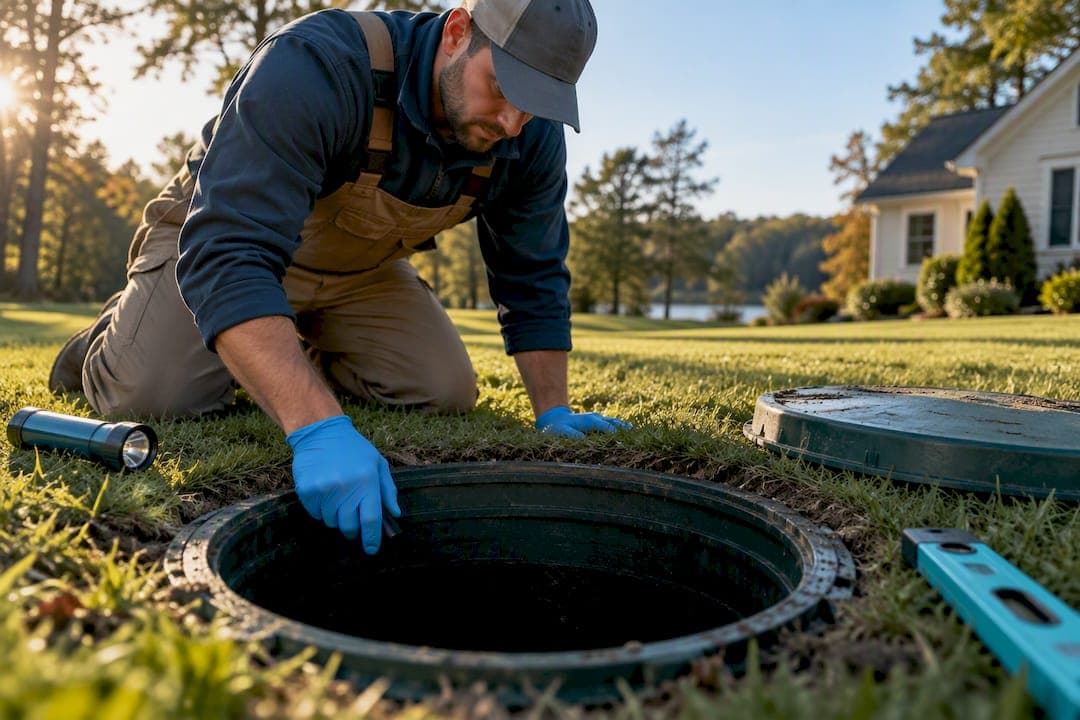
Virginia does not require a septic inspection for every home sale, but once one is ordered, the rules are no longer optional. Since July 1, 2025, any septic inspection tied to a sale, refinance, or title transfer must follow Code §59.1-310.9: a licensed inspector, a signed written contract with a pumping option, a check of every accessible component, and a report delivered within 10 business days. Skip any of those steps and the inspection doesn't meet the legal standard, no matter how thorough it looked on paper.
TL;DR:
- Septic inspections ordered after July 1, 2025, must be performed by licensed inspectors, include a signed contract with pumping, and deliver reports within 10 days.
- Only three license classes are authorized for inspections: onsite sewage system operator, installer, and soil evaluator, with verification required before hiring.
- Inspectors cannot issue pass/fail judgments, move obstructions, or perform soil suitability tests; their reports only document existing conditions.
- The inspection process should be initiated early, with permits reviewed beforehand and pump-and-inspect chosen deliberately to avoid delays.
- Sellers benefit from pre-listing permits and system checks, ensuring bedroom counts match permitted capacity and avoiding last-minute issues during closing.
Table of Contents
- What Virginia's Septic Inspection Law Actually Requires
- Who's Legally Allowed to Inspect a Septic System in Virginia
- What Inspectors Must Check, and What They're Barred From Doing
- What the Written Report Has to Include and When You'll Get It
- Ordering the Inspection: Contracts, Pumping, and Who Pays
- Special Situations: Shared Systems, Missing Permits, and Loans
- Beams Realty Group's Pre-Listing Checklist for Sellers
- Sources
- FAQ
- Editorial Perspective: Why Homeowners Shouldn't Wait for a Buyer to Ask
What Virginia's Septic Inspection Law Actually Requires
The trigger date matters more than most buyers realize. If the inspection itself happens on or after July 1, 2025, it falls under the new statute even if the sales contract was signed months earlier. A house that went under contract in April 2025 but doesn't get its septic checked until August still needs a compliant inspection.
The law defines an "inspection" narrowly: it's one requested by a lender, a real estate licensee, a prospective buyer, or another party with a financial stake, specifically as a condition of a sale, refinance, or title transfer. A routine maintenance pump-out by your regular service company doesn't automatically trigger these rules unless someone in the transaction is relying on it for that purpose.
A few structural points worth knowing before you order one:
- The law applies retroactively to the inspection date, not the contract date.
- "Inspection" under the statute means work done for a real estate or lending transaction, not general upkeep.
- Only licensees holding the correct protected title may call themselves an authorized septic inspector, and misusing that title carries a statutory penalty.
- Virginia REALTORS® confirms the law does not force an inspection on every residential sale — it only governs how one is performed once requested.
Who's Legally Allowed to Inspect a Septic System in Virginia
Not every plumber or home inspector qualifies. Virginia limits septic inspections to three license classes: onsite sewage system operator, onsite sewage system installer, and onsite soil evaluator. Anyone outside those three categories who perform a real estate septic inspection is operating outside the law, and their report doesn't satisfy the statute.
Before you hire anyone, run these checks:
- Confirm the license through Virginia's DPOR License Lookup, and make sure the class matches the system type (alternative and engineered systems often need a soil evaluator, not just an operator).
- Ask directly which license class they hold and request the license number in writing.
- Confirm they carry insurance, since the statute doesn't require inspectors to offer any warranty on their findings.
Pro Tip: If the property has an alternative treatment system with a control panel or pump, ask specifically whether your inspector has experience with that equipment class. A general septic license doesn't guarantee familiarity with engineered systems.
What Inspectors Must Check, and What They're Barred From Doing
The statute lays out a defined scope. Inspectors must examine every readily accessible or operable component when present, which typically includes:
- The septic tank and any pump tank
- Distribution devices that route effluent to the drain field
- Treatment units and their control panels
- The dispersal field itself
- Any component specifically named in the property's operation permit
On the ground, that means checking for signs of trouble: unusual vegetation growth, poor grading around the tank or field, evidence of surfacing effluent, ponding, or saturated soil that suggests the system is failing to absorb water properly.
Here's what surprises a lot of sellers: the law explicitly bars inspectors from issuing pass/fail verdicts. There's no hydraulic load test, no soil suitability evaluation, and no warranty of any kind. Inspectors also can't move obstructing items like sheds or decking to get a better look. The report documents conditions; it doesn't grade the system.
What the Written Report Has to Include and When You'll Get It
Inspectors have 10 business days from the inspection date to deliver a written report to the client. That's a hard statutory deadline, and it matters for closing timelines more than most buyers expect.
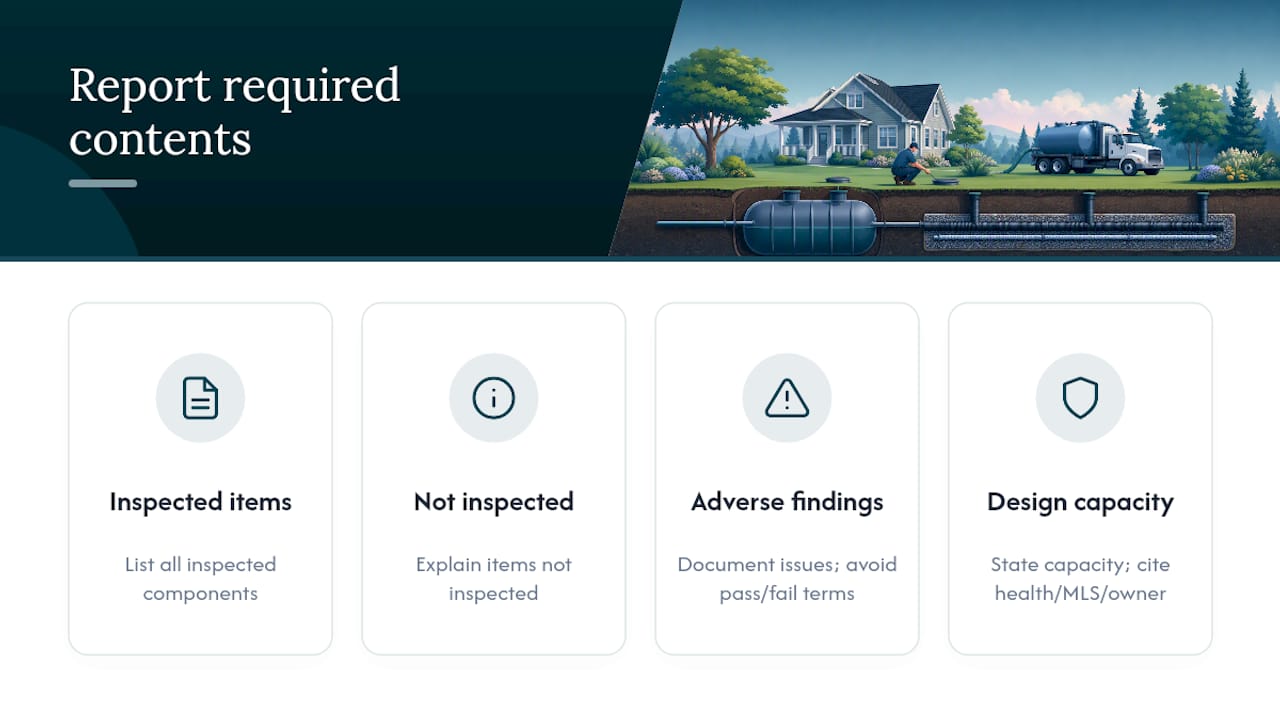
The report must include all inspected components, explanations for any not inspected, documentation of adverse conditions without pass/fail language, and the system's design capacity based on local health records, MLS data, or owner statement. If no capacity record is available, that must be noted and followed up on, since discrepancies between bedroom count and permit capacity can delay closing. Buyers and agents should treat adverse-condition findings as negotiation material, not a verdict on whether to walk away.
Ordering the Inspection: Contracts, Pumping, and Who Pays
Getting this right early saves weeks later. Here's the practical sequence:
- Pull the operating permit first. Whoever orders the inspection should request the health department's permit record before scheduling anything, since it confirms the system's design capacity and avoids surprises during report review.
- Put everything in writing. The contract needs the scope of work, the cost, and an explicit statement about whether pumping will occur as part of the inspection contract.
- Decide on pumping deliberately. Trade-association guidance treats pump-and-inspect as the recognized standard for a complete inspection, and a simple walkover or rod-probe check generally won't meet the statute's minimum bar. Clients can decline pumping, but the contract must document that choice in writing.
- Negotiate payment and repairs upfront. Virginia REALTORS® points sellers and buyers toward the VAR Septic Addendum Form 600M to settle who pays for the inspection and any follow-up repairs before it becomes a last-minute fight at the closing table.
Pro Tip: A visual-only inspection is cheaper and faster, but if the system later fails, you'll wish you'd paid for the pump-and-inspect version. Weigh the savings against how much you actually know about the system's maintenance history.
Special Situations: Shared Systems, Missing Permits, and Loans
A few scenarios trip people up more than the standard single-family sale.
- Communal or HOA-owned systems: Inspect only the components the homeowner is actually responsible for under the HOA agreement; shared infrastructure usually falls under separate maintenance arrangements.
- Missing permits: If the health department has no record, request a formal search in writing, and use public tax records or prior transaction disclosures as interim documentation while you wait.
- Loans and refinances: Some loan programs, including certain government-backed products, impose their own septic requirements beyond the state statute, so check with your lender before assuming a visual inspection will satisfy underwriting.
Beams Realty Group's Pre-Listing Checklist for Sellers
Sellers who get ahead of this law close faster. Pull the operating permit before you list, not after an offer comes in. If the property has an older system or no recent pumping history, consider ordering a pump-and-inspect before you go live, so any adverse conditions surface on your terms instead of during a buyer's due diligence window.
Double-check that your listed bedroom count matches the permitted design capacity. A mismatch here is one of the most common reasons septic issues stall a closing, and it's entirely avoidable with a five-minute records check.
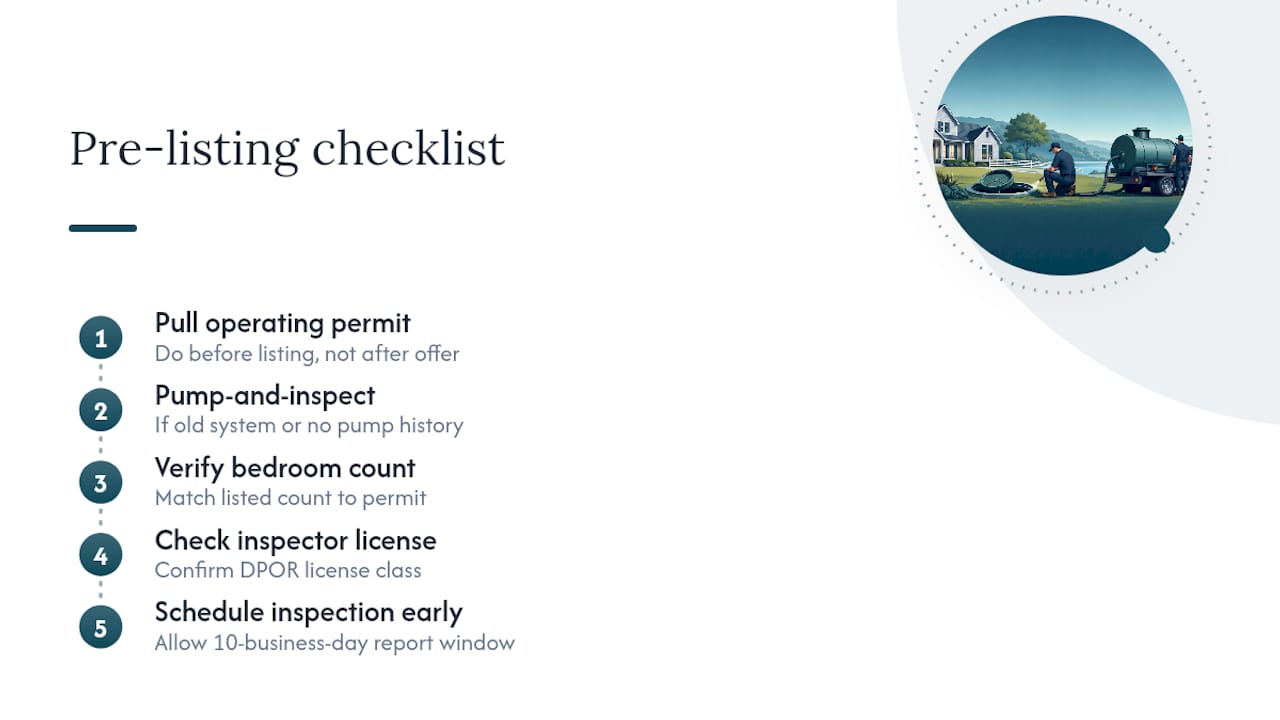
For agents, the checklist is simple: verify the inspector's DPOR license class before you recommend anyone, confirm the written contract spells out pumping terms clearly, and schedule the inspection early enough to absorb that 10-business-day reporting window without threatening your closing date. These steps are typically incorporated into the listing timeline for sellers, with coordination for permit retrieval and inspection scheduling as part of managing the transaction from list to close. If you're weighing whether to list now or wait, our home valuation team can walk through how a septic finding might affect pricing before you commit to a number, and our Sell My Home service handles the scheduling coordination directly.
Sources
- § 59.1-310.9. Requirements for authorized septic system inspectors and minimum requirements for performance of septic system inspections
- Septic Inspection Legislation FAQ - Virginia REALTORS®
- VOWRA FAQs: Virginia septic inspection guidance (July 2025)
FAQ
Is a Septic Inspection Required in Virginia?
Not universally. Virginia doesn't mandate a septic inspection for every residential sale, but if one is ordered as a condition of a sale, refinance, or title transfer on or after July 1, 2025, it must meet the requirements in Code §59.1-310.9.
What Is the New Law for Virginia Septic Inspections?
The law, effective July 1, 2025, requires that any qualifying septic inspection be performed by a licensed onsite sewage system operator, installer, or soil evaluator. It also requires a written contract with a pumping option, inspection of accessible components, and a written report to the client within 10 business days that avoids pass/fail language.
Can You Do Your Own Septic Inspection?
You can inspect your own system informally for maintenance purposes, but that inspection won't satisfy the statute for a real estate transaction. Only someone holding the correct DPOR license class, verified through the state's license lookup, can perform an inspection that meets Virginia's legal standard for a sale or refinance.
Does Virginia Require Well and Septic Inspections for Every Sale?
No. Neither well nor septic inspections are mandatory across the board for Virginia home sales. They typically come into play when a buyer, lender, or agent requests one as a contract condition, at which point the septic portion must follow the licensing, contract, and reporting rules under the 2025 law.
Editorial Perspective: Why Homeowners Shouldn't Wait for a Buyer to Ask
The most common mistake sellers make isn't skipping the inspection. It's waiting for someone else to demand one. By the time a buyer's agent requests a septic check, you're negotiating from a weaker position: the clock is running toward closing, the report deadline eats into your timeline, and any adverse finding becomes a last-minute crisis instead of a manageable line item.
There's also a quieter problem buried in the statute that deserves more attention than it gets. The law bars pass/fail language, which sounds like a technicality but actually shifts real work onto the buyer and their agent. A report that says "surfacing observed near the distribution box" isn't a verdict. It's raw information, and someone still has to translate that into a repair estimate, a price adjustment, or a walk-away decision. Buyers who treat a clean-sounding report as a green light are missing the point of how the statute was written.
The bedroom count issue is underrated, too. A permit capped at three bedrooms sitting on an MLS listing for a four-bedroom house is the kind of mismatch that surfaces during underwriting, not during the home tour, and by then you've lost weeks. Pulling that record before listing costs almost nothing and prevents a genuinely disruptive problem later.
— Myra