
Title insurance in Virginia is a one-time premium paid at closing that protects against pre-existing defects in the property's title. Lenders almost always require a lender's policy on financed purchases, and most buyers should also buy an owner's policy to protect their equity. Rates come from schedules insurers file with the Virginia State Corporation Commission, so get written quotes and ask specifically about reissue and simultaneous-issue credits.
TL;DR:
- Title insurance in Virginia is a one-time payment at closing that protects against pre-existing title defects, with premiums based on filed insurer rates.
- Buyers typically pay for the lender's policy, which covers the mortgage, while purchasing an owner's policy is optional but recommended for long-term protection.
- Cost varies by insurer, with discounts available for reissue credits if a prior policy exists and for buying owner and lender policies together.
- Comparing quotes requires requesting written estimates from multiple agents, asking about discounts, and reviewing itemized ancillary charges before signing.
- A professional review of title estimates can prevent surprises at closing and ensure charges align with filed rate schedules.
Table of Contents
- What Is Title Insurance and How Do Owner and Lender Policies Differ?
- What Does Title Insurance Cover, and What Does a Title Search Check?
- How Much Does Title Insurance Cost in Virginia?
- Who Pays for Title Insurance in Virginia?
- How Do You Shop for Title Insurance and Get a Reliable Quote?
- How Beams Realty Group Helps Virginia Buyers Navigate Title and Closing
- Get a Second Look at Your Title Estimate Before You Sign
- Sources
What Is Title Insurance and How Do Owner and Lender Policies Differ?
Title insurance is a single, upfront payment made at closing in exchange for protection against covered defects that existed before you bought the property. Unlike homeowner's insurance, there's no renewal, no monthly bill, and no annual premium. You pay once, and the coverage attaches when your deed gets recorded at the courthouse.
Virginia buyers deal with two separate policies, and they protect two different parties. A lender's policy insures the mortgage company for the loan amount, and it fades away once the loan is paid off or refinanced. An owner's policy insures you, the buyer, for the purchase price, and it stays in force as long as you or your heirs own the home, according to the Virginia SCC's consumer guide.
Mortgage lenders typically require their own policy before they'll fund a loan, but Virginia law doesn't force you to buy an owner's policy, according to the Virginia Association of Credit Unions. Skip it, and you're the only party in the transaction with no title protection at all.
What Does Title Insurance Cover, and What Does a Title Search Check?
Title defects rarely show up during a walkthrough. A title search digs through decades of public records, and what it sometimes finds is unsettling: a lien nobody disclosed, a forged signature on a decades-old deed, a clerical error that clouds the chain of ownership, or an heir who never signed off on a prior sale.
A standard policy typically covers:
- Undisclosed liens or judgments against a previous owner
- Forged or fraudulently executed deeds
- Errors or omissions in the public record
- Impersonation of a prior owner during an earlier sale
- Undisclosed heirs with a legitimate claim to the property
Coverage has limits. Zoning violations, boundary disputes revealed by a new survey, and issues you already knew about at closing are usually excluded unless you pay extra for an endorsement that adds specific protection. The settlement agent or attorney handling your closing runs the title search and flags anything that needs clearing before the deed changes hands.
Pro Tip: Read the title commitment before closing, not at the table. The "exceptions" section lists exactly what your policy will not cover, and it's the one page most buyers skip.
How Much Does Title Insurance Cost in Virginia?
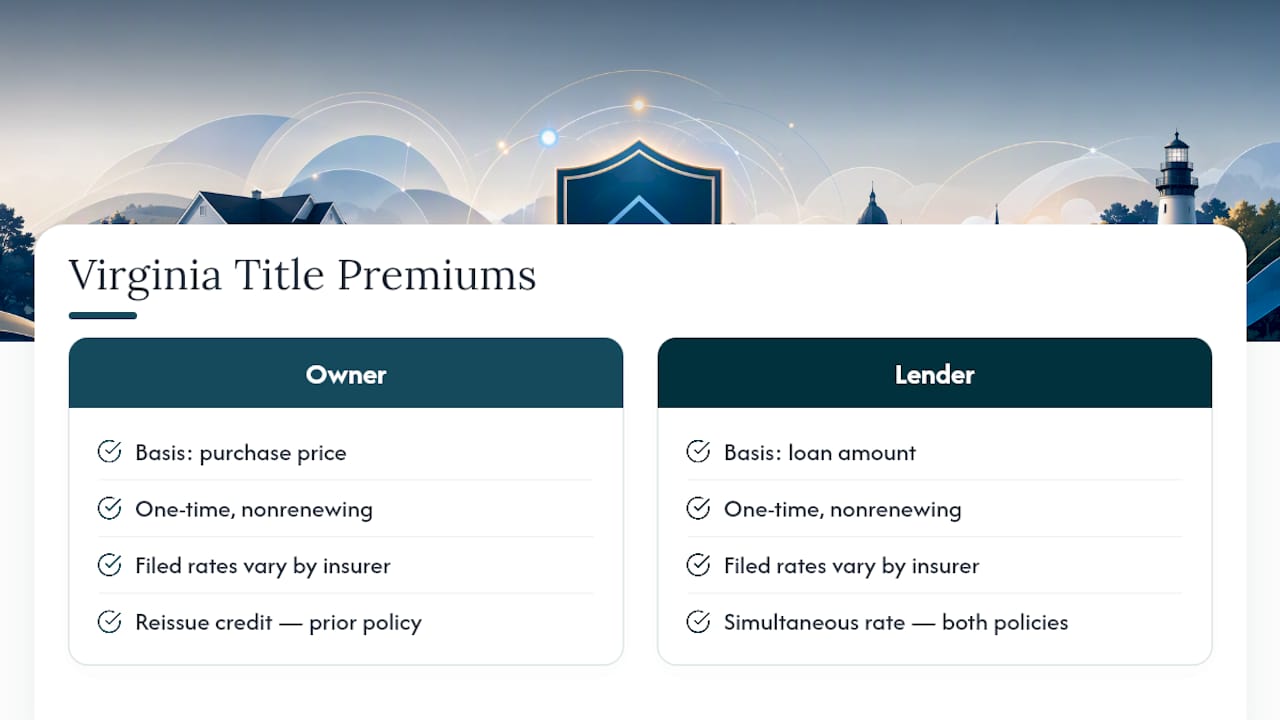
Two separate premiums show up at closing: one for the owner's policy, priced against your purchase price, and one for the lender's policy, priced against your loan amount. Both are one-time charges, and neither renews. Exact amounts depend on the underwriter’s filed rates and your transaction details.
Virginia doesn't set a single statewide rate. Insurers file their own rate schedules with the SCC, and the law requires those risk rates to be reasonable, not fixed, according to Code of Virginia § 38.2-4608. That means two companies quoting the same $400,000 purchase can legitimately land on different numbers, and it's why shopping around actually pays off.
Filed rate manuals give you a realistic starting point. Stewart Title Guaranty Company's Virginia schedule, for example, shows a minimum policy charge and per-thousand-dollar bands that scale with purchase price, including a minimum policy charge of several hundred dollars and per-thousand-dollar rates that decrease as purchase price increases.
The Stewart Title Virginia rate manual treats these as filed examples, not guaranteed quotes for your file. Two discounts can knock real money off that number: a reissue credit if a prior owner's policy exists on the property, and a simultaneous-issue rate when you buy the owner's and lender's policies together through the same underwriter.
Who Pays for Title Insurance in Virginia?
Virginia law stays silent on who pays for what. There's no statute assigning the lender's premium to the buyer or the owner's premium to the seller. Local custom fills that gap, and around most of the state, buyers cover the lender's policy since it protects their financing, while either side can pick up the owner's policy depending on how the contract is written.
That means it's negotiable, and it belongs in the purchase agreement in writing, not assumed. A few line items on the settlement statement often get confused with the insurance premium itself, so it helps to know they're billed separately:
- Title search and examination fees
- Closing or settlement agent fees
- Recording taxes and government filing costs
- Escrow and document preparation charges
If your budget is tight, ask your agent about seller concessions that cover part of these costs. Full transaction guidance, including how to estimate every line item on your closing costs in Virginia, makes this conversation a lot less confusing at the table.
How Do You Shop for Title Insurance and Get a Reliable Quote?
Comparing title insurance takes more discipline than comparing mortgage rates, mostly because the industry buries real savings inside credits most buyers never think to ask for.
- Request at least two written quotes from licensed Virginia title agents or underwriters, not verbal estimates.
- Ask directly whether a reissue credit applies, which happens when a prior owner's policy already exists on the property.
- Confirm whether the simultaneous-issue rate applies when you're buying owner and lender policies together.
- Get an itemized breakdown of ancillary charges: title search, exam, commitment prep, endorsements, escrow fees, and closing protection letters.
- Compare the total, not just the headline premium, since ancillary fees vary company to company even when the risk premium looks similar.
Pro Tip: If an agent quotes a discount, ask them to point to the exact line on their filed rate schedule. A real credit has a paper trail; a verbal promise doesn't.
Calculators can estimate coverage amounts and recording taxes and flag when you likely qualify for a reissue or simultaneous-issue discount, but the number that matters is the written quote tied to your actual file.
How Beams Realty Group Helps Virginia Buyers Navigate Title and Closing
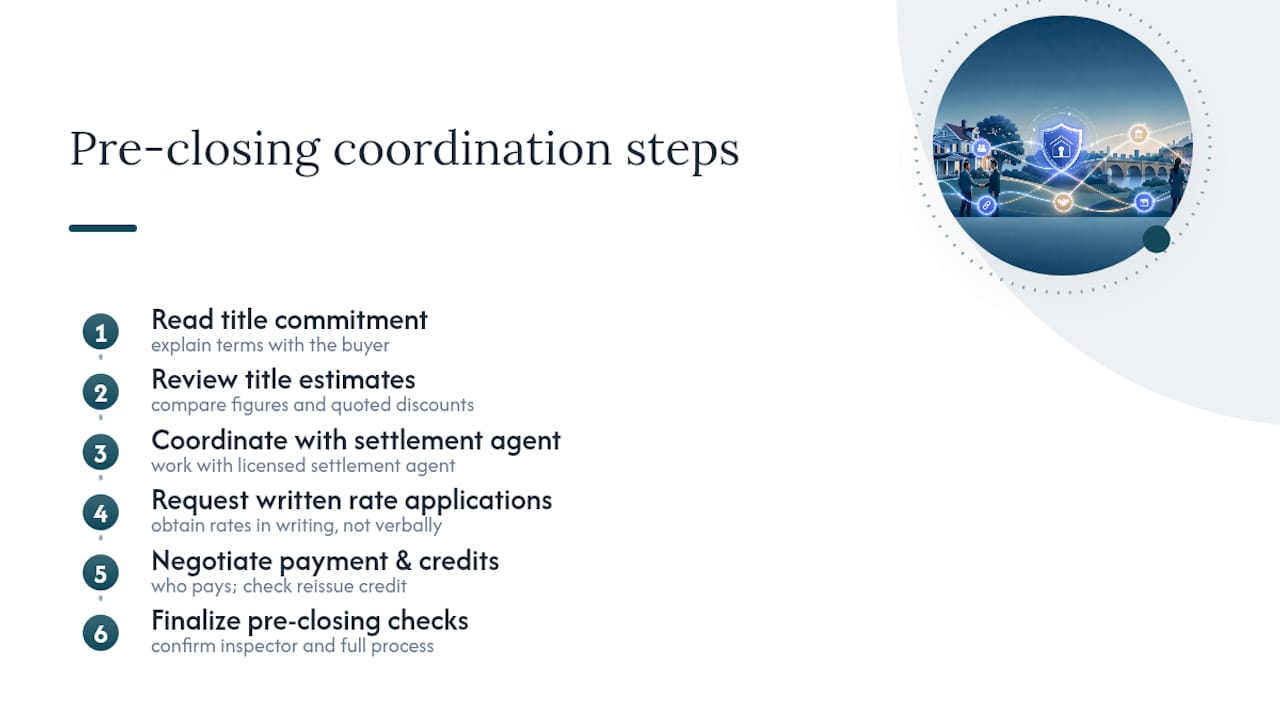
Reading a title commitment cold is hard, and most buyers only see one in their life. Title estimates can be reviewed alongside clients, coordinating with licensed settlement agents, and requesting written rate applications behind any quoted discounts instead of relying on verbal numbers.
That coordination matters most when negotiating who pays, or when checking whether a reissue credit applies to your file. It pairs naturally with other pre-closing steps, like confirming a licensed home inspector in Virginia and understanding the full buying process from offer to keys.
Get a Second Look at Your Title Estimate Before You Sign
Virginia buyers benefit from having a professional who checks title company quotes against the whole transaction before they are locked into it. If you've already got a title estimate in hand and something feels off, or the ancillary fees look padded next to what your closing cost breakdown suggests they should be, that's worth a second set of eyes before you sign anything.

The team provides support by reviewing estimates line by line, connecting clients with licensed settlement agents experienced in Virginia closings, and flagging anything that doesn't match the filed rate schedule. If you're heading toward a closing date and want that estimate reviewed, reach out through Beams Realty Group and get a straight answer before you sign.
Sources
- Virginia Consumer's Guide for Title Insurance — Virginia State Corporation Commission
- Code of Virginia — Title 38.2 Chapter 46: Title Insurance
- Virginia rate manual (Stewart Title Guaranty Company) — filed schedule (example)
- Title insurance calculator and explanatory article (PrimeTitleVA)