
Wire fraud in real estate happens when criminals impersonate a title company, agent, or lender to redirect your closing funds into an account they control, usually through Business Email Compromise. Real estate transactions are a top target for BEC because the dollar amounts are large and the deadlines are tight. The one rule that stops most of these losses: never wire money based on instructions you only received by email. Call a phone number you looked up yourself, not one pulled from the message, and confirm the details before you send a dime.
TL;DR:
- Nearly all wire fraud attempts rely on last-minute email instruction changes or urgent requests to divert funds to scammers' accounts.
- Verification protocols include verified phone numbers, written no-email-changes rules, and callback procedures that should be established before closing.
- Immediate action after wiring money to a wrong account involves calling your bank immediately to request a recall and filing reports with relevant authorities.
- Agencies, title companies, and banks are responsible for implementing secure processes like portals, fraud training, and internal verification to prevent wire scams.
- Building verification into the process from escrow opening, rather than relying on instinct or alerts during closing, significantly reduces wire fraud risks.
Table of Contents
- What is wire fraud in real estate, and how do these schemes operate?
- What red flags signal a wire fraud attempt?
- What's the step-by-step way to prevent wire fraud during closing?
- What should you do if you wired money to the wrong account?
- Who's responsible for preventing wire fraud, and what should each party do?
- How does Beams Realty Group protect clients from wire fraud?
- Why the "just be careful" advice on wire fraud misses the point
- How Beams Realty Group Keeps Your Closing Funds Secure
- Where to report or learn more about wire fraud
- Sources
What is wire fraud in real estate, and how do these schemes operate?
Wire fraud in real estate almost always starts the same way: a criminal gets into an email account somewhere in the transaction chain, either the buyer's, the agent's, or the title company's, and just watches. They read every message for weeks, learning names, dates, and dollar figures, waiting for the moment closing is scheduled.
Then they strike. Using a spoofed domain that looks nearly identical to the real one (swap a lowercase "l" for a capital "I," add a hyphen, change ".com" to ".net"), they send new wiring instructions that appear to come from your title company or lender. Sometimes it's a genuinely hacked account sending the message directly. Other times it's a look-alike address one keystroke off from the real one. Either way, the email usually lands within a few days of closing, framed as an "updated" instruction because of a "system change" or "new escrow account."
Some schemes now add a phone call to reinforce the email. Voice-cloning tools let scammers mimic an agent's or lender's voice convincingly enough to talk a nervous buyer through a fraudulent wire over the phone, a tactic the National Association of REALTORS® has flagged as a fast-growing risk. Once funds move, they typically clear through a chain of accounts within hours, long before anyone notices the money went to the wrong place.
What red flags signal a wire fraud attempt?
Most wire fraud attempts share a handful of tells, and once you know them, they're not subtle. The problem is that buyers under closing-week stress rarely stop to look.
- A wiring instruction that changes at the last minute, especially in the last moments before closing.
- A request to send funds to an account under a personal name rather than the title company or escrow entity.
- An email address that's almost right but not quite (a missing letter, an extra dash, a different domain extension).
- Unusual urgency: "wire today or the closing will be delayed," "the escrow officer is unavailable, please confirm with me directly."
- Attachments or links you weren't expecting, particularly PDFs with new bank routing details.
- A phone call that sounds like your agent or lender but pushes you to skip your normal verification step.
Pro Tip: If an email urges speed, treat that urgency itself as the red flag. Legitimate title companies almost never demand you skip a callback verification, even under a tight deadline.
What's the step-by-step way to prevent wire fraud during closing?
Prevention works best as a sequence, not a single habit. Build it in from the day escrow opens, not the week you're wiring funds.
- At escrow opening, collect verified phone numbers directly from your title company's and lender's official websites, not from any email signature. Save them in your phone under a clear label.
- Establish a known-contact protocol with your agent: agree in writing that wiring instructions will never change by email alone, and any change gets a callback to the number you already have on file.
- Never wire based on email instructions alone. Call your title company using the number you verified earlier, and stay on the line while someone reads the instructions back to you.
- Use secure transaction portals when your title company offers one. These typically require login credentials and often flag instruction changes automatically.
- Where possible, wire in person at a bank branch. Bring the printed instructions and ask the teller about the bank's own wire-verification procedures, since many banks have internal fraud checks that catch discrepancies before the transfer clears.
- Ask your agent about their errors and omissions or cyber coverage. A firm that's thought about liability has usually also thought about prevention.
The scale of this problem justifies the extra ten minutes at every step. CertifID's State of Wire Fraud research has repeatedly found that a large share of consumers get little to no wire-fraud education from their real estate professional, which leaves them unprepared exactly when speed matters most.
What should you do if you wired money to the wrong account?
Every hour counts, but the initial days matter most. Banks can sometimes recall a wire before it fully clears; after that window, recovery odds drop fast.
- Call your bank immediately and request a wire recall, and ask them to contact the receiving bank directly.
- File a complaint with the FBI's Internet Crime Complaint Center and with the FTC, which explicitly warns that wired money moves like cash and is hard to reverse.
- Contact your state attorney general's office and file a police report with your local department.
- Notify your title company and lender the moment you suspect a problem, since they may have their own fraud-response contacts at the receiving institution.
- Preserve every email, timestamp, and bank confirmation. Investigators and your bank's fraud team will need the full paper trail.
Recovery is possible but never guaranteed, which is exactly why prevention deserves more attention than most closings give it.
Who's responsible for preventing wire fraud, and what should each party do?
Everyone in the transaction owns a piece of this. Title companies should run secure portals, train staff to flag instruction changes, and document every verification call. Agents should issue written wire-fraud notices at contract signing and independently confirm contact numbers rather than relying on whatever's in an email signature, following the practices NAR outlines for its members. Banks should maintain fast wire-recall processes, staffed fraud teams, and in-branch verification options for nervous clients who want a human to double-check the numbers.
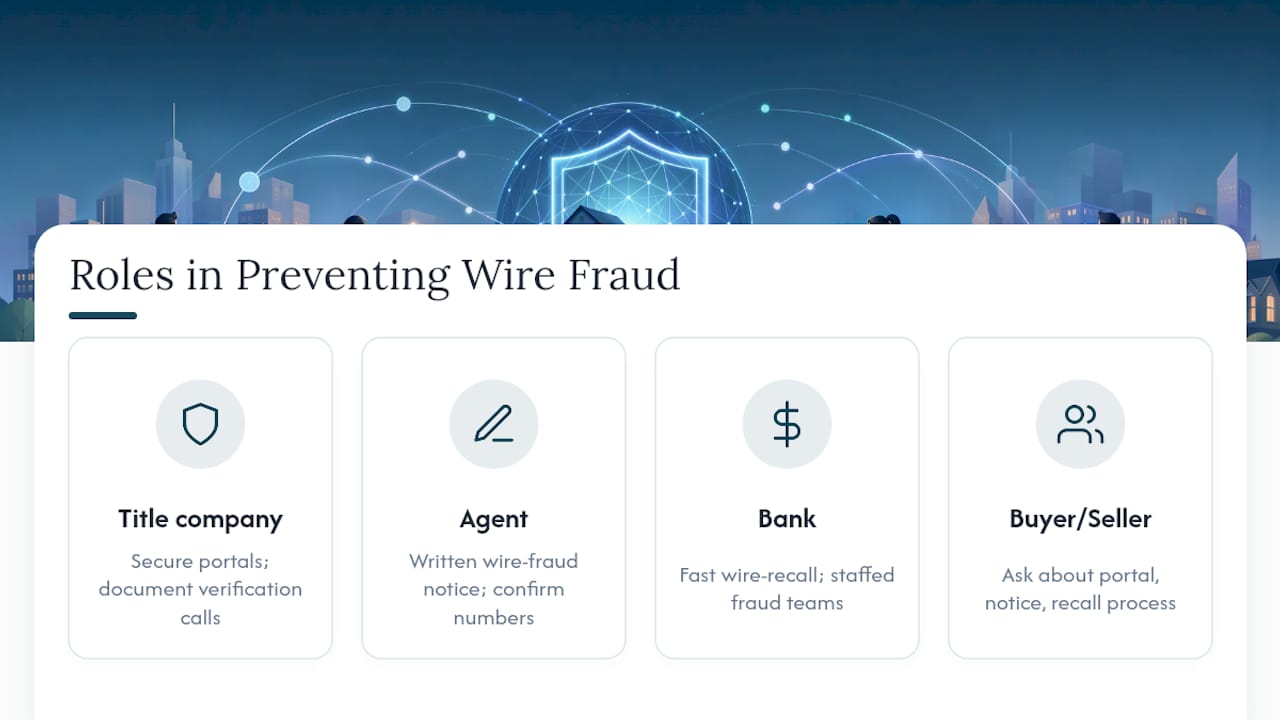
As a buyer or seller, you can simply ask: does my title company use a secure portal? Has my agent given me a written wire-fraud notice? Can my bank walk me through their recall process before I need it? A team that answers those questions clearly is doing its job.
How does Beams Realty Group protect clients from wire fraud?
Beamsrealtygroup builds a known-contact protocol into every client's onboarding, collecting verified phone numbers for the title company and lender before escrow even opens, so no one is scrambling to confirm a number under deadline pressure. Clients are told, in writing, that wiring instructions will never change by email alone and that any change triggers a callback to a pre-verified line.

At escrow start, ask your agent for the same in writing: verified contacts, a stated no-email-changes policy, and confirmation of which title company portal you'll be using. Those three requests take five minutes and close most of the gap that scammers rely on. If you're selling a home yourself, our guide to maximizing your sale proceeds covers this same wire-fraud checklist in the context of what sellers specifically need to request from their agent.
Why the "just be careful" advice on wire fraud misses the point
Most wire fraud guidance tells people to "stay alert" or "trust your instincts," and that advice is close to useless. Instincts don't catch a domain that's one character off, and alertness fades fast during the most stressful week of a home purchase. What actually works is boring, procedural, and set up before you're under pressure: a verified phone number saved weeks in advance, a written no-email-changes rule, a callback you make every single time regardless of how legitimate the email looks.
The IC3 and FTC data make clear this isn't a fringe risk, it's a routine cost of doing business in an industry that still leans on email for six-figure transfers. What's underrated is how much of the fix sits with agents and title companies, not just cautious buyers. A firm that hands you a written protocol at contract signing is doing more to protect your closing than any amount of "watch out for scams" messaging ever will. Prioritize the team that builds verification into the process, not the team that just warns you about it after the fact.
— Myra
How Beams Realty Group Keeps Your Closing Funds Secure
Beamsrealtygroup builds verification into the closing process itself, not as an afterthought after something goes wrong. Buyers and sellers working with our Virginia team get a known-contact protocol from day one: verified phone numbers, a written no-email-changes policy, and a clear callback procedure before any funds move.

That's a meaningfully different starting point than going into closing without any verification plan and hoping your title company catches a problem before you do. If you want a walk-through of what to ask for at escrow start, or you're weighing whether your current representation has these protocols in place, reach out to Beams Realty Group for a consultation and request our client wire-fraud verification checklist before your next closing date.
Where to report or learn more about wire fraud
- IC3: file a federal complaint after suspected fraud.
- FTC: report fraud and read wire-transfer safety guidance.
- NAR: industry best practices for agents and consumers.
- Identitytheft: recovery steps if personal data was compromised.
This article is general information, not a substitute for advice from a qualified financial advisor. Consult a qualified financial professional about your own circumstances before acting on anything here.
Sources
- FBI — Business Email Compromise
- IC3 2025 annual report
- FTC — What to know before you wire money
- NAR — Wire Fraud