
North Carolina runs about 6 to 7% cheaper than Virginia overall, based on regional price parity data from the Bureau of Economic Analysis. Housing drives nearly all of that gap. Virginia's higher price level is offset partly by higher wages, and its lower top income tax rate can close the gap further for high earners, so the "cheaper" answer depends on your income and where you land.
TL;DR:
- Housing costs in Virginia are about 30% higher than in North Carolina, significantly impacting overall affordability depending on the specific metro area.
- Moving from North Carolina to Virginia requires an income adjustment of roughly 7%, but higher income taxes in Virginia can increase this needed salary by an additional 2 to 3 percent.
- The median home value in Virginia exceeds North Carolina's by over 30%, and median rent is nearly 29% higher, mostly driven by housing costs rather than other living expenses.
- Property taxes slightly favor North Carolina with a 0.66% rate compared to Virginia's 0.73%, but Virginia's higher home prices offset this advantage.
- To accurately compare moving costs, analyze metro-level price parity ratios and local property tax quirks, rather than relying on statewide averages.
Table of Contents
- Cost of Living Virginia vs North Carolina: The Numbers Side by Side
- Why Housing Explains Most of the Price Gap
- Taxes and Take-Home Pay: Factoring State Taxes Into Affordability
- How to Convert Salaries and Compare Purchasing Power Between the States
- Worked Examples: What the Math Looks Like in Practice
- Transportation Costs: Fuel, Insurance, and Commuting
- Utility Costs: Electricity, Water, and Heating
- Healthcare Costs: Premiums and Out-of-Pocket Spending
- Education and Childcare: Tuition, Public Schools, and Daycare
- Grocery and Food Prices
- What Virginia Movers Should Actually Do With These Numbers
- Let Beams Realty Group Turn These Numbers Into a Plan
- Sources
- FAQ
Cost of Living Virginia vs North Carolina: The Numbers Side by Side
Virginia's regional price parity index sits at 101.1, meaning prices run about 1% above the national average. North Carolina comes in at 94.3, roughly 6% below the U.S. baseline. That gap between the two states works out to about 7 percentage points, and almost all of it traces back to shelter costs rather than groceries or gas.
| Metric | Virginia | North Carolina |
|---|---|---|
| BEA Regional Price Parity | 101.1 | 94.3 |
| Median household income | $90,974 | Lower than Virginia average |
| Median rent | $1,514–$1,579 | ~$1,228 |
| Median home value | $360,700–$383,700 | ~$288,900 |
| Top state income tax rate | 5.75% | 3.99% |
| Effective property tax rate | 0.73% | 0.66% |
The income gap partly explains why Virginia doesn't feel dramatically more expensive to people who live there. Virginia households often earn more on average, which cushions the higher price level.
Why Housing Explains Most of the Price Gap
Rent and home prices account for the overwhelming majority of the Virginia-North Carolina cost gap. Median gross rent runs about $1,228 in North Carolina versus $1,579 in Virginia, a difference of roughly 29%. Median home values show a similar pattern, with North Carolina averaging around $288,900 against Virginia's $383,700, a gap north of 30%.
Virginia's higher housing costs alone can add several hundred dollars a month to a household budget compared to a similar home in North Carolina, even before factoring in property taxes or insurance.
That gap isn't uniform across either state. A few things shape how much it actually matters to you:
- Northern Virginia (Arlington, Alexandria, Fairfax) pulls the statewide average up sharply, while cities like Roanoke or Lynchburg run much closer to North Carolina's typical costs.
- Charlotte and the Raleigh-Durham corridor have gotten pricier in recent years, narrowing the gap with mid-tier Virginia metros.
- Rural counties in both states cluster near the bottom of the cost range, where the state-level difference nearly disappears.
Renters feel this gap every single month in a fixed line item. Homeowners feel it differently. Higher home values mean higher mortgage payments and, in Virginia's case, a slightly higher effective property tax rate on top of that larger loan balance. A move to a market like Charlottesville can look very different on paper than a move to the D.C. suburbs, even though both fall under "Virginia" in statewide averages.
Taxes and Take-Home Pay: Factoring State Taxes Into Affordability
Virginia's top marginal income tax rate is 5.75%, compared to North Carolina's 3.99%. On a $90,000 salary, that difference works out to roughly $1,500 to $1,800 more in state income tax owed in Virginia, depending on deductions and bracket structure. That's a real dent in take-home pay that doesn't show up in a simple rent comparison.
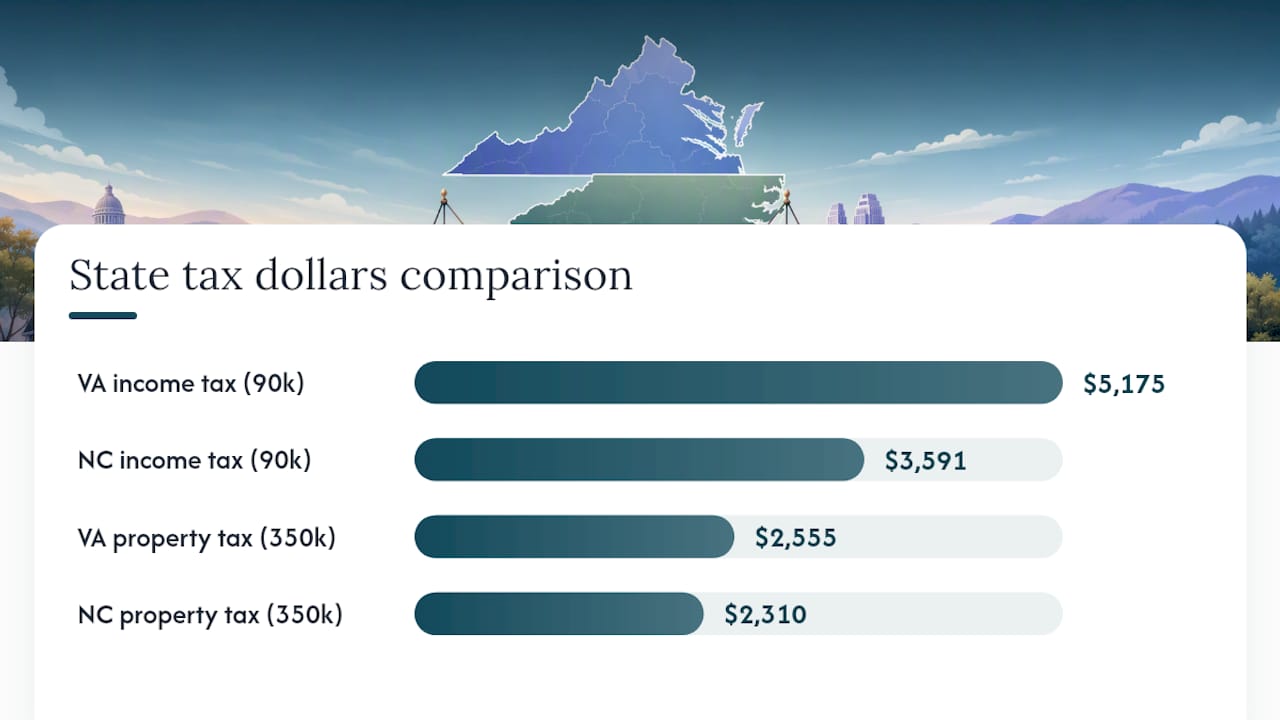
Property taxes tilt the same direction, though by a smaller margin. Virginia's effective property tax rate runs about 0.73%, against North Carolina's 0.66%. On a $350,000 home, that's roughly $2,555 a year in Virginia versus $2,310 in North Carolina, a difference of about $245 annually. Small on its own, but it stacks on top of the income tax gap and the higher purchase price.
When you budget a relocation, treat taxes as a line item, not an afterthought:
- Calculate your expected state income tax liability in both states using your actual income, not a rough average.
- Add expected annual property tax to your housing cost estimate, not just the mortgage principal and interest.
- Remember North Carolina's lower income tax rate can partly offset higher relative wages you might find in Virginia's job market.
How to Convert Salaries and Compare Purchasing Power Between the States
The formula real estate analysts use is straightforward: Equivalent Salary = Current Salary × (Target State RPP ÷ Origin State RPP). Moving from North Carolina to Virginia, you'd multiply your current salary by 101.1 divided by 94.3, or about 1.072. A $75,000 salary in North Carolina would need to become roughly $80,400 in Virginia just to maintain equivalent purchasing power, before taxes.
That's step one. Step two is layering in the tax differential, since Virginia's higher income tax rate eats into any raise you negotiate.
- Find the right RPP. Use metro-level price parity when possible instead of the statewide average, since a Richmond move and a Fairfax move require very different adjustments.
- Recalculate your housing share. Housing typically eats 25 to 35% of income, so run the rent or mortgage comparison separately from your grocery and transportation budget.
- Estimate the after-tax gap. Apply each state's top marginal rate to the income bracket you'll actually land in, not the headline rate alone.
- Add property tax and insurance if buying. These vary by county and can shift the math by hundreds of dollars a year.
Pro Tip: Don't rely on the statewide RPP if you're moving somewhere like Northern Virginia. A metro-specific calculation, like the ones used for markets such as Raleigh, can change your required equivalent salary by several percentage points compared to the state average.
Worked Examples: What the Math Looks Like in Practice
A single renter earning $75,000 in North Carolina and moving to Virginia would need roughly $80,400 to maintain the same purchasing power, based on the RPP ratio of 101.1 to 94.3. Factor in Virginia's higher income tax bracket, and the realistic target climbs closer to $82,000 to $83,000 to truly break even.
For a family comparing home purchases, the math shifts on the housing side specifically:
- A $383,700 home in Virginia carries an estimated $2,801 in annual property tax at 0.73%, versus $1,907 on a $288,900 North Carolina home at 0.66%.
- The Virginia home's larger loan balance alone adds a mortgage payment difference well beyond the tax gap, often several hundred dollars a month.
- A mid-career professional earning $110,000 with no state tax adjustment loses more ground to Virginia's 5.75% bracket than a lower earner would, since the rate applies to a larger taxable base.
The takeaway across all three: North Carolina wins on raw housing cost, but Virginia's income advantage in certain sectors, especially government and defense contracting near D.C., can offset a meaningful share of that gap for the right buyer.
Transportation Costs: Fuel, Insurance, and Commuting
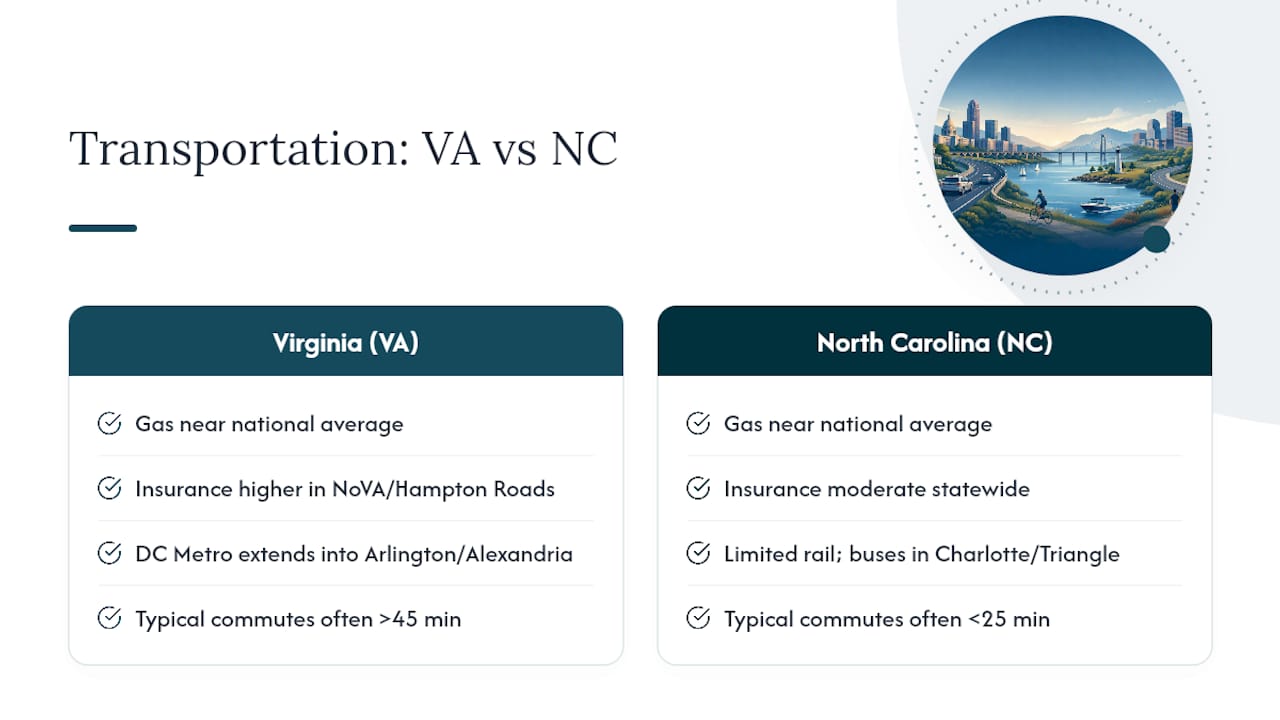
Gas prices in both states track close to the national average, with Virginia running slightly higher in border-adjacent counties near D.C. and slightly lower in the southern part of the state. The difference rarely exceeds a few cents per gallon on a statewide basis, so fuel alone won't swing a relocation decision.
Car insurance tells a different story. Virginia requires lower minimum liability coverage than many states, but premiums in Northern Virginia and the Hampton Roads area run higher than the state average due to traffic density and claims frequency. North Carolina's insurance market tends to run moderate statewide, with less of a gap between its priciest and cheapest metros.
Public transit access varies more by metro than by state. Washington D.C.'s Metro system extends into Arlington and Alexandria, giving Northern Virginia commuters an option that doesn't exist anywhere in North Carolina outside limited bus networks in Charlotte and the Triangle. If you commute daily, that access can offset a car payment and insurance premium entirely, which matters more than any statewide average when you're actually budgeting.
Commute length matters just as much as commute cost. Northern Virginia commutes routinely stretch past 45 minutes each way, while similar-income jobs in Raleigh or Charlotte often come with commutes under 25 minutes. That time difference has a real dollar value most cost calculators skip entirely, whether it's gas, wear on your vehicle, or the value of your own hours.
Utility Costs: Electricity, Water, and Heating
Both states sit in a similar climate band, but their utility structures differ enough to matter for a monthly budget. Virginia's electricity rates run close to the national average, while North Carolina tends to price slightly below it, largely due to a mix of nuclear and natural gas generation that keeps rates stable across seasons.
Heating and cooling costs follow climate more than state lines. Coastal North Carolina and the Hampton Roads area of Virginia both see mild winters and humid summers, keeping HVAC costs moderate. Inland and mountain areas in both states, think the Blue Ridge in Virginia or the western North Carolina highlands, see higher heating bills in winter months.
Water and sewer costs vary more by municipality than by state, so a Richmond resident and a Charlotte resident might pay similar rates while a small town in either state could charge noticeably less. If you're comparing two specific addresses, pull local utility rate sheets rather than relying on a statewide estimate, since the spread between cities in the same state can be wider than the spread between the two states themselves.
Healthcare Costs: Premiums and Out-of-Pocket Spending
Health insurance premiums in both states track close to national marketplace averages, with modest year-to-year shifts driven by insurer participation rather than a consistent state advantage. Virginia's marketplace has seen more insurer competition in recent years, which has kept some plan tiers competitive in urban areas, while rural counties in both states tend to see fewer plan options and higher premiums.
Out-of-pocket costs depend heavily on where you live within each state. Major metro areas like Richmond, Charlotte, and the D.C. suburbs have more hospital systems competing for patients, which can moderate prices compared to rural counties with a single dominant provider. Neither state shows a dramatic statewide advantage on out-of-pocket spending, so this is one category where your specific metro matters far more than which state you choose.
Employer-sponsored coverage remains the norm for most working households in both states, which softens the practical impact of marketplace pricing differences for anyone with a full-time job offering benefits. If you're self-employed or between jobs during a relocation, budget extra time to shop marketplace plans in your new state, since provider networks reset when you cross state lines even if your insurer stays the same.
Education and Childcare: Tuition, Public Schools, and Daycare
Public K-12 education is funded primarily through local property taxes in both states, which means school quality and per-pupil spending vary more by county than by state line. A family choosing between a high-tax Northern Virginia county and a lower-tax North Carolina county isn't just comparing state averages. They're comparing two very different local funding models.
Childcare costs run high in both states, but Virginia's Northern Virginia region and North Carolina's Research Triangle both rank among the more expensive childcare markets in their respective states. Rural counties in both states offer meaningfully lower daycare rates, often half of what metro families pay.
For families weighing overall affordability, the Living Income Standard for North Carolina puts the annual cost of basics for two adults and two children at roughly $97,550 statewide, a figure that folds in childcare alongside housing, food, and transportation. That number varies considerably by county, but it's a useful reality check against a simple statewide cost-of-living index, which tends to undercount what families with young kids actually spend. Groups like United For ALICE build similar household survival budgets that consistently run higher than the federal poverty line, reinforcing that headline averages understate real family costs.
Grocery and Food Prices
Grocery prices between the two states run closer together than housing or income taxes. Both states have strong grocery chain competition, from regional players to national chains, which keeps staple prices fairly consistent across metro areas. Rural areas in either state sometimes pay a premium due to fewer stores and longer supply routes.
Restaurant prices show more variation by metro than by state. Dining out in Northern Virginia or Richmond tends to cost more than in a mid-sized North Carolina city like Greensboro, driven by labor costs and commercial rent rather than anything state-specific. A single adult's monthly budget in North Carolina, including food, lands around $3,362 when you account for housing, transportation, and healthcare together, giving a sense of how food fits into the broader picture rather than standing alone as a major differentiator.
If groceries and dining are your primary budget concern, the state-line comparison matters less than choosing the right metro within either state.
What Virginia Movers Should Actually Do With These Numbers
Statewide averages hide as much as they reveal. A number that says Virginia costs 7% more means very little if you're comparing Roanoke to Charlotte instead of Arlington to Charlotte. Local real estate experts work these numbers at the neighborhood level, and the gap between two Virginia zip codes often dwarfs the gap between Virginia and North Carolina statewide.
If you're serious about a move, start by narrowing your target metro, then run the salary conversion against that specific area's price level, not the state average. From there, talk to someone who knows the local market: property tax quirks, HOA norms, and which neighborhoods are actually worth the premium. A good next step is working through a 30/60/90 day relocation checklist before you commit to a specific area.
— Myra
Let Beams Realty Group Turn These Numbers Into a Plan
You can get neighborhood-level pricing, closing-cost estimates, and home valuation guidance specific to the Virginia market you are considering.

If you're comparing a Virginia move against North Carolina, the numbers in this article are a starting point, not a final answer. A home valuation grounded in real comparable sales tells you far more than a statewide RPP figure ever will, and it's the natural next step if you're weighing a specific address rather than a state average.
First-time buyers relocating to Virginia can also lean on resources built for exactly this transition, including guidance on closing costs and first-time homebuyer programs. When you're ready to see what your budget actually buys in a specific Virginia neighborhood, start with Home Buying and get guidance tailored to your target metro and price range.
Sources
- Virginia vs North Carolina comparison — StateCalc
- 2025 Living Income Standard — NC Budget & Tax Center
FAQ
Which State Is Cheaper, Virginia or North Carolina?
North Carolina is generally cheaper, with a regional price parity index of 94.3 versus Virginia's 101.1, a gap of roughly 7%. Housing costs, particularly median rent and home values, account for most of that difference.
How Much More Does Housing Cost in Virginia?
Median home values in Virginia run about 30% higher than North Carolina's average, and median rent runs roughly 29% higher. Northern Virginia metros push the statewide average up significantly compared to more affordable areas like Roanoke or Lynchburg.
Does Virginia's Lower Property Tax Offset Its Higher Home Prices?
No. Virginia's effective property tax rate of 0.73% is actually slightly higher than North Carolina's 0.66%, so higher home values combine with a marginally higher tax rate rather than offsetting it.
How Do I Calculate an Equivalent Salary Between the Two States?
Multiply your current salary by the target state's regional price parity divided by your origin state's parity.
Can a Local Agent Help Me Budget for a Virginia Move Beyond These Statewide Numbers?
Yes. Statewide averages don't capture neighborhood-level price swings, property tax quirks, or which metros offer the best value for your income. Beams Realty Group provides home valuation and buying guidance tailored to the specific Virginia market you're targeting.