
You have deadlines to title and register your vehicle and to swap your driver's license in Virginia, with shorter periods for CDL holders. The moment you get keys or sign a lease, your top three moves are: update your mailing address, book a DMV appointment, and get utilities and insurance transferred. Everything else on this list supports those three deadlines.
TL;DR:
- Book your DMV appointment within the first week of moving to avoid multi-week delays, especially in Northern Virginia.
- Complete vehicle registration, safety inspection, and emissions testing within 30 days to prevent legal issues or rework.
- Exchange your out-of-state driver's license within 60 days, prioritizing appointment booking immediately after arriving.
- Gather proof of Virginia residency, such as lease agreements and utility bills, to register to vote and update official records on time.
- Contact utility providers and request record transfers early to ensure services are established and paperwork is processed promptly.
Table of Contents
- Moving to Virginia Checklist: What to Do and When
- What Documents Do You Need for Virginia DMV?
- How Do You Establish Virginia Residency?
- Who Do You Need to Notify About Your Address Change?
- Setting Up Utilities and Internet in Your New Virginia Home
- Transferring Medical Records, School Files, and Prescriptions
- Your 30/60/90-Day Virginia Moving Timeline
- Should You Rent or Buy When Relocating to Virginia?
- What Does It Actually Cost to Live in Virginia?
- What Does the Virginia Job Market Look Like for New Residents?
- Getting Around Virginia: Public Transit and Commuting Realities
- How Do You Enroll Your Kids in Virginia Schools?
- Finding Healthcare Providers and Insurance in Virginia
- A Local Agent's Take: What Newcomers Consistently Get Wrong
- How Beams Realty Group Helps You Land in Virginia the Right Way
- Official Virginia Links to Bookmark Before You Move
- Sources
Moving to Virginia Checklist: What to Do and When
The single biggest mistake new Virginia residents make is treating the DMV as a "get to it eventually" task. Offices in Northern Virginia routinely run multi-week appointment backlogs, and if you wait until week five to book, you can blow past your legal deadline before you even get seen. Book that appointment during your first week, even before you've unpacked the last box.
Week 0 to 1: settle in and start the paper trail
- Confirm your housing situation (lease signed, closing complete, or temporary housing secured).
- Set up or transfer electricity, water, gas, and internet.
- File a mail forwarding request with USPS.
- Gather your records: birth certificates, Social Security cards, medical and school files, old vehicle title.
- Schedule your DMV appointment now, not later.
Within 30 days: vehicle deadlines
- Title and register your vehicle with Virginia DMV.
- Get your annual safety inspection completed.
- Complete emissions testing if your locality requires it.
- Buy local vehicle decals if your county or city still issues them.
Within 60 days: license and voting
- Exchange your out-of-state driver's license for a Virginia license (CDL holders get 30 days, not 60).
- Finalize your voter registration if you plan to vote in an upcoming election.
Pro Tip: Bring your car in for its safety inspection before your DMV appointment, not after. Some Virginia DMV transactions ask for proof of inspection, and showing up without it means a second trip you didn't need to make.
What Documents Do You Need for Virginia DMV?
Virginia DMV wants proof of who you are, proof you live here, and proof of what you're bringing with you. Show up without the right paperwork and you'll be rescheduling, which eats into your 30 and 60-day windows fast.
For a driver's license exchange, bring:
- Your out-of-state driver's license.
- Proof of identity (passport, certified birth certificate, or similar).
- Your Social Security card or documentation of your SSN.
- Two documents proving Virginia residency (a signed lease, a utility bill, a bank statement with your Virginia address).
For vehicle titling and registration, bring:
- Your current out-of-state title or registration.
- Proof of Virginia auto insurance.
- A completed Application for Certificate of Title (form VSA 17A).
- Your safety inspection certificate.
Every vehicle registered in Virginia needs an annual safety inspection regardless of where you live in the state, but emissions testing only applies in specific localities tracked by the DEQ's AirCheck Virginia program, mostly concentrated in Northern Virginia and Richmond area jurisdictions. Check your specific county or city before assuming you're exempt.
The appointment bottleneck is real. Offices near Washington, D.C. see the heaviest volume in the state, and walk-ins there can mean hours of waiting or getting turned away entirely. Booking online the week you arrive, rather than the week your deadline hits, is the difference between a smooth transaction and a missed deadline.
How Do You Establish Virginia Residency?
Virginia generally looks for two things: physical presence and intent to stay. The commonly cited threshold, used for tuition and voting purposes, is maintaining a Virginia home for more than 183 days in a calendar year combined with active ties to the state, like a job, a lease, or property ownership.
DMV doesn't check your calendar. It checks your paperwork, and it wants two proofs of residency. These typically qualify:
- A signed lease or mortgage statement.
- A utility bill in your name at your Virginia address.
- A bank or credit card statement showing your new address.
- Pay stubs listing your Virginia employer and address.
Once you've got your proofs lined up, register to vote through the Virginia Department of Elections portal, which handles online registration and posts deadlines ahead of each election cycle. Do this while you're already gathering DMV documents. It's one form, and you'll have the paperwork on hand anyway.
Who Do You Need to Notify About Your Address Change?
USPS mail forwarding buys you time, but it's a bandage, not a fix. It doesn't update your address with anyone who actually needs the correct one on file, and packages, tax documents, and account notices can still slip through the cracks.
Work through these in order:
- Update your address directly with your employer's payroll department so your paycheck and tax forms land correctly.
- Update banks and credit card issuers to avoid fraud flags and misrouted statements.
- File IRS Form 8822 to notify the IRS of your new address for tax purposes.
- Update the Social Security Administration and Medicare if either applies to you.
- Change your address with Virginia DMV using its online address change service, and confirm the update went through before your license or registration renewal comes up.
- Update subscription services, delivery accounts, and any recurring shipments.
Setting Up Utilities and Internet in Your New Virginia Home
Every Virginia locality has its own patchwork of providers, so check with your county or city government site to confirm exactly who serves your new address before you call anyone.
- Electricity and gas: most of the state runs through a regional utility, but rural areas may use a co-op.
- Water and sewer: usually billed by your city or county, not a private company.
- Trash and recycling: sometimes bundled with local taxes, sometimes a separate private contract.
- Internet and cable: availability varies block to block, especially outside major metro areas.
Pro Tip: Call to set up internet installation the same week you sign your lease or close on your home. Appointment windows for technician visits commonly run seven to fourteen days out, and showing up to an empty apartment with no Wi-Fi for two weeks is avoidable with one early phone call.
Transferring Medical Records, School Files, and Prescriptions
Continuity of care and continuity of schooling both depend on paperwork moving before you do, not after. Request your medical and school records from your prior providers before you leave your old state, and carry physical or digital copies to your first Virginia appointments rather than waiting for a file transfer that might lag weeks behind you.
- Ask your prior doctor's office and school for copies of records, including immunization history, which most Virginia schools require at enrollment.
- Call your pharmacy chain to transfer prescriptions to a Virginia location, or ask a new pharmacy to request the transfer directly.
- Use your insurance provider's directory, or a site like Healthgrades, to find primary care doctors and pediatricians accepting new patients near your new address.
Your 30/60/90-Day Virginia Moving Timeline
Print this and stick it on the fridge. It's the deadline skeleton behind everything above.
- Days 1 to 7: Book your DMV appointment, forward mail, transfer utilities, gather documents.
- Days 1 to 30: Title and register your vehicle, complete safety inspection, handle emissions testing if your locality requires it.
- Days 1 to 60: Exchange your driver's license (CDL holders: days 1 to 30), finalize voter registration.
- Before you arrive: Check your new locality's rules on emissions zones and vehicle decals so there are no surprises at your DMV appointment.
| Deadline | Action | Recommended timing |
|---|---|---|
| 30 days | Vehicle title and registration | Book inspection in week 1 |
| 30 days (CDL only) | Commercial driver's license exchange | Book DMV appointment week 1 |
| 60 days | Standard driver's license exchange | Book DMV appointment week 1 |
| No hard deadline | Voter registration | Complete alongside DMV paperwork |
Should You Rent or Buy When Relocating to Virginia?
Renting buys you flexibility while you learn a metro area you've never lived in. If you're relocating for a job and haven't spent real time in Northern Virginia, Richmond, or Hampton Roads, a one-year lease lets you test a neighborhood before committing six figures to it. The tradeoff is cost. Rental rates in Northern Virginia's inner suburbs run well above the state average, and you're paying for that flexibility every month.
Buying makes more sense if you already know the area, have a stable job offer in hand, and plan to stay put for several years. Virginia's housing market varies enormously by region. A townhouse in Fairfax County costs dramatically more than a comparable home in the Shenandoah Valley or Southwest Virginia, so "the Virginia market" isn't really one market at all.
A few practical differences to weigh:
- Closing timelines matter for movers. If you're buying, closing costs typically run between 2% and 5% of the purchase price, and coordinating a closing date with a moving truck takes real planning.
- First-time buyer programs exist. Down payment assistance programs can meaningfully lower your upfront cash if you qualify, and it's worth checking eligibility before you assume renting is your only option.
- Home inspections aren't optional. Any home you're seriously considering needs a licensed inspector, especially in older Virginia housing stock where foundation and HVAC issues are common surprises.
If you're relocating with kids and a firm school district in mind, buying in that district often beats renting first and buying later, since inventory in top-rated districts moves fast.
What Does It Actually Cost to Live in Virginia?
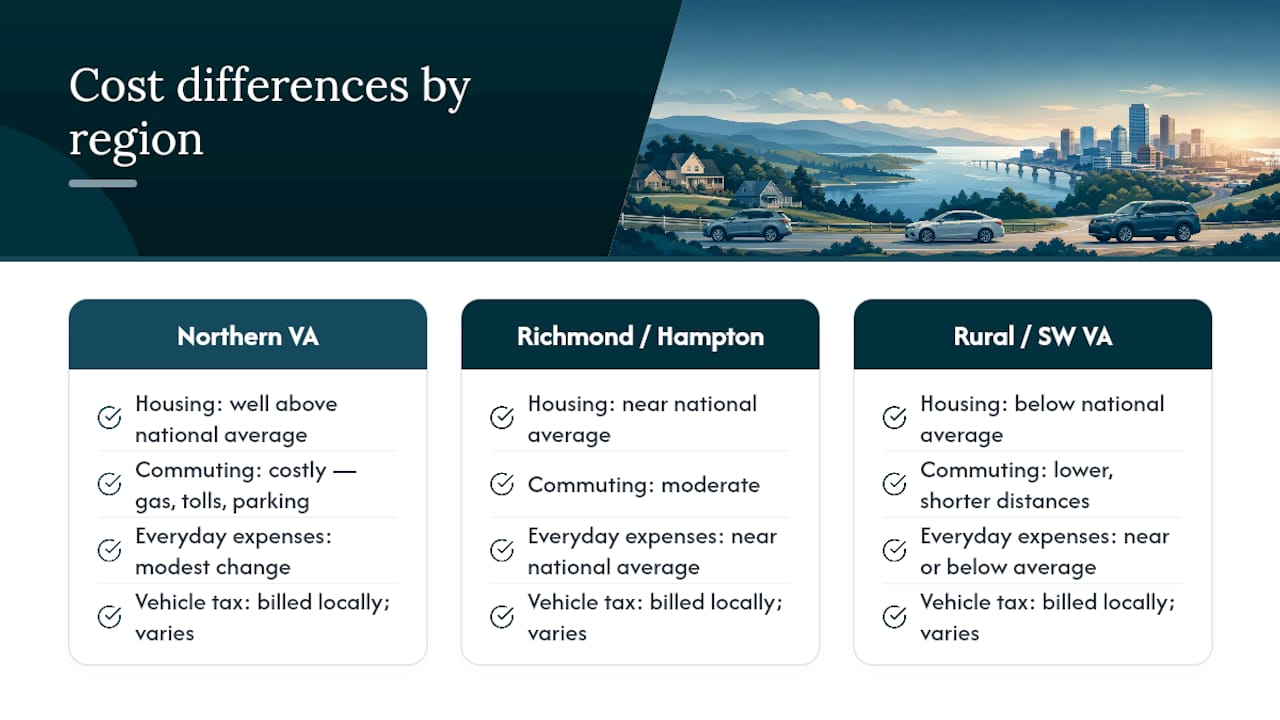
Virginia's cost of living isn't one number. It's at least three different numbers depending on where you land. Northern Virginia, inside the D.C. commuter belt, runs well above the national average on housing, and that gap is the single biggest driver of your total moving budget. Richmond and Hampton Roads sit closer to the national average, and rural and Southwest Virginia often run below it.
Housing is the expense that swings hardest by region, but it's not the only one. Virginia's personal property tax on vehicles catches a lot of newcomers off guard. It's billed annually by your county or city, not by the state, and rates and relief programs differ by locality. Check your new Commissioner of the Revenue's site before you assume your car payment is your only vehicle expense.
Grocery and utility costs track closer to the national average statewide, with some regional variation. Where Virginia genuinely surprises transplants is commuting cost. If you're moving into the Northern Virginia job market and living farther out for cheaper rent, factor gas, tolls, and parking into your monthly math, not just your mortgage or lease payment.
A rough budgeting rule that holds up across most of the state: if you're moving from a lower cost-of-living state into Northern Virginia specifically, expect your housing line item to jump the most, your everyday expenses to shift only modestly, and your commuting costs to become a real budget category for the first time.
What Does the Virginia Job Market Look Like for New Residents?
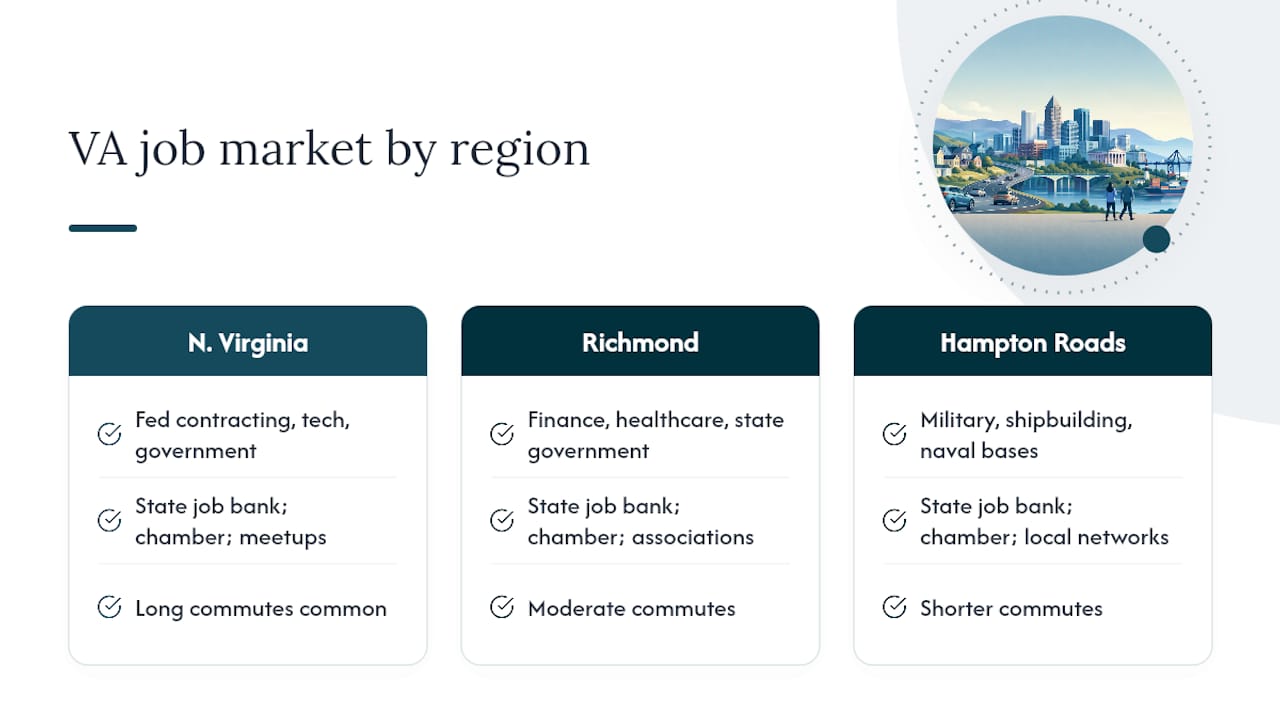
Virginia's job market splits sharply by region, and that split should shape where you look for housing before you sign anything. Northern Virginia runs on federal contracting, technology, and government work, with a heavy concentration of employers clustered around the D.C. metro corridor. Richmond has a diversified base of finance, healthcare, and state government employment. Hampton Roads leans on the military and shipbuilding industries, given its concentration of naval and defense installations.
If you're relocating without a job already lined up, start with Virginia's statewide job bank and your target region's chamber of commerce, both of which post openings that don't always surface on national job boards. Networking groups tied to specific industries, like tech meetups in the Northern Virginia corridor or healthcare associations in Richmond, often surface openings faster than a cold application.
One thing worth knowing before you commit to a neighborhood: commute times in Northern Virginia can stretch well past an hour each way if you pick housing based on price alone. Weigh a slightly smaller or older home closer to your job against a bigger place with a brutal commute. It's a tradeoff every Northern Virginia transplant eventually has to make, usually after learning it the hard way.
Getting Around Virginia: Public Transit and Commuting Realities
Public transit quality in Virginia depends almost entirely on which part of the state you land in. Northern Virginia has the most developed system by far, with Metrorail service connecting into D.C. and commuter rail options serving longer-distance commuters heading into the city from outer suburbs. Richmond runs a bus system covering the metro area, and Hampton Roads has its own regional bus network, though neither approaches the density of Northern Virginia's rail options.
Outside these three metro regions, expect to drive. Rural and small-city Virginia simply doesn't have the population density to support frequent transit service, and a car isn't optional. It's the default.
If you're commuting into Northern Virginia specifically, look into vanpool and carpool programs before you assume you're stuck driving solo every day. Toll roads on major commuter corridors add up fast, and a lot of long-time residents route around them once they learn the back roads. Ask a neighbor, not a map app, for the real shortcuts.
How Do You Enroll Your Kids in Virginia Schools?
School enrollment in Virginia runs through your local district, and requirements are fairly consistent statewide even though district quality varies widely. You'll need proof of residency (the same lease or utility bill you're already gathering for DMV), your child's birth certificate, and immunization records.
Immunization records are the item that trips up the most families, because school nurses check them closely and Virginia's requirements don't always match what another state required. Request these from your previous pediatrician before you move, not after, since some offices take a week or more to process record requests.
For families weighing where to settle, school district quality is one of the biggest reasons to research a specific city or county before signing a lease or making an offer. A regional guide covering areas like Charlottesville can help you compare what different parts of the state actually offer beyond the headline cost-of-living numbers, since a cheaper county isn't always the better deal once you factor in school ratings and afterschool program availability.
Finding Healthcare Providers and Insurance in Virginia
Healthcare access in Virginia mirrors the state's broader urban-rural divide. Northern Virginia, Richmond, and Hampton Roads have dense networks of specialists and major hospital systems, while rural regions have fewer providers and longer drive times to specialty care.
If you're relocating with employer-sponsored insurance, confirm your new address doesn't shift you into a different plan network, since some employer plans use regional networks that change based on where you live within the state. If you're buying your own insurance, Virginia's health insurance marketplace opens enrollment windows annually, and moving to a new state typically qualifies you for a special enrollment period outside the normal window.
Finding a primary care doctor before you need one matters more than it sounds. Wait times for new-patient appointments with in-demand doctors in Northern Virginia can run several weeks, so start that search the same week you handle your DMV paperwork rather than waiting until you actually feel sick.
A Local Agent's Take: What Newcomers Consistently Get Wrong
The mistake I see most often isn't skipping a step. It's sequencing. People handle DMV last because it feels like paperwork, then discover their 30 or 60-day clock is nearly up. A good local agent can shortcut a lot of this by pointing you toward the right utility vendors and school-zone data before you sign anything, which saves you from redoing decisions later. If you're weighing markets, our guide to buying in Virginia covers the incentive side most checklists skip entirely.
— Myra
How Beams Realty Group Helps You Land in Virginia the Right Way
There are services that help you understand Virginia's regional differences. They can assist with matching you to neighborhoods based on your commute tolerance, school priorities, and budget, and point you toward utility providers and local resources to simplify your move. That local knowledge, not a generic listing search, is what actually shortens your transition.
If you're weighing your first home purchase, our down payment assistance guide breaks down programs that can lower your upfront cost, and our home inspection guide helps you vet an inspector before you're locked into a contract. For a broader look at what selling or transferring property involves during a relocation, this overview of tax considerations for inherited property is worth a read if you're managing a family property alongside your move.
Whether you're buying, selling, or still deciding which Virginia region fits your life, request a consultation through Beams Realty Group and get a straight answer on what your move actually requires, starting with your first call.
Official Virginia Links to Bookmark Before You Move
- DMV new resident guide: your master source for titling, registration, and license deadlines.
- DMV moving overview: general relocation logistics and appointment scheduling.
- SCHEV residency guidance: the 183-day rule explained for tuition and residency purposes.
- VSP vehicle safety inspection: find inspection stations and requirements.
- DEQ AirCheck Virginia: confirm if your locality requires emissions testing.
- Virginia voter registration portal: register online and check deadlines.
Sources
- New to Virginia | Virginia DMV
- In-State Residency | State Council of Higher Education for Virginia (SCHEV)
- Vehicle safety inspection | Virginia State Police