
If you're searching "for sale by owner Virginia," the smartest move is usually the opposite of going it alone: hire a licensed, full-service Virginia real estate agent to represent you from listing to closing. Virginia REALTORS® recommends professional representation because agents carry ethical and legal obligations that protect your money and your timeline, and research on self-represented sales shows the savings rarely outweigh the risk of a lower sale price or a mishandled contract.
Here's why that matters before you list anything:
- Virginia REALTORS® ties professional representation to stricter ethical standards and ongoing legal accountability that individual sellers don't carry.
- Sellers who skip agent representation typically save 2.5% to 3% on listing commission, but often net less overall because unrepresented sales tend to close at lower prices.
The next step is simple: schedule a comparative market analysis (CMA) with a licensed Virginia agent before you set a price or sign anything.
Key Takeaways
Hiring a licensed full-service Virginia agent typically protects net proceeds and reduces legal risk more than the commission it costs.
| Point | Details |
|---|---|
| Representation protects proceeds | Unrepresented sales often net less than the 2.5% to 3% saved on commission. |
| Contract deadlines carry real risk | Missed earnest money or notice deadlines can trigger regulatory discipline, per Virginia REALTORS® case data. |
| Disclosure rules still apply | Virginia's "as is" framework doesn't excuse concealing known material defects or skipping lead paint disclosures. |
| Local data drives accurate pricing | MLS comps, not public tax records, produce the most defensible asking price. |
| Beams Realty Group delivers full service | A CMA, written marketing plan, and closing coordination come standard with a Beams Realty Group engagement. |
Table of Contents
- What a Full-Service Virginia Agent Actually Does for You
- How Much Does an Agent Cost, and What Does It Save You?
- What Contract Risks Does an Agent Help You Avoid?
- How Beams Realty Group Delivers Full-Service Representation
- How to Vet and Hire the Right Agent
- What to Prepare Before Your First CMA Meeting
- Virginia's Legal Disclosure Rules for Home Sellers
- Setting a Realistic Asking Price Using Local Market Data
- The FSBO Sale Process in Virginia, Step by Step
- Handling Offers, Counteroffers, and the Option Period
- Contracts, Disclosures, and Paperwork You'll Need
- Closing a Virginia FSBO Sale: Title, Escrow, and Settlement
- Sources
What a Full-Service Virginia Agent Actually Does for You
A full-service agent isn't just someone who puts a sign in your yard. The job breaks down into distinct, sequential responsibilities that shape your final sale price and how smoothly you get there.
- Pricing strategy. The agent pulls recent comparable sales in your specific neighborhood and builds a comparative market analysis, not a guess based on Zillow's estimate.
- Professional marketing. This means MLS syndication, professional photography, yard signage, and direct outreach to other agents with active buyers.
- Showing coordination. Agents vet buyer prequalification, manage scheduling, and handle the safety logistics of letting strangers into your home.
- Negotiation and earnest money. They negotiate price and terms, oversee the earnest money deposit, and track every contingency deadline in the contract.
- Closing coordination. The agent works directly with the title company, resolves last-minute title or lender issues, and manages the paperwork through settlement.
Pro Tip: Ask any agent you interview to walk you through their exact marketing plan for the first two weeks of your listing. If they can't give specifics, they're improvising.
How Much Does an Agent Cost, and What Does It Save You?
Full-service representation isn't free, but the math usually favors it once you factor in final sale price, not just commission percentage.
Skipping that co-op offer shrinks your buyer pool to only those willing to go unrepresented or pay their own agent out of pocket.
Typical seller-side closing costs beyond commission include:
- Title insurance and settlement fees, often a modest percentage of the sale price
- Recording and transfer taxes, which vary by locality in Virginia
- Attorney fees, where a settlement attorney is involved
On timeline, a well-priced, professionally marketed Virginia home typically moves from listing to a signed contract within a few weeks, with closing following 30 to 45 days later depending on the buyer's financing. Agents shorten that window by pre-qualifying buyers and catching financing or title issues early instead of discovering them at the settlement table.
Here's the trade-off in plain terms: self-representation typically saves 2.5% to 3% in commission, but that saving is frequently erased by a lower closing price, since unrepresented sales tend to net less overall.
What Contract Risks Does an Agent Help You Avoid?
Real estate contracts in Virginia carry hard deadlines, and missing one can cost you the deal or expose you to legal claims. A licensed agent's entire job is managing those risks so they never reach your kitchen table as a crisis.
A Virginia REALTORS® legal case study from August 2025 documents exactly what goes wrong when contract duties slip:
A licensee's failure to ensure an earnest money deposit was properly handled, and to send required notices on time, led to regulatory discipline and financial penalties. The case underscores how routine-seeming contract steps carry real legal weight.
The risks an agent manages day to day include:
- Missed inspection or financing contingency deadlines that can void the contract or forfeit earnest money
- Material defect disclosure failures that create long-term liability, even after closing
- Repair negotiations and addenda that must be drafted correctly to hold up legally
- Lender communication gaps that delay or kill financing at the last minute
Earnest money handling in particular is a common failure point, and it's one reason brokerages carry errors-and-omissions insurance that individual sellers simply don't have. Virginia law requires an attorney for certain transaction types, and a good agent already knows when to bring one in rather than guessing.
How Beams Realty Group Delivers Full-Service Representation
Beams Realty Group builds its process around clear communication and local market knowledge specific to Virginia neighborhoods, not a generic national playbook.
That shows up in a few concrete ways:
- A CMA delivered with actual comparable sales data from your specific area, not automated estimates
- Marketing that includes professional photography, MLS exposure, and direct agent-to-agent outreach
- Experience with nonstandard sales, including divorce sales and farm properties, where standard playbooks don't apply
- Internal guides on pricing your home and maximizing sale proceeds that reflect the same process clients get in a live engagement
A typical seller engagement starts with a walkthrough and a CMA meeting, where you get comparable sales, a suggested price range, and a written marketing timeline before you sign anything.
| Step | What you get |
|---|---|
| Initial CMA | Comparable sales data and a realistic price range for your home |
| Marketing plan | A written timeline covering photography, listing launch, and showings |
| Ongoing communication | Regular updates on showings, feedback, and offer activity |
How to Vet and Hire the Right Agent
Not every licensed agent operates at the same level, so the interview stage matters as much as the hiring decision itself.
- Verify the license and REALTOR® membership. Virginia's Department of Professional and Occupational Regulation maintains license lookups, and REALTOR® membership signals adherence to a stricter ethics code.
- Ask for recent comps. A qualified agent should hand you three to five recent sales in your specific neighborhood, not a citywide average.
- Request a written marketing plan. This should include a specific timeline for listing launch, photography, and open houses.
- Ask for a net-proceeds estimate. This shows you the real number after commission, closing costs, and any repair credits.
Red flags include an agent who can't explain their pricing rationale, one who dodges written plans in favor of verbal promises, or one who takes days to return calls before you've even signed anything.
Pro Tip: Compare at least two agents side by side on their net-proceeds estimate, not just their commission rate. The lowest commission doesn't always produce the highest number in your pocket.
What to Prepare Before Your First CMA Meeting
A little prep work makes your first meeting with an agent far more productive and gets your home to market faster.
Before that meeting, gather your deed, recent mortgage statement, property tax bill, and any utility cost history buyers might ask about. Walk through the home and handle obvious repairs, decluttering, and curb appeal fixes now, since these are the same items an inspector will flag later.

At the CMA meeting itself, expect the agent to walk the property, present comparable sales, and leave you with a written price recommendation and marketing timeline. Most Virginia listings launch within one to two weeks of that meeting, with showings typically starting the same week the listing goes live on the MLS.
Virginia's Legal Disclosure Rules for Home Sellers
Virginia operates under a "buyer beware" framework for most residential sales, but that doesn't mean sellers are exempt from disclosure obligations. The state requires sellers to complete a Residential Property Disclosure Statement, which discloses that the property is sold "as is" and directs buyers to inspect the property themselves rather than requiring sellers to list every known defect.
That said, Virginia law still holds sellers liable for actively concealing known material defects or making false statements about the property's condition. Federal law layers on top of this: homes built before 1978 require a lead-based paint disclosure and an EPA-approved pamphlet, regardless of any state-level "as is" framework.
Environmental issues deserve particular attention in Virginia, where older septic systems, well water, and flood zone status frequently surface during inspections. Sellers near known flood plains or with private wells should be prepared to disclose testing history and any known issues, since failure to do so can create the exact kind of long-term liability that material defect concealment triggers under Virginia and federal law.
Getting these disclosures wrong, even unintentionally, is one of the most common sources of post-closing legal disputes. A licensed agent who handles these forms regularly catches gaps that a first-time or infrequent seller easily misses, which is a large part of why professional representation reduces long-term legal exposure rather than just speeding up the sale.
Setting a Realistic Asking Price Using Local Market Data
Pricing a Virginia home correctly requires more than checking what the house down the street sold for last year. Local market data changes by neighborhood, sometimes street by street, and pricing too high often costs sellers more in the long run than pricing conservatively from the start.
A defensible price starts with a comparative market analysis pulling at least three to five closed sales within the past three to six months, adjusted for square footage, lot size, condition, and upgrades. Virginia's local Multiple Listing Services carry the most current and accurate comparable data, far more current than public tax assessment records, which often lag actual market value by a year or more.
Sellers without agent access to the MLS have a few compliant paths to real market data. A licensed appraiser can produce a formal appraisal for a few hundred dollars, giving a defensible, third-party valuation. Flat-fee MLS services and appraisal-based pricing are legitimate middle-ground options, and pairing either approach with an attorney for contract review preserves some cost savings while still protecting against pricing and legal mistakes.
The risk of pricing without solid local data cuts both ways. Overpricing leads to a stale listing that eventually requires a price cut, which buyers interpret as a red flag. Underpricing leaves money on the table that a buyer would have paid without hesitation. Both mistakes are far more common among sellers working from public records or automated online valuation tools instead of live, hyperlocal comparable sales data.
The FSBO Sale Process in Virginia, Step by Step
Selling a home without an agent in Virginia follows a specific sequence, and skipping steps or doing them out of order is where most self-represented sales run into trouble.
The process generally unfolds like this:
- Prepare the property. Handle repairs, deep cleaning, and staging before any photos get taken or showings scheduled.
- Set a price. Use comparable sales data or a paid appraisal rather than an automated estimate.
- Market the listing. Without agent MLS access, this typically means a flat-fee MLS service, yard signage, and online listing platforms.
- Schedule and conduct showings. This includes screening potential buyers for basic seriousness and safety before letting them into the home.
- Field offers directly. Every offer needs review for price, contingencies, financing type, and proposed closing date.
- Negotiate terms. This includes price, repair credits, and closing timeline, often over multiple rounds.
- Manage the contract to closing. This covers inspection deadlines, financing contingencies, and coordinating with a title company or attorney.
Each of these steps carries its own failure points. Marketing without MLS exposure limits your buyer pool significantly, since most active buyers search through agent-connected platforms first. Negotiating directly with buyers also means you lose the natural buffer an agent provides, handling emotional back-and-forth without a neutral third party managing the conversation.
Handling Offers, Counteroffers, and the Option Period
Virginia contracts commonly include an option period, called a "due diligence" or inspection period depending on the specific contract used, during which the buyer can inspect the property and potentially renegotiate or withdraw. Managing this period correctly determines whether a deal survives to closing.
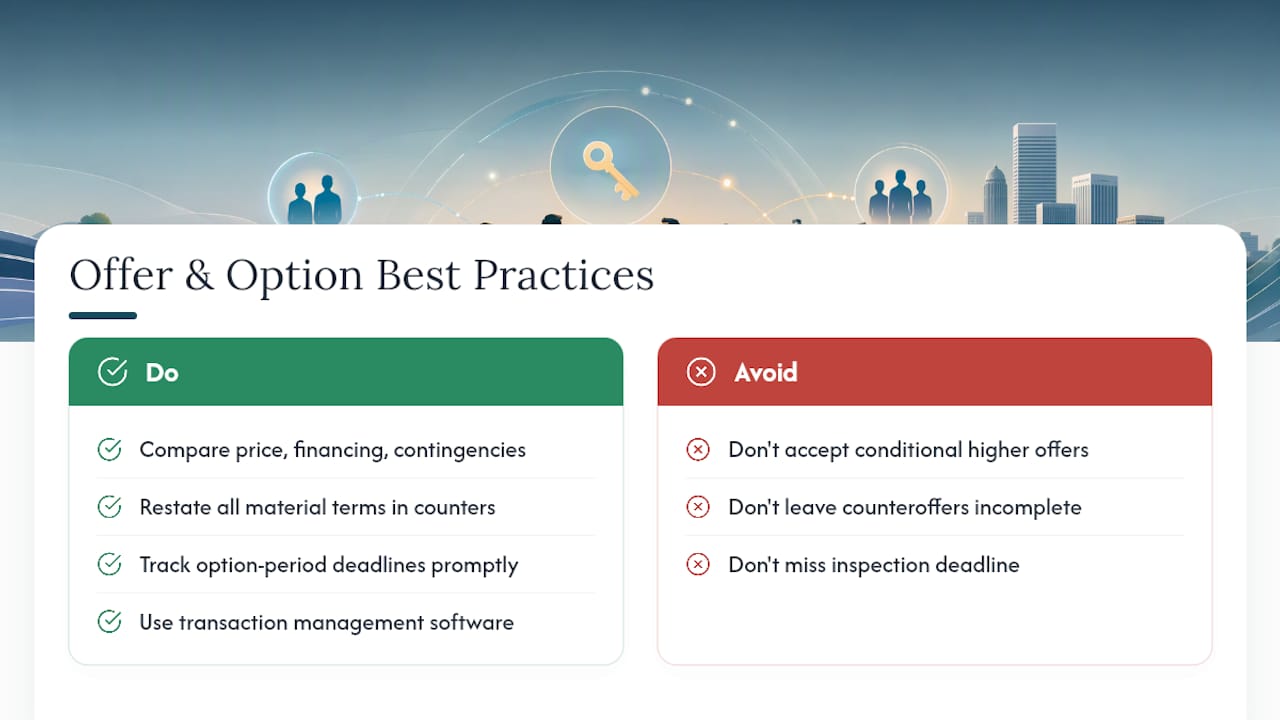
When an offer arrives, review the purchase price, financing type, contingencies, proposed closing date, and any requested seller concessions together, not in isolation. A slightly lower offer with strong financing and a shorter contingency period often outperforms a higher offer loaded with conditions that can fall through.
Counteroffers in Virginia function as a new offer that cancels the previous one, meaning you can't simply "accept" your own counter later if a buyer walks away. Every counteroffer needs to restate all material terms clearly, not just the changed price, since incomplete counters create ambiguity that can void enforceability entirely.
During the option or inspection period, buyers typically have a fixed number of days, often 10 to 14, to complete inspections and request repairs or credits. Missing this deadline on either side, buyer or seller, has real contract consequences: a buyer who doesn't act within the window generally loses the right to renegotiate based on inspection findings, and a seller who doesn't respond to a timely request risks the buyer exercising a contractual right to terminate.
Tracking these deadlines without a transaction management system is where many self-represented sellers lose leverage they didn't realize they had.
Contracts, Disclosures, and Paperwork You'll Need
Virginia FSBO sellers need a state-compliant residential purchase agreement, and using a generic template pulled from another state creates real legal exposure since contract law and required disclosures vary by state.
The core paperwork stack typically includes the purchase agreement itself, the Residential Property Disclosure Statement, the federal lead-based paint disclosure for homes built before 1978, and any addenda covering financing contingencies, inspection contingencies, or specific repair agreements.
Addendums and amendments matter more than most first-time sellers expect. An addendum adds new terms not covered in the original contract, such as a repair credit agreed to after inspection. An amendment changes an existing term, such as adjusting the closing date. Using the wrong one, or handwriting changes directly onto a signed contract, can create disputes over what both parties actually agreed to.
Every signature, date, and initial needs to match across all parties and all documents exactly, since even a small discrepancy can delay closing or give a title company reason to flag the file for legal review before they'll insure it.
Closing a Virginia FSBO Sale: Title, Escrow, and Settlement
Closing in Virginia almost always runs through a title company or a settlement attorney, both of which exist independently of whether either party has an agent. This is the part of the process where professional coordination matters most, regardless of how the sale started.
The title company or attorney handling settlement will run a title search to confirm clear ownership, hold the earnest money in escrow until closing, prepare the settlement statement, and coordinate the actual transfer of funds and deed on closing day. Sellers without an agent need to proactively schedule this with a title company early, ideally as soon as a contract is signed, since delays here push back the entire closing timeline.
Virginia closings typically happen at the title company or attorney's office, with both parties signing final paperwork, though remote or mail-away closings are increasingly common for out-of-state buyers or sellers. Expect to bring a government-issued ID and be prepared to wire or receive proceeds electronically rather than by paper check in most cases.
Sellers should confirm well before closing day that all inspection-related repairs or credits have been documented in writing and reflected accurately in the final settlement statement, since discrepancies discovered at the closing table create last-minute delays that are entirely avoidable with earlier coordination.
A Local Perspective on Virginia's Market
Virginia's neighborhood-level pricing swings are sharper than most sellers expect, and the sellers who net the most are rarely the ones who saved the most on commission, according to local market commentary that highlights the importance of expert valuation and timing. The gap between a good price and a great one almost always comes down to preparation and timing, not luck.
— Myra
Get a Free CMA from Beams Realty Group
Beams Realty Group gives you what a solo sale can't: a licensed agent's pricing accuracy, MLS exposure, and contract protection, without you having to learn Virginia disclosure law and contract deadlines under pressure.
If you're weighing whether to sell on your own or bring in professional representation, the fastest way to know your real numbers is a free comparative market analysis. Beams Realty Group will walk your property, pull actual comparable sales for your neighborhood, and hand you a written net-proceeds estimate, so you can compare it honestly against what a solo sale would net after the deductions most sellers forget to count. Schedule your consultation and get a real number before you list anything.
Sources
- Why use a REALTOR®? - Virginia REALTORS®
- Can I Be My Own Real Estate Agent? Rights and Risks - LegalClarity
- Earnest money in real estate: refunds, returns and regulations - NAR
This article is general information, not a substitute for advice from a qualified financial advisor. Consult a qualified financial professional about your own circumstances before acting on anything here.