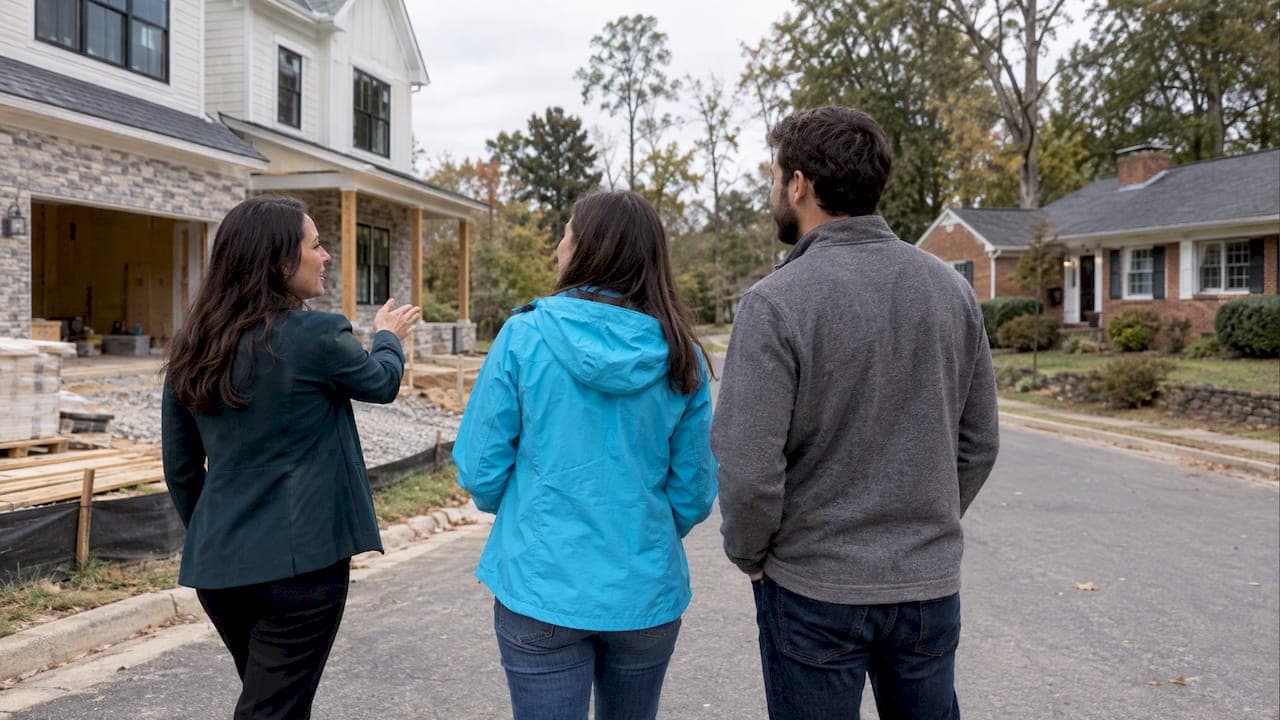
Neither option is better across the board: new construction suits buyers who want customization and lower short-term maintenance, while an existing home suits buyers who need to move quickly, want an established neighborhood, or are working with a tighter budget. The right call depends on your timeline, financing comfort, and how much you want to personalize before you move in.
TL;DR:
- Upgrades can significantly increase the final cost of a new construction home, as they are often priced separately and can add tens of thousands of dollars.
- Construction delays are common due to material shortages and permitting issues, so builders may not meet the estimated move-in date.
- Resale homes offer immediate move-in, established neighborhood details, and often more flexible pricing through negotiation.
- Older homes require budgeting for major system replacements and may have undisclosed defects, making inspections crucial.
- Buyer timelines and financing options vary, with new builds often requiring construction loans that convert to mortgages, while resale purchases typically use standard mortgages.
Table of Contents
- What new construction offers: features, warranties, and real expectations
- Drawbacks and risks of buying new construction
- What existing homes offer: the case for buying resale
- Drawbacks and risks of buying an existing home
- Money, financing, and timeline: how to run the numbers
- Decision checklist: questions to ask before you commit
- How our team guides buyers through this decision
- Who tends to benefit from each option
- Let our team help you choose with confidence
- FAQ
- Sources
What new construction offers: features, warranties, and real expectations
Buying new gives you a say in the finished product. Builders typically sell a base floor plan, then charge separately for upgrades: flooring, countertops, fixtures, and structural changes each carry their own price list, and those choices can add tens of thousands of dollars to the number you saw advertised.

New homes also come with modern systems. You get current insulation codes, newer HVAC equipment, and often pre-wiring for smart-home features, which tends to translate into lower utility bills and fewer early repairs than an older house. Energy Star's smart appliance guidance is worth reviewing if efficiency is a priority, since not every "smart" feature a builder offers delivers the same savings.
Builder warranties typically layer coverage: a short workmanship period, a longer window for major systems, and a structural warranty that can run a decade. Coverage terms vary significantly by builder, so get them in writing before you sign.
- Upgrade pricing is negotiable in slower markets but fixed in high-demand communities.
- Warranty tiers usually separate workmanship, systems, and structural coverage into different timeframes.
- New communities often have ongoing construction noise and incomplete landscaping for a year or more after you move in.
Pro Tip: Ask the builder for a written list of standard versus upgraded features before you tour the model home, since model homes almost always show upgraded finishes.
Drawbacks and risks of buying new construction
The sticker price on a new build rarely matches what you'll actually pay. Upgrades, landscaping, and window treatments can push the final cost well past the base price, which affects your loan amount and how the home appraises.
Delays are common. Material shortages, permitting backlogs, and labor availability can push a projected move-in date back by months, and your purchase contract should spell out what happens if that occurs.
Builder warranties don't replace an independent inspection. The CFPB recommends a third-party inspection even on new homes, since warranty claims are often slower and more limited than catching a defect before closing.
- Standard finishes in advertised price points are often the builder's lowest-cost options.
- Smaller lots are common in new developments built to maximize the number of homes per acre.
- A move-in date in a contract is frequently an estimate, not a guarantee.
Pro Tip: Build a buffer of several weeks into any lease-end or sale-contingent timeline when buying new construction.
What existing homes offer: the case for buying resale
An existing home lets you move in on your timeline instead of a builder's. You also get to see exactly what you're buying: the landscaping has matured, the neighbors have settled in, and the street's character is already established rather than guessed at from a rendering.
Resale pricing often has more room to negotiate, particularly when a seller is motivated by a job relocation, a divorce, or an estate sale. A home valuation comparing recent sales can show you how much flexibility a seller might have.
Established neighborhoods also come with a track record: school performance history, commute patterns, and flood or drainage issues tend to be visible or at least documented, where a brand-new subdivision has none of that history yet. Older homes frequently include architectural details, larger lots, or mature trees that current zoning or construction costs make hard to replicate in new builds.
- Move-in can happen in weeks rather than months.
- Neighborhood character, schools, and commute times are already observable.
- Price negotiation room tends to be wider than on a new build with a fixed builder price list.
Drawbacks and risks of buying an existing home
Older systems mean near-term repair costs. Roofs, HVAC units, water heaters, and electrical panels all have a finite lifespan, and a home nearing the end of one of those cycles can mean a major expense within the first year or two.

Undisclosed defects are a real risk, which is why an inspection contingency matters. The CFPB's inspection guidance notes that a contingency lets you walk away or renegotiate if an inspector finds significant problems. A pre-listing inspection playbook shows how sellers prepare for this scrutiny, and the same issues it covers are what your own inspector will look for.
Renovating an older home takes time and money: permits, contractor scheduling, and the disruption of living through a remodel all add up. Older electrical or plumbing systems can also affect insurance premiums or eligibility for certain loan programs.
- Expect to budget for at least one major system replacement within the first several years.
- An inspection contingency protects you if the report reveals costly surprises.
- Renovation timelines depend heavily on local permit offices and contractor availability.
Money, financing, and timeline: how to run the numbers
The number you see in a listing or on a builder's website rarely matches your final cost. For new construction, upgrades and landscaping can add a meaningful amount to the base price, and appraisers may not value every upgrade dollar for dollar, which affects your loan-to-value ratio. For resale, closing costs and any needed repairs after inspection play the same role.
Nationally, new single-family home sales ran at a seasonally adjusted annual rate of 684,000 in August 2026, with about 8.5 months of supply and a median sales price of $393,700, according to the Census Bureau's New Residential Sales report. That supply level means buyers in many markets have real negotiating leverage on incentives rather than facing bidding wars.
Build timelines vary by region and by how far along construction is when you sign. The Census stage-of-construction data breaks homes into "not started," "under construction," and "completed" categories, and a home that's "not started" when you sign can take considerably longer to close than one already framed.
Financing differs too. A construction loan converts to a standard mortgage once the home is finished, while a resale purchase uses a standard mortgage from day one, or an FHA 203k loan if you're financing renovations into the purchase. The CFPB's home loan toolkit walks through fixed-rate versus adjustable-rate trade-offs that matter more when a build timeline stretches your rate lock.
- List the base price plus every upgrade, landscaping, and closing cost you expect.
- Run that total through a home affordability calculator to see the real monthly payment.
- Compare loan types, since a conventional mortgage works differently than a construction loan or renovation loan.
- Factor in your expected move-in date against your current lease or sale timeline.
Decision checklist: questions to ask before you commit
Before you sign anything, ask builders about warranty scope, how change orders are priced, and what happens contractually if completion slips. Ask sellers of existing homes about recent repairs, permit history on any additions, and why they're selling.
- Does the purchase contract include an inspection contingency, and have you confirmed it in writing?
- Are there HOA rules that affect future renovations, paint colors, or fencing?
- For new builds, when do utilities, sidewalks, and landscaping get completed?
- Does your appraisal contingency protect you if the home appraises below the agreed price?
- Which factor matters most to you: timeline, budget, or customization?
Pro Tip: Bring your checklist to every tour rather than relying on memory, since builder sales offices and listing agents rarely volunteer the less flattering details.
How our team guides buyers through this decision
We walk buyers through comparing upgrade costs against appraised value, coordinating independent inspections on both new and resale properties, and timing offers around financing deadlines. For readers weighing this decision in Virginia, our home-buying resources cover the same inspection and negotiation questions raised above, and our guide for first-time buyers breaks down financing timelines in more detail.
Who tends to benefit from each option
A first-time buyer on a tight budget often does better with resale. A growing family that wants specific floor plans leans toward new construction. A downsizer usually values resale's established neighborhoods, while an investor often prioritizes whichever option pencils out at the lowest total cost.
— Myra
Let our team help you choose with confidence
Whether you're weighing upgrade costs on a new build or negotiating repairs on a resale, we provide hands-on guidance through inspections, offers, and closing. Visit our home buying page to get started.
FAQ
What does it mean on Zillow when it says new construction?
A "new construction" tag on a listing site means the home has never been owner-occupied and is either recently completed or still being built. It does not guarantee a specific completion date, so confirm the build stage directly with the builder or listing agent.
What is the 3-3-3 rule for buying a house?
Treat it as a rough budgeting check rather than a lending requirement, since actual qualification depends on your lender's criteria.
Why are new builds sometimes cheaper than existing homes?
In some markets, builders offer mortgage rate buydowns, incentives, or smaller lots to move inventory, which has narrowed or reversed the traditional price premium for new homes compared to resale. Always compare the upgrade-adjusted total cost rather than the base advertised price.
Why are some new construction homes not selling?
Slower sales can reflect elevated months of supply in a given area, pricing that hasn't adjusted to buyer budgets, or locations still lacking finished amenities. The Census Bureau's monthly sales data tracks months' supply nationally, which helps explain when builders are more willing to negotiate.
Sources
- New Residential Sales, U.S. Census Bureau
- Monthly New Residential Sales, August 2026 (data tables)
- Schedule a home inspection | Consumer Financial Protection Bureau
- Your home loan toolkit | CFPB